Spraying machine applies percutaneous hepatic biliary drainage kit
Spraying machine applies percutaneous hepatic biliary drainage kit
The percutaneous hepatic biliary drainage kit is a core sterile consumable in the field of interventional biliary diagnosis and treatment. Its core function is to establish a biliary drainage channel through percutaneous puncture of the liver under DSA or ultrasound guidance, draining accumulated bile from the body to relieve biliary obstruction, reduce biliary pressure, and control biliary infection. It can also be used for preoperative decompression, postoperative drainage, and palliative treatment of malignant biliary obstruction, and is hailed as a “minimally invasive drainage tool for biliary obstruction.” It is widely used in departments such as interventional radiology, gastroenterology, and hepatobiliary surgery, and is suitable for diagnosing and treating biliary obstruction caused by bile duct stones, bile duct strictures, and bile duct cancer. It directly affects the success rate of percutaneous hepatic biliary drainage surgery, patient postoperative recovery, and the incidence of complications, making it an indispensable key consumable in modern minimally invasive biliary diagnosis and treatment. This kit features diverse components and a sophisticated structure, requiring prolonged contact with bile, blood, and disinfectants. Therefore, it demands extremely high standards for the coating’s sealing, antibacterial properties, corrosion resistance, and adhesion to various substrates. Chifei’s professional ultrasonic spray coating process is the core technology for optimizing its performance, compensating for inherent shortcomings, and meeting stringent clinical requirements, showcasing Chifei’s expertise in the field of biliary interventional consumables spray coating.
The percutaneous hepatic biliary drainage kit is classified as a Class II medical device, requiring strict adherence to industry standards and medical device safety requirements. It complies with ISO 10993 biocompatibility standards and GB/T 16886 series standards, while also meeting relevant medical drainage device industry standards. It meets the core indicators of non-cytotoxicity, non-sensitization, sterilization resistance, and leak-proof sealing. After ethylene oxide sterilization, the sterility assurance level (SAL) is ≤10⁻⁶, capable of stably withstanding clinical drainage negative pressure and fluid pressure without leakage or deformation. As a single-use product, it completely eliminates the risk of cross-infection. It mainly consists of components such as catheters, puncture needles, guidewires, dilators, fixation plates, connecting tubes, and drainage bags, using a variety of medical materials: the catheters are made of polyurethane and polypropylene, combining flexibility and corrosion resistance to adapt to the complex anatomy of the biliary tract; the puncture needles and guidewires are made of medical-grade stainless steel, balancing strength and puncture smoothness; the fixation plates are made of silicone rubber and polyamide, conforming to the skin and providing secure fixation; the connecting tubes and drainage bags are made of polyvinyl chloride and polycarbonate, ensuring smooth fluid transport. However, the original kit still has significant shortcomings: the catheter surface has a high coefficient of friction, easily damaging liver tissue and bile duct mucosa during puncture and placement; uneven coating at the connection points can easily lead to bile leakage and bile fistula; and the surface is prone to bacterial growth, increasing the risk of biliary tract infection. Therefore, professional spraying using a Chifei ultrasonic spraying machine has become a core element in ensuring its quality.
With its core technological advantages of precise atomization, uniform film formation, non-destructive spraying, and high material utilization, the Chifei ultrasonic spraying machine is perfectly suited to the diverse components, precise structure, multi-material combination, and stringent clinical requirements of percutaneous hepatic biliary drainage kits. It can accurately cover key areas such as the inner and outer surfaces of catheters, puncture needle tips, connecting interfaces, sealing areas, and drainage bag interfaces. It is compatible with the spraying needs of special medical coatings such as high-pressure sealing coatings, silver ion antibacterial coatings, and corrosion-resistant and wear-resistant coatings, effectively solving the pain points of uneven coating, poor sealing, and easy peeling in traditional spraying processes, while maximizing the preservation of the kit’s core characteristics such as smooth puncture, high drainage efficiency, and fixation stability. Its working principle involves using 50kHz-120kHz high-frequency ultrasonic vibration to atomize a specialized medical coating material into uniform micron-sized droplets with a particle size of 1-50μm. This “soft landing” method precisely deposits the coating onto key areas of the kit, resulting in a controllable, uniform, and dense coating thickness with a fluctuation error of ≤±1μm. This precise control of the nanoscale coating thickness ensures sealing, antibacterial, and corrosion resistance without compromising catheter flexibility, needle sharpness, or drainage channel patency. Combined with plasma activation treatment, the coating’s adhesion to various materials such as polyurethane, stainless steel, and silicone is significantly improved, preventing coating detachment during puncture procedures, bile immersion, and disinfection. This aligns with the core requirements of “precision, minimally invasiveness, and safety” in biliary intervention.
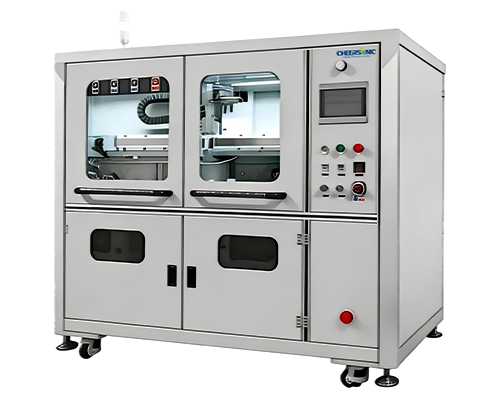
The process of applying the percutaneous hepatic biliary drainage kit using the Chifei ultrasonic spraying machine is rigorous and standardized, adhering to the relevant requirements for Class II medical device production and biliary intervention consumables standards throughout the process. It considers both the structural characteristics of the kit and the clinical needs of percutaneous hepatic biliary drainage surgery. The coating uses a specialized medical-grade sterile formula that is non-allergenic and non-cytotoxic, meeting ISO 10993 biocompatibility standards. It is compatible with ethylene oxide sterilization, ensuring stable coating performance throughout its shelf life. Simultaneously, it prevents reactions between the coating and bile, blood, and disinfectants, producing no harmful substances, contaminating drainage fluid, or interfering with treatment procedures. The high-pressure sealing coating strengthens the sealing performance of the fitting connections and catheters, preventing bile leakage and reducing the risk of bile fistula. The silver ion antibacterial coating effectively inhibits the growth of pathogenic bacteria such as Staphylococcus aureus and Escherichia coli, reducing bacterial count by more than 90% and lowering the incidence of biliary tract infections. The corrosion-resistant and wear-resistant coating resists the erosion of bile and disinfectants, preventing aging and damage to catheters and connecting tubes, while reducing the surface friction coefficient of the catheter and minimizing tissue damage during puncture and placement. Before spraying, all components of the kit undergo ultra-clean pretreatment to remove surface oil, impurities, and processing residues. During spraying, ultrasonic parameters are precisely adjusted to control droplet deposition speed, ensuring no missed spraying, no bubbles, no accumulation, no blockage of drainage channels, and no impact on the sharpness of the puncture needle. After spraying, a stable functional layer is formed through low-temperature curing, followed by rigorous testing for coating adhesion, sealing, and antibacterial properties, meeting Class 10000 cleanroom production requirements throughout the entire process.
The percutaneous hepatic biliary drainage kit treated with Chifei ultrasonic spraying exhibits significantly improved overall performance. Its superior sealing performance allows it to stably withstand clinical drainage pressure without bile leakage, effectively reducing the risk of serious complications such as bile leakage. Reliable antibacterial properties ensure long-term inhibition of pathogenic bacteria growth, meeting the needs of biliary infection control, and making it particularly suitable for long-term drainage of malignant biliary obstruction. The coating exhibits strong adhesion, showing no delamination or damage after puncture, bile immersion, and sterilization. Its outstanding corrosion and wear resistance ensures a smooth catheter surface, facilitating smooth puncture and placement, reducing damage to liver tissue and bile duct mucosa, and extending the kit’s stability. Compared to traditional spraying processes, Chifei ultrasonic spraying achieves a material utilization rate of over 90%, eliminating splashing and waste. It precisely covers delicate areas such as the puncture needle tip and connecting interfaces, reducing nozzle clogging and maintenance costs. This effectively lowers production costs for medical device manufacturers, enhancing product competitiveness, and adapting to the large-scale production needs of various specifications of percutaneous hepatic biliary drainage kits.
In clinical applications, the percutaneous hepatic biliary drainage kit treated with Chifei ultrasonic spraying has gained widespread recognition from interventional radiology and hepatobiliary surgery professionals and medical device manufacturers. It is suitable for percutaneous hepatic biliary drainage procedures for various types of biliary obstruction, and is particularly suitable for high-risk patients who cannot tolerate open surgery, such as the elderly or those with poor cardiopulmonary function, as well as palliative treatment scenarios for malignant biliary obstruction. It can significantly improve the safety and efficiency of percutaneous hepatic biliary drainage surgery, quickly relieve symptoms such as jaundice and abdominal distension, reduce complications such as bile leakage and infection, reduce the workload of medical staff, and help patients recover quickly after surgery. Simultaneously, it drives the percutaneous hepatic biliary drainage kit industry towards higher precision and higher safety.
In summary, Chifei’s professional spraying treatment perfectly solves the core technical pain points of percutaneous hepatic biliary drainage kits, such as poor sealing, susceptibility to infection, and easy tissue damage. It not only meets the stringent requirements of biliary interventional diagnosis and treatment but also demonstrates Chifei’s professional strength in the field of medical spraying, providing reliable technical support for minimally invasive biliary diagnosis and treatment.
About Cheersonic
Cheersonic is the leading developer and manufacturer of ultrasonic coating systems for applying precise, thin film coatings to protect, strengthen or smooth surfaces on parts and components for the microelectronics/electronics, alternative energy, medical and industrial markets, including specialized glass applications in construction and automotive.
Our coating solutions are environmentally-friendly, efficient and highly reliable, and enable dramatic reductions in overspray, savings in raw material, water and energy usage and provide improved process repeatability, transfer efficiency, high uniformity and reduced emissions.
Chinese Website: Cheersonic Provides Professional Coating Solutions