
Selective Flux Spraying
Ultrasonic selective spraying equipment; flux spraying equipment; selective flux spraying
In sectors relying on soldering processes—such as electronics manufacturing and automotive component processing—the precision of flux application directly determines soldering quality and production efficiency. Leveraging unique atomization principles and precise control capabilities, ultrasonic selective spraying equipment has become a key technology for upgrading flux application processes. It effectively resolves issues inherent in traditional methods—such as material waste, uneven coating, and significant pollution—thereby driving soldering processes toward greater efficiency, precision, and environmental sustainability.

The core operating principle of ultrasonic selective spraying equipment relies on the atomization effect produced by high-frequency ultrasonic vibration. A piezoelectric transducer converts electrical energy into high-frequency mechanical vibrations (ranging from 20 kHz to 120 kHz). These vibrations are transmitted to a vibrating element at the nozzle tip, causing the flux to form a uniform liquid film on its surface. Under the influence of high-frequency shear forces, this liquid film breaks apart and atomizes into uniform droplets in the 5–50 μm range; a directed airflow then guides these droplets to deposit precisely onto the workpiece’s soldering area. This nozzle-less atomization design not only eliminates the clogging issues common to traditional nozzles but also allows for precise control of droplet size by adjusting the vibration frequency. This enables accurate regulation of coating thickness—ranging from 10 nm to 100 μm—fully meeting the specific soldering requirements of diverse workpieces.
Compared to traditional methods such as pneumatic spraying, brushing, or dip coating, ultrasonic selective spraying equipment offers significant advantages. First, it delivers high positional accuracy; targeted spraying based on preset workpiece coordinates prevents flux contamination of non-soldering areas. This makes it particularly suitable for processing precision components—such as high-density PCBs and micro-electronic parts—effectively reducing defect rates associated with issues like solder bridging and cold joints. Secondly, the equipment boasts extremely high material utilization; atomized flux droplets are deposited directionally with virtually no waste from overspray, achieving a utilization rate of over 90%. This results in a 30%–50% reduction in flux consumption compared to traditional processes, significantly lowering production costs. Thirdly, it ensures excellent coating uniformity—with droplet size consistency exceeding 90%—forming a dense, defect-free film. This guarantees the effective removal of surface oxides from the workpiece, thereby enhancing the strength and sealing integrity of the solder joints. Furthermore, the equipment features an enclosed spraying design that minimizes fugitive emissions of volatile flux compounds, aligning with green manufacturing standards while reducing health risks to operators.
The equipment is widely applied across key sectors such as electronics manufacturing, the automotive industry, and aerospace. In electronics manufacturing (specifically PCBA processing), it handles flux application for high-density circuit boards—including those with 01005 micro-components and precision BGA packages—to ensure high soldering yields. In automotive electronics, it is used for pre-soldering treatment of safety-critical components like ECUs and sensors, meeting stringent requirements for vibration and corrosion resistance. In the aerospace sector, it supports brazing processes for precision aluminum components, ensuring joint reliability through uniform flux application. Additionally, the equipment offers flexible process adaptability; spraying parameters can be adjusted based on workpiece dimensions and production cycle times, making it suitable for everything from small-batch laboratory prototyping to continuous operation on large-scale industrial production lines.
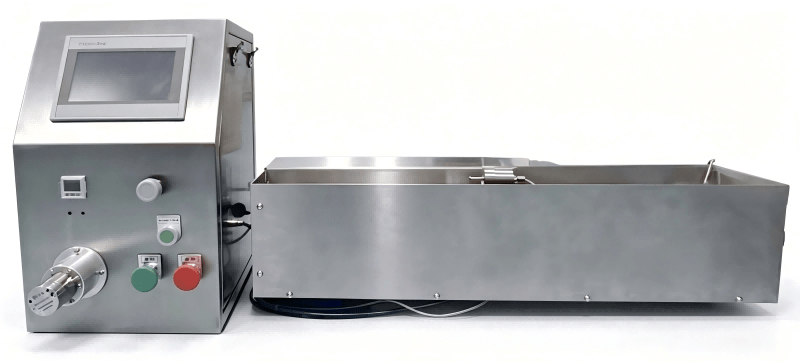
Proper operation and maintenance are crucial for ensuring the equipment’s efficient performance. Before operation, safety precautions must be taken—including wearing protective gear and ensuring adequate ventilation in the work area—alongside verifying power and air supply connections and presetting parameters such as ultrasonic frequency and spray flow rate based on flux viscosity. During the spraying process, test sprays are required to calibrate coating thickness and ensure uniform coverage. After operation, the reservoir and piping must be promptly cleaned with a suitable solvent to prevent residual flux from hardening and causing clogs. Routine maintenance involves periodically removing and wiping the nozzle, as well as injecting anti-rust agents during extended periods of inactivity; such systematic maintenance can extend the cleaning cycle to three to five times that of traditional equipment, thereby reducing operation and maintenance costs. As industrial manufacturing evolves toward greater precision and environmental sustainability, the value of ultrasonic selective spraying equipment in the field of flux application has become increasingly prominent. Characterized by precise selective control, high material utilization efficiency, and stable process performance, this equipment provides reliable support for optimizing welding processes across various industries. It not only enhances welding quality but also drives cost reduction, efficiency improvements, and eco-friendly upgrades in manufacturing, establishing itself as indispensable equipment in modern industrial welding.
About Cheersonic
Cheersonic is the leading developer and manufacturer of ultrasonic coating systems for applying precise, thin film coatings to protect, strengthen or smooth surfaces on parts and components for the microelectronics/electronics, alternative energy, medical and industrial markets, including specialized glass applications in construction and automotive.
Our coating solutions are environmentally-friendly, efficient and highly reliable, and enable dramatic reductions in overspray, savings in raw material, water and energy usage and provide improved process repeatability, transfer efficiency, high uniformity and reduced emissions.
If you have any technical questions, customization demands, or procurement inquiries about ultrasonic atomization nozzles, feel free to contact our professional sales and technical team for detailed parameters, customized solutions, and industry application support.
Email: market2@cheersonic.com
