
Rubber Stopper With Silicone Coating
Rubber Stopper With Silicone Coating – Ultrasonic Coating – Cheersonic
Butyl rubber plug
Butyl rubber stopper is a sealing component made from butyl rubber as raw material. Its core material, butyl rubber, is polymerized from isobutene and a small amount of isoprene at ultra-low temperatures. In terms of performance, this type of rubber plug has multiple advantages:
Outstanding airtightness: The gas permeability coefficient is only 1/20 of natural rubber, which can effectively block the infiltration of gas and water vapor;
Excellent heat resistance: The conventional operating temperature range is 130 ° C-160 ° C, which can adapt to most pharmaceutical processing scenarios;
Strong chemical stability: good acid and alkali resistance, not prone to swelling or degradation reactions;
High internal cleanliness: The impurities contained are only 1/8 of natural rubber, the amount of additives added in the formula is small, and the extractability is low.
In the application field, butyl rubber stoppers are a key component of pharmaceutical packaging, widely used in packaging containers such as syringes, oral liquid bottles, penicillin bottles, etc., playing an important role in ensuring the quality and safety of drugs.
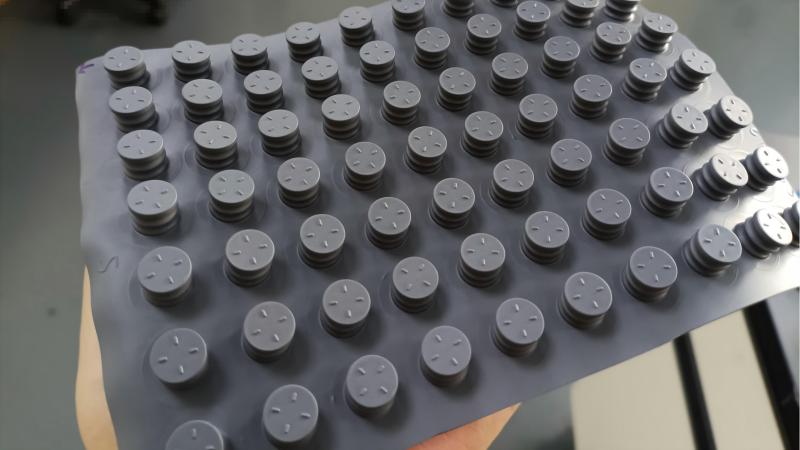
Halogenated butyl rubber stopper
Halogenated butyl rubber stoppers are products modified by introducing halogen atoms (chlorine or bromine) on the basis of butyl rubber. Compared with ordinary butyl rubber stoppers, their airtightness, chemical stability, and heat resistance are further improved. They are mainly divided into two types: chlorinated butyl rubber stoppers and brominated butyl rubber stoppers.
1. Chlorinated butyl rubber stopper
As a modified product of butyl rubber, chlorinated butyl rubber stoppers are prepared by introducing chlorine gas into the butyl rubber solution, and the double bonds of butyl rubber are basically retained during the preparation process. It has the following characteristics in terms of performance:
High intrinsic purity, due to the stronger inertness of chlorine element than bromine element, no additional stabilizer is required, resulting in better storage stability;
Adopting a non sulfur vulcanization system, the product has good heat resistance and produces less odor during high-temperature sterilization;
The rubber component does not contain epoxidized soybean oil, which makes it less likely to cause wall adhesion, opalescence, and other phenomena that affect the quality of the drug when in contact with it.
2. Brominated butyl rubber stopper
Also a modified product of butyl rubber, brominated butyl rubber stoppers are prepared by reacting butyl rubber with bromine elements within a specific temperature range. The performance advantages and precautions are as follows:
High vulcanization efficiency and fast speed: The molecular chain not only contains C=C double bonds, but also active halogen atoms, both of which can promote crosslinking reactions;
Low moisture absorption, significant application effect in the packaging of freeze-drying drugs;
Weak storage stability: Due to the high activity of bromine element, self sulfuration phenomenon is prone to occur, and stabilizers (usually epoxy soybean oil, added in an amount of about 1.3% by weight) need to be added to the rubber.
3. The difference between two types of halogenated rubber plugs
Stabilizers and Purity: Chlorinated butyl rubber has strong chlorine inertness and does not require stabilizers, resulting in higher intrinsic purity; Brominated butyl rubber requires the addition of approximately 1.3% by weight of epoxy soybean oil as a stabilizer due to the active bromine element;
Sulfurization performance and process: Brominated butyl rubber has high vulcanization activity, a wide range of vulcanization system choices, and fast vulcanization speed; Chlorinated butyl rubber has relatively low vulcanization activity, and there are limitations in the selection of vulcanization systems, which require higher production process requirements;
Heat resistance and drug compatibility: Brominated butyl rubber is often vulcanized with sulfur, which has slightly lower heat resistance. During high-temperature sterilization, due to the activity of bromine element, it is prone to produce a smell similar to rotten eggs (presumably HBr or H ₂ S gas), and the sulfurizing agent used has a significant impact on the rubber plug hemolysis test; Chlorinated butyl rubber adopts a non sulfur vulcanization system, which has good heat resistance, low odor during high-temperature sterilization, and is less prone to problems such as wall adhesion and opalescence when in contact with drugs.
Laminated rubber plug
The laminated rubber plug is an innovative upgraded product of ordinary rubber plugs. The core improvement lies in covering a layer of plastic film with barrier properties on the surface of the rubber plug in contact with drugs. Common film materials include fluoroplastics such as polytetrafluoroethylene (PTFE), perfluoroethylene propylene (FEP), and ethylene tetrafluoroethylene copolymer (ETFE).
From the perspective of the principle of action, when ordinary rubber plugs come into direct contact with drugs, some components in the rubber plugs may migrate to the inside of the drug, or the drug may cause swelling and other effects on the rubber plugs, thereby threatening the stability and quality of the drug; The film coated rubber stopper shields the direct contact between the rubber stopper and the drug through a thin film, effectively reducing the interactions such as absorption, adsorption, leaching, and permeation between the two, thereby reducing or delaying the compatibility problem between the drug and the rubber stopper, and improving the long-term storage stability of the drug.
In terms of performance, the chemical stability and biological inertness of the laminated rubber plug are greatly improved, and it can withstand strong acids, strong bases, and various organic solvents; The thin film covering its surface has extremely low surface free energy, making it difficult for almost all solid materials to adhere and reducing drug residue on the surface of the stopper. Based on these advantages, laminated rubber plugs are mainly used for packaging high-quality drugs such as complex chemical drugs, biological products, anti-tumor drugs, protein drugs, highly active preparations, high-sensitivity preparations, and preparations with strong acidity and alkalinity.
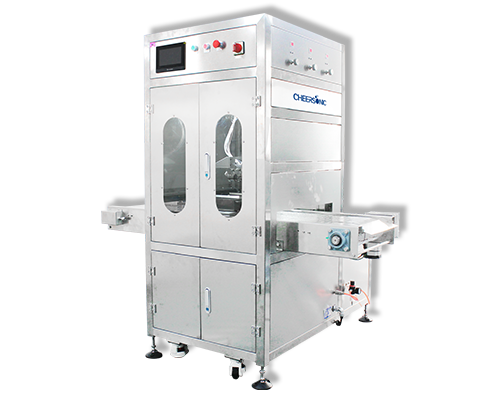
Ultrasonic spraying of butyl rubber plug
Ultrasonic spraying of butyl rubber stopper is a new type of butyl rubber stopper prepared by ultrasonic spraying technology. Its core process is to use the high-frequency vibration energy of ultrasonic waves to atomize the butyl rubber slurry (or molten butyl rubber) into uniform and small particles, and then accurately spray them on the surface of the substrate (such as the stopper base or other supporting structures). After solidification and molding, the rubber stopper product is made.
From the perspective of technological advantages, this type of rubber plug has the following characteristics:
High uniformity of coating: Ultrasonic atomization can form uniformly sized droplets of butyl rubber material, and the coating thickness deviation on the surface of the rubber plug after spraying is small, avoiding the local accumulation or missed coating problems that are prone to occur in traditional spraying;
Stronger sealing performance: The uniform coating structure reduces the small pores inside the rubber plug, combined with the low breathability of butyl rubber itself, further enhancing the overall sealing performance of the rubber plug, which can better block gases, water vapor, and external impurities;
High material utilization rate: Ultrasonic spraying has strong directionality, which can reduce the waste of butyl rubber materials and lower the cost of subsequent processing and repair;
Excellent compatibility: The spraying process temperature is controllable, and the coating thickness and structure can be adjusted according to needs. It can adapt to different specifications of packaging containers (such as low-dose syringes, high-end reagent bottles, etc.), and has good contact safety with various drugs, which is not easy to cause component migration or swelling problems.
In terms of application scenarios, ultrasonic spray butyl rubber stoppers are currently mainly used in fields that require high sealing accuracy, such as high-end pharmaceutical preparations (such as gene therapy drugs and vaccine products), precision instrument sealing (such as laboratory specific reagent containers), and drug packaging in special environments (such as biological agents stored at low temperatures for a long time). In the future, with the maturity of ultrasonic spray technology, its application scope is expected to further expand.
About Cheersonic
Cheersonic is the leading developer and manufacturer of ultrasonic coating systems for applying precise, thin film coatings to protect, strengthen or smooth surfaces on parts and components for the microelectronics/electronics, alternative energy, medical and industrial markets, including specialized glass applications in construction and automotive.
Our coating solutions are environmentally-friendly, efficient and highly reliable, and enable dramatic reductions in overspray, savings in raw material, water and energy usage and provide improved process repeatability, transfer efficiency, high uniformity and reduced emissions.
Chinese Website: Cheersonic Provides Professional Coating Solutions
