
Proton Exchange Membrane Substrate Thin Film Preparation
Application of Ultrasonic Spraying Technology in Proton Exchange Membrane Substrate Thin Film Preparation
In electrochemical energy conversion devices such as fuel cells and water electrolysis for hydrogen production, the proton exchange membrane (PEM) is a core component. The uniformity and bonding strength of its surface thin film layer directly affect the device’s performance and lifespan. Obtaining a high-quality, highly consistent thin-film coating on the PEM substrate has always been a key challenge in the manufacturing process of constructing catalytic coating membranes (CCM) and membrane electrode assemblies (MEAs). Ultrasonic spraying technology, with its unique atomization mechanism and gentle deposition method, has become a favored thin film preparation method in this field.

The basic principle of ultrasonic spraying is to use a piezoelectric transducer to generate high-frequency mechanical vibration. This vibration is amplified by an amplitude transformer and transmitted to the nozzle tip, causing the liquid to generate intense capillary waves at the ultrasonic frequency. When the vibration amplitude is large enough, the droplets overcome surface tension and fly out from the nozzle tip, forming a fine, uniform mist of microdroplets. Unlike traditional pneumatic atomization, ultrasonic atomization does not rely on high-speed airflow shearing the liquid, thus producing droplets with a narrower droplet size distribution—typically between 10 and 50 micrometers—and extremely low kinetic energy. The droplets are transported to the proton exchange membrane substrate surface in a near-floating manner with an auxiliary carrier gas (such as nitrogen or purified air), rather than being “impacted” onto the substrate at high speed. This “soft landing” characteristic allows ultrasonic spraying to non-destructively construct functional coatings on proton exchange membranes that are only tens of micrometers thick, flexible, and temperature-sensitive.
Directly coating the proton exchange membrane surface with a slurry containing noble metal catalysts such as platinum, iridium, and ruthenium is the core step in preparing CCMs. Traditional blade coating or screen printing methods are prone to scratching or wrinkling the film due to mechanical contact, while ultrasonic spraying is a completely non-contact process, fundamentally eliminating the risk of substrate damage. More importantly, because the solvent partially evaporates during droplet flight, the slurry reaches the substrate in a relatively concentrated state. This helps suppress the “coffee ring” effect in the coating, resulting in a catalytic layer with uniform crystallization and a reasonable pore distribution. For polymer materials like proton exchange membranes (PEMs) with relatively low surface energy, ultrasonic spraying, through precise control of droplet size (small droplets are less likely to coalesce into a macroscopic liquid film) and substrate temperature, enables a point-by-point drying and layer-by-layer stacking film-forming mechanism, ultimately yielding a thin film layer with a thickness controllable in the submicron to tens of micrometer range and extremely high flatness.
The complete construction from CCM to MEA involves coating the anodic and cathode catalytic layers on both sides of the proton exchange membrane, as well as bonding the diffusion layer to the frame material. Ultrasonic spraying technology can also be used to spray microporous layers or hydrophobic agents (such as polytetrafluoroethylene emulsions) onto the surface of the gas diffusion layer, but this article focuses on the process of directly constructing the coating on the proton exchange membrane. In actual production, proton exchange membranes (PEMs) are often transported continuously in a roll-to-roll manner. Ultrasonic spraying systems can be integrated into automated production lines, achieving high-speed, uniform coating of wide-width films through multi-nozzle arrays. Because their atomization flow rate can be as low as a fraction of a milliliter to several milliliters per minute, they are ideal for coating small batches of high-value catalyst slurries, significantly reducing material waste—especially important for the manufacture of fuel cells where platinum group metals are expensive.
Furthermore, another advantage of ultrasonic spraying on PEM substrates lies in its tolerance to slurry rheological properties. Whether it’s low-viscosity catalyst inks (such as alcohol-water mixtures) or high-viscosity ionomer dispersions, ultrasonic atomization operates stably and is less prone to clogging. In contrast, piezoelectric inkjet printheads are highly sensitive to slurry particle size and viscosity, easily clogging the nozzles; while ultrasonic printheads do not have tiny orifices, and can atomize normally as long as the slurry can flow to the atomization surface. Therefore, ultrasonic spraying provides researchers with significant process flexibility when developing new catalyst formulations or optimizing the ratio of ionomers to carbon supports.
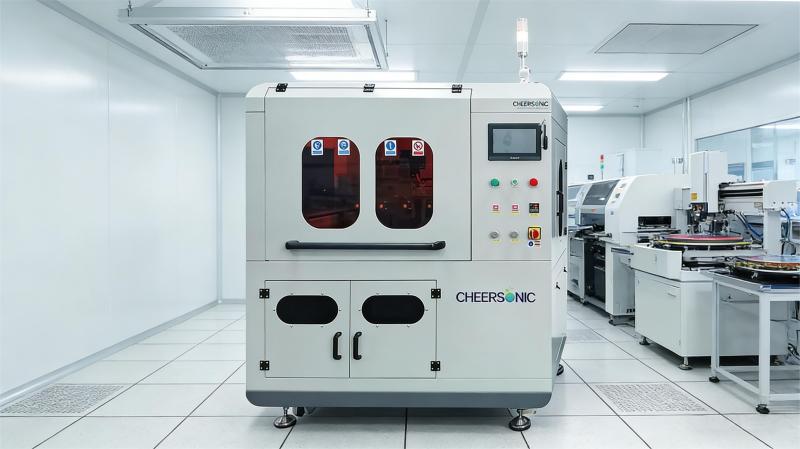
In summary, ultrasonic spraying technology is an ideal alternative to traditional coating methods for fabricating functional films for CCM and MEA on proton exchange membrane substrates due to its advantages such as non-contact operation, low damage, high uniformity, high material utilization, and strong adaptability to complex slurries. It can not only precisely control the catalyst loading and microstructure but also protect the fragile proton exchange membrane substrate from mechanical stress damage, thus providing a reliable process path for improving the output performance, durability, and consistency of fuel cells. With the rapid development of the hydrogen energy industry, ultrasonic spraying technology will play an increasingly crucial role in the large-scale manufacturing of membrane electrode assemblies.
About Cheersonic
Cheersonic is the leading developer and manufacturer of ultrasonic coating systems for applying precise, thin film coatings to protect, strengthen or smooth surfaces on parts and components for the microelectronics/electronics, alternative energy, medical and industrial markets, including specialized glass applications in construction and automotive.
Our coating solutions are environmentally-friendly, efficient and highly reliable, and enable dramatic reductions in overspray, savings in raw material, water and energy usage and provide improved process repeatability, transfer efficiency, high uniformity and reduced emissions.
Chinese Website: Cheersonic Provides Professional Coating Solutions
