
Precision Spraying Technology Assists Thin-film Photovoltaics
Mass Production Verification: Precision Spraying Technology Takes Center Stage in Thin-Film Photovoltaic Scale-Up
In today’s rapidly developing new energy industry, thin-film solar cells are gradually becoming an important branch of photovoltaic technology due to their advantages such as lightweight, flexibility, and low-cost large-area fabrication. In the manufacturing process of thin-film solar cells, the key to determining device performance and yield lies in how to uniformly, controllably, and efficiently deposit functional layer materials—such as light-absorbing layers, electron transport layers, and hole transport layers—on the substrate surface. Traditional coating techniques such as spin coating, blade coating, or slot coating, while having their own applicable scenarios, often exhibit problems such as poor uniformity, low material utilization, or complex equipment maintenance when dealing with large-size, non-planar substrates or high-viscosity, low-surface-tension inks. In recent years, a precision spraying technology based on the principle of liquid atomization has begun to receive high attention from the industry and has successfully moved from the laboratory research stage to large-scale production.
This technology utilizes high-frequency vibration or piezoelectric effects to break functional inks into micron- or even submicron-sized droplets. A carrier gas guides these atomized droplets to a heated substrate surface. Upon impact, the droplets rapidly spread, fuse, and dry, forming a dense, uniform solid film. Unlike conventional pneumatic spraying, this technology achieves high droplet size uniformity through a specific energy conversion method, while significantly reducing droplet velocity and avoiding “bounce” or “splashing” phenomena. This allows for precise control of film thickness and edge contours. More importantly, this spraying system can operate under ambient pressure, eliminating the need for vacuum equipment, and maintains a non-contact distance between the atomizing head and the substrate. This enables it to adapt to continuous roll-to-roll production processes, significantly improving production efficiency.
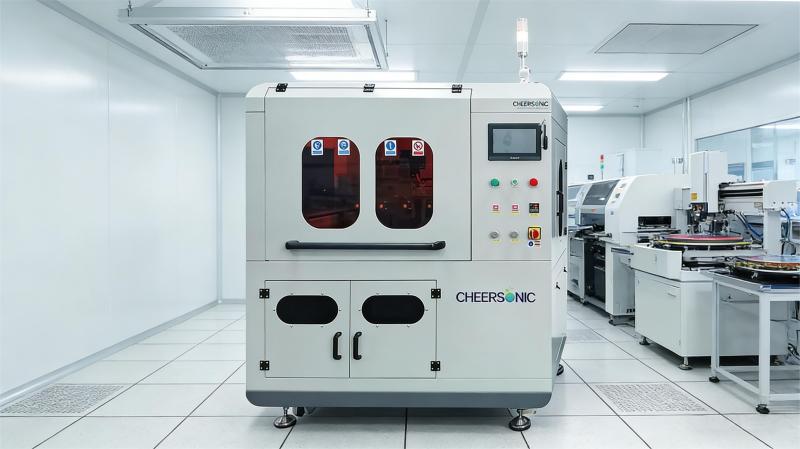
In the past, this type of precision spraying technology was mainly confined to university materials research laboratories or pilot production lines, used for the fabrication of small-area devices and formula screening. Researchers used it to quickly change inks and adjust process parameters, thereby optimizing the photoelectric conversion efficiency of cells. However, there is a huge gap between research and development and large-scale mass production—processes that run well on pilot production lines often encounter problems such as uniformity drift, nozzle clogging, and excessively short maintenance cycles when scaled up to square meter-level substrates and producing thousands of wafers continuously per day. Because of this, many advanced coating technologies ultimately failed to overcome this obstacle, remaining only in the high-cost, low-volume laboratory stage.
However, encouragingly, a leading global thin-film solar cell manufacturer has now fully implemented the aforementioned ultrasonic precision spraying system in its main production lines. After long-term technology verification and process optimization, this company has successfully integrated the spraying technology, originally used only for research and development and small-batch pilot production, into a large-scale production line operating continuously every day with substrate sizes exceeding one square meter. In real-world production environments, this spraying system demonstrated exceptional long-term stability: atomization fluctuations were kept within a minimal range, droplet size distribution remained highly consistent, and no nozzle cleaning was required after hundreds of hours of continuous operation. Furthermore, the technology achieved ink utilization rates exceeding 95%—far higher than the approximately 50% of traditional spraying—significantly reducing costs for thin-film battery manufacturing using expensive functional materials.
More importantly, the manufacturer discovered that the thickness uniformity of key functional layers deposited using this precision spraying technology could be controlled within ±3% across the entire panel surface. This directly improved output consistency after series and parallel cell connection, thereby enhancing the overall module yield and reliability. Simultaneously, because the spraying process is insensitive to substrate surface morphology, even precursor electrodes with laser-etched grooves or micro-roughness can achieve perfect coating, avoiding leakage and short-circuit risks.
This real-world mass production case is a milestone. It proves to the entire photovoltaic industry that ultrasonic-based precision spraying technology is no longer a “laboratory toy,” but a mature, readily applicable industrial-grade solution for scalable photovoltaic manufacturing. For thin-film solar energy companies seeking technological upgrades or new production capacity, this means they can confidently adopt this technology to replace traditional, high-cost, and inflexible coating methods. This allows them to achieve faster production cycles and lower overall operating costs while maintaining high quality. It is foreseeable that as more manufacturers follow this successful practice, ultrasonic precision spraying technology will play an increasingly crucial role in the mass production of various thin-film batteries, including perovskite, CIGS, CdTe, and organic photovoltaics, powerfully promoting grid parity for photovoltaic power generation and the widespread adoption of clean energy.
About Cheersonic
Cheersonic is the leading developer and manufacturer of ultrasonic coating systems for applying precise, thin film coatings to protect, strengthen or smooth surfaces on parts and components for the microelectronics/electronics, alternative energy, medical and industrial markets, including specialized glass applications in construction and automotive.
Our coating solutions are environmentally-friendly, efficient and highly reliable, and enable dramatic reductions in overspray, savings in raw material, water and energy usage and provide improved process repeatability, transfer efficiency, high uniformity and reduced emissions.
Chinese Website: Cheersonic Provides Professional Coating Solutions
