
Precision Manufacturing of Ultrasonic Coating Microsphere Chips
Precision Manufacturing of Ultrasonic Coating Microsphere Chips – Cheersonic
With the rapid development of micro-nano manufacturing technology, microspheres, as functional carriers with uniform size and excellent performance, have been widely used in many high-end fields such as biomedicine, semiconductors, and new energy. Ultrasonic spraying microsphere generation chips, as the core equipment for achieving efficient and precise microsphere preparation, have broken through the bottlenecks of traditional microsphere preparation processes with their unique technological advantages, driving the iterative upgrade of micro-nano material preparation technology and becoming an important innovation direction in the field of precision manufacturing.
The core working principle of ultrasonic spraying microsphere generation chips is to use the energy of high-frequency ultrasonic vibration to atomize the precursor solution of the microspheres to be prepared into uniform and fine micron-sized droplets. Then, through precise temperature and speed control processes, the droplets are solidified and shaped inside the chip, ultimately generating microspheres with uniform size and regular morphology. Its core structure consists of an ultrasonic generator, an atomization device, microchannels, and a temperature control module. These modules work together to achieve precise and controllable microsphere preparation throughout the entire process.
Compared with traditional microsphere preparation processes, ultrasonic spraying microsphere generation chips have three significant advantages. First, the manufacturing precision is extremely high. By precisely controlling parameters such as ultrasonic frequency and solution flow rate, the microsphere size error can be controlled within ±5%, far superior to traditional processes, meeting the stringent requirements of high-end fields for microsphere size consistency.
Second, material utilization is significantly improved. Ultrasonic spraying technology can reduce material waste by 30%-50%, avoiding losses caused by droplet splashing and uneven distribution in traditional spraying. It is particularly suitable for the preparation of microspheres for expensive functional materials, effectively reducing production costs.
Third, the process has strong compatibility, not limited by the viscosity and composition of precursor materials. It can be adapted to a variety of materials from low-viscosity solutions to high-viscosity slurries, enabling the preparation of inorganic microspheres, organic microspheres, and multi-material composite microspheres. It can also seamlessly integrate with automated production lines, significantly improving production efficiency. Furthermore, its non-contact spraying method avoids surface damage to microspheres, ensuring the integrity of the microsphere morphology and further improving product quality.
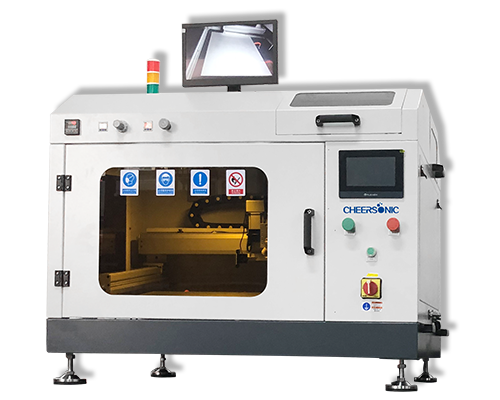
In practical applications, the value of ultrasonically sprayed microspheres for chip generation has been fully demonstrated in multiple fields. In the biomedical field, it can be used to prepare drug-release microspheres. By precisely controlling the size and structure of the microspheres, long-term, targeted drug release can be achieved, improving therapeutic effects and reducing side effects. In the semiconductor field, it can be used to prepare photoresist microspheres and conductive microspheres, providing core material support for the precision processing of chips and helping chips develop towards smaller sizes and higher integration.
In the new energy field, the catalyst microspheres prepared from it can be applied to fuel cells and power batteries, effectively improving electrode reaction efficiency and energy conversion rate. In the environmental monitoring field, functionalized microspheres can be used for pollutant adsorption and detection, contributing to the upgrading of environmental monitoring technologies. With continuous technological optimization, its application scenarios are constantly expanding, gradually penetrating into high-end fields such as aerospace and new displays.
Currently, with the increasing demands for microsphere performance in various fields, ultrasonic spraying microspheres for chip generation are developing towards intelligence, miniaturization, and multifunctionality. By integrating AI intelligent control technology, real-time dynamic adjustment of spraying parameters can be achieved, further improving the consistency and stability of microsphere preparation. The combination with 3D printing and microfluidic technology will drive the research and development of multifunctional composite microspheres, expanding their application boundaries.
As a key piece of equipment in the field of micro-nano manufacturing, ultrasonic spraying of microspheres to generate chips has not only driven innovation in microsphere preparation technology but also provided strong support for the upgrading of multiple high-end industries. In the future, with continued technological breakthroughs, it will play an even more important role in precision manufacturing, biomedicine, new energy, and other fields, helping related industries in my country achieve high-quality development and showcasing the technological strength of high-end manufacturing.
About Cheersonic
Cheersonic is the leading developer and manufacturer of ultrasonic coating systems for applying precise, thin film coatings to protect, strengthen or smooth surfaces on parts and components for the microelectronics/electronics, alternative energy, medical and industrial markets, including specialized glass applications in construction and automotive.
Our coating solutions are environmentally-friendly, efficient and highly reliable, and enable dramatic reductions in overspray, savings in raw material, water and energy usage and provide improved process repeatability, transfer efficiency, high uniformity and reduced emissions.
Chinese Website: Cheersonic Provides Professional Coating Solutions