
PEM Water Electrolysis/Fuel Cell Membrane Electrode Preparation
Cheersonic Ultrasonic Spray Coating Technology for PEM Water Electrolysis/Fuel Cell Membrane Electrode Preparation
Introduction
The global transition toward clean energy has placed proton exchange membrane (PEM) water electrolysis and PEM fuel cells at the forefront of sustainable power generation and hydrogen production. Central to both technologies is the membrane electrode assembly (MEA)—the core component where electrochemical reactions occur. The MEA consists of a proton exchange membrane sandwiched between anode and cathode catalyst layers, flanked by gas diffusion layers. The performance, durability, and cost of MEAs directly determine the commercial viability of PEM electrolyzers and fuel cells.
Among various catalyst deposition techniques—including doctor blade coating, screen printing, airbrush spraying, and inkjet printing—ultrasonic spray coating has emerged as a superior manufacturing method. This article provides a comprehensive overview of ultrasonic spray coating technology for MEA fabrication, covering its working principles, key advantages, critical process parameters, and application scenarios.
Working Principle
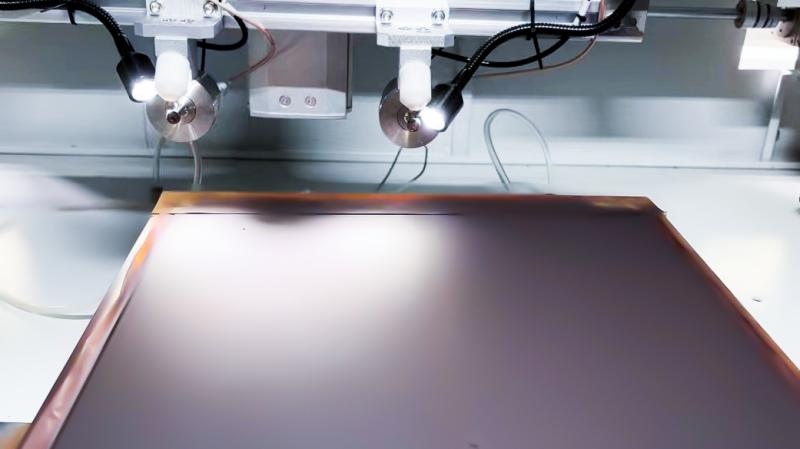
Ultrasonic spray coating operates on the principle of high-frequency ultrasonic atomization. A piezoelectric transducer converts high-frequency electrical signals into mechanical vibrations, which are transmitted to the spray nozzle. When catalyst slurry passes through the vibrating nozzle, it forms a thin liquid film that breaks into uniformly sized micro-droplets—typically ranging from 10 to 50 micrometers in diameter. These droplets are then gently carried by a low-pressure carrier gas and deposited precisely onto the PEM or gas diffusion layer substrate. Unlike conventional air-assisted spraying, ultrasonic atomization does not rely on high-pressure air for droplet formation, resulting in a soft, low-velocity mist that minimizes overspray and substrate damage.
Core Advantages
Uniform Coating Quality: Ultrasonic atomization produces droplets with a narrow size distribution, enabling catalyst layer thickness uniformity within ±5%. This eliminates common defects such as striations, pinholes, and the “coffee ring effect”, creating a homogeneous three-phase reaction interface that significantly enhances power density and electrochemical performance.
High Material Utilization: The directed droplet transport and minimal overspray enable material utilization rates of 80–90% or higher. This is particularly critical for noble metal catalysts such as platinum, iridium, and ruthenium, reducing precious metal consumption by up to 50% compared to conventional spraying methods.
Non-Destructive Deposition: The low-velocity mist and non-contact nature of ultrasonic spraying prevent mechanical damage, membrane swelling, or perforation—issues commonly associated with traditional coating techniques. This preserves membrane integrity and extends MEA service life.
Precise Thickness Control: By adjusting ultrasonic power, slurry flow rate, spray speed, and other parameters, coating thickness can be controlled across a wide range from nanometers to tens of micrometers. This flexibility accommodates diverse MEA design requirements, with typical catalyst loadings of 0.3–1.0 mg/cm² for platinum cathodes and 0.5–2.0 mg/cm² for iridium anodes.
Process Reliability: The continuous ultrasonic vibration within the nozzle actively disperses agglomerated particles, preventing nozzle clogging and ensuring consistent catalyst particle distribution. This enables reliable operation with nanoparticle-containing slurries and supports both intermittent and continuous production modes.
Critical Process Parameters
Optimal MEA fabrication via ultrasonic spraying requires careful control of several interdependent parameters:
– Ultrasonic Frequency (20–120 kHz): Higher frequencies produce finer droplets, suitable for thin, uniform catalyst layers.
– Spray Speed (5–50 mm/s): Lower speeds yield thicker coatings, though production efficiency must be balanced against coating quality.
– Slurry Flow Rate (0.1–5 mL/min): Flow rate must match drying kinetics to prevent run-off or cracking.
– Substrate Temperature (40–80°C): Moderate heating promotes solvent evaporation and prevents membrane swelling.
– Catalyst Ink Formulation: Solid content typically ranges from 1–10 wt%, with ionomer-to-catalyst ratios optimized (commonly 1:1) to ensure effective three-phase boundary formation.
Applications in PEM Electrolyzers and Fuel Cells
For PEM water electrolyzers, ultrasonic spray coating enables the deposition of highly stable catalyst layers capable of withstanding the harsh oxidative environment and elevated temperatures during operation. The technology supports both catalyst-coated membrane (CCM) and gas diffusion electrode (GDE) approaches, with demonstrated performance exceeding 2 A/cm² at 1.8 V for iridium-based anodes.
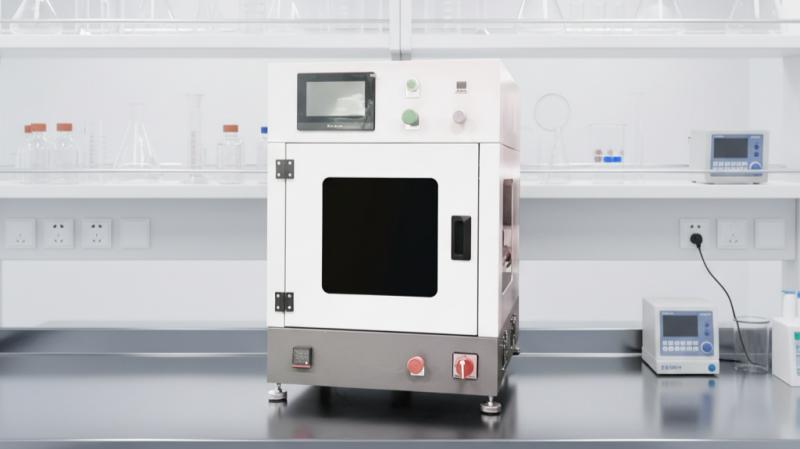
For PEM fuel cells, the technology facilitates ultra-low platinum loadings while maintaining high performance through optimized catalyst layer structure and porosity. Dual-nozzle configurations enable independent deposition of catalyst and ionomer, providing unprecedented control over ionomer distribution and catalyst layer architecture.
Conclusion
Ultrasonic spray coating technology has established itself as a transformative manufacturing solution for MEA fabrication in PEM water electrolysis and fuel cell applications. Its combination of exceptional coating uniformity, high material utilization, non-destructive deposition, precise thickness control, and process reliability addresses the critical challenges of performance, durability, and cost that have historically limited widespread adoption of PEM technologies. As the hydrogen economy continues to expand, ultrasonic spray coating will play an increasingly vital role in enabling the scalable, cost-effective production of high-performance membrane electrode assemblies.
About Cheersonic
Cheersonic is the leading developer and manufacturer of ultrasonic coating systems for applying precise, thin film coatings to protect, strengthen or smooth surfaces on parts and components for the microelectronics/electronics, alternative energy, medical and industrial markets, including specialized glass applications in construction and automotive.
Our coating solutions are environmentally-friendly, efficient and highly reliable, and enable dramatic reductions in overspray, savings in raw material, water and energy usage and provide improved process repeatability, transfer efficiency, high uniformity and reduced emissions.
If you have any technical questions, customization demands, or procurement inquiries about ultrasonic atomization nozzles, feel free to contact our professional sales and technical team for detailed parameters, customized solutions, and industry application support.
Email: market2@cheersonic.com
