ITO Conductive Glass and Photolithography Coating Process
ITO Conductive Glass and Photolithography Coating Process
ITO conductive glass, a special material with conductive properties, plays a crucial role in the LCD display field. Its core function is to form the desired display pattern through etching. When an electric current is applied between two ITO conductive layers, an electric field is generated in the overlapping area, while no electric field is generated in the area without an ITO conductive layer. Under the influence of the electric field, the liquid crystal undergoes a state transition, thereby enabling effective light transmission and providing the fundamental conditions for LCD display. It is worth noting that ITO is essentially a conductive metal layer composed of indium oxide or tin oxide, and its chemical properties are relatively active. It reacts strongly with acids and is easily corroded in strong alkaline environments. This characteristic requires close attention in subsequent processing.
Coating, as the first step in the photolithography process, directly affects the effect of subsequent processes. Its core is to uniformly coat the ITO glass surface with photoresist. Photoresist has special storage requirements; it must be stored in a low-temperature and light-protected environment to ensure its chemical stability. Before using photoresist, its viscosity must be rigorously tested, as viscosity significantly affects coating performance: excessively high viscosity improves corrosion resistance but reduces resolution; conversely, low viscosity improves resolution but weakens corrosion resistance. To resolve this contradiction, a measured amount of thinner is typically added before use, thoroughly stirred, and allowed to stand for a period, then the viscosity is measured again until it meets the process requirements before application.
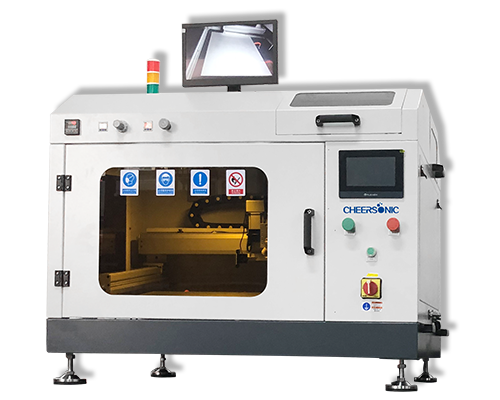
Currently used ultrasonic coating processes have clear and stringent requirements for coating quality. First, the adhesive layer must adhere well to the glass surface, with no peeling allowed. This is fundamental for subsequent processing. Second, the coating thickness must be uniform; uneven thickness will easily lead to pattern defects during subsequent development and acid etching processes, affecting the final display effect. Finally, the coating surface must be smooth and clean, free from defects such as streaks, pinholes, dirt spots, and protrusions. The number of impurity points with a diameter of 0.2mm or larger on the effective area of a single glass adhesive layer should not exceed three. If dirt spots or pinholes are located more than 3mm beyond the glass edge, they are considered to meet the release standard.
After coating, a drying process is necessary. This step allows the solvent in the adhesive to fully evaporate, allowing the adhesive film to dry and solidify. A dried adhesive film not only enhances adhesion to the ITO surface but also improves its wear resistance. More importantly, only in a dry state can the photoresist fully undergo the photochemical reaction, ensuring the photolithography effect. The drying process requires extremely precise control of temperature and time: if the temperature is too low or the time is insufficient, the solvent within the photoresist film cannot evaporate fully. During subsequent exposure and development, the unexposed portions may dissolve, forming a gel-like substance, or even causing pattern deformation. Conversely, if the drying time is too long or the temperature is too high, the photoresist film may warp and harden, leading to problems such as the pattern not developing or residual film remaining during development, severely impacting the entire photolithography process.
About Cheersonic
Cheersonic is the leading developer and manufacturer of ultrasonic coating systems for applying precise, thin film coatings to protect, strengthen or smooth surfaces on parts and components for the microelectronics/electronics, alternative energy, medical and industrial markets, including specialized glass applications in construction and automotive.
Our coating solutions are environmentally-friendly, efficient and highly reliable, and enable dramatic reductions in overspray, savings in raw material, water and energy usage and provide improved process repeatability, transfer efficiency, high uniformity and reduced emissions.
Chinese Website: Cheersonic Provides Professional Coating Solutions