
Guidewire Spray-Coated with PTFE
Ultrasonic spraying technology has significant advantages in surface treatment of medical guide wires, which can accurately achieve the composite function of PTFE lubricating coating and drug sustained-release coating. The following are its core technical features and application solutions:
Technical principles and equipment characteristics
The ultrasonic spraying machine atomizes the liquid into uniform droplets of 10-50 μ m through high-frequency vibration (20-120kHz), and achieves micrometer level precision control by combining XYZ three-axis motion system. The equipment is made of titanium alloy or stainless steel material, which has strong corrosion resistance and is compatible with PTFE solution, paclitaxel and other drug suspensions, as well as various organic solvents such as acetone and tetrahydrofuran. The key parameters include:
– Atomization efficiency: The coating conversion rate is over 95%, which is more than four times that of traditional spraying, significantly reducing material waste.
– Thickness control: It can achieve coating thickness adjustment from nanometer level to tens of micrometers, with an error of ≤± 5%, meeting industry standards such as YY/T 1898-2024.
– Nozzle design: Adopting non clogging ultrasonic nozzle, supporting low flow continuous spraying (such as 0.1ml/min), suitable for three-dimensional uniform coverage of complex structures.
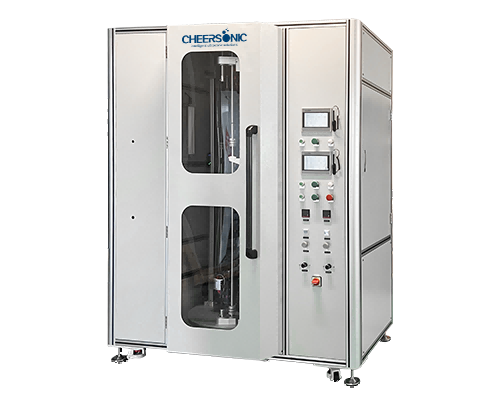
Key points of PTFE coating process
1. Preprocessing techniques
The surface of the guide wire needs to be subjected to plasma treatment or sandblasting roughening (roughness Ra 0.1-1 μ m) to enhance the adhesion of the coating. For example, introducing hydroxyl groups on the metal surface through oxygen plasma, and then coating a methoxy PEG silane primer layer to form covalent bonds.
2. Optimization of spraying parameters
– Solution ratio: PTFE particles are mixed with acetone in a mass to volume ratio of 1:3-1:5, and sonicated for 30 minutes to avoid agglomeration.
– Process parameters: Spray distance of 10-20cm, carrier gas flow rate of 30-50L/h, ultrasonic power of 200-400W, capable of forming superhydrophobic surfaces with contact angles>150 °.
3. Curing process
After spraying, cure in a 60-120 ℃ oven for 1-3 hours, or use UV curing technology to achieve rapid cross-linking and improve the durability of the coating.
Preparation plan for drug coating
1. Drug loading technology
For poorly soluble drugs such as paclitaxel and rapamycin, micronization treatment (particle size<5 μ m) and the addition of dispersants (such as polyvinylpyrrolidone) are required. For example, mixing the drug with PVA/PVP solution and sonicating at 65 ℃ for 15 minutes to form a stable suspension.
2. Multi layer coating structure
– Primer layer: Methoxy PEG silane solution (40mg/mL) is cured under vacuum conditions to provide chemical anchoring points.
– Drug layer: Low flow rate (0.12-0.15ml/min) and high-frequency (30kHz) spraying are used to form needle shaped crystalline drug distribution and increase drug loading.
– Barrier layer: Spray PVA/PVAc mixture (1:3 mass ratio), solidify through freezing/thawing cycles, and control drug release rate.
3. Quality control
The drug particle size distribution is monitored using a laser diffractometer, and the drug loading and release curves are detected by high performance liquid chromatography (HPLC) to ensure the uniformity and stability of the coating.
Integrated process of composite coating
1. Process route
Pre treatment → Primer spraying → PTFE coating → Drug layer spraying → Barrier layer curing, ensuring interface adhesion between each process through nitrogen blowing or vacuum drying.
2. Equipment configuration
It is necessary to integrate an ultrasonic dispersion supply system (to prevent drug precipitation), a temperature and humidity control system (to optimize atomization effect), and an exhaust gas purification device (to treat organic solvent volatilization). For example, using a closed-loop ventilation system combined with activated carbon adsorption to ensure VOC emissions meet environmental standards.
This technology has been widely applied in the field of cardiovascular intervention. By precisely regulating the coating structure, it can simultaneously meet the mechanical properties, lubricity, and drug release requirements of guide wires, providing high-performance interventional device solutions for clinical use.
About Cheersonic
Cheersonic is the leading developer and manufacturer of ultrasonic coating systems for applying precise, thin film coatings to protect, strengthen or smooth surfaces on parts and components for the microelectronics/electronics, alternative energy, medical and industrial markets, including specialized glass applications in construction and automotive.
Our coating solutions are environmentally-friendly, efficient and highly reliable, and enable dramatic reductions in overspray, savings in raw material, water and energy usage and provide improved process repeatability, transfer efficiency, high uniformity and reduced emissions.
Chinese Website: Cheersonic Provides Professional Coating Solutions
