
Full Analysis of TGV Chip Adapter Board Coating
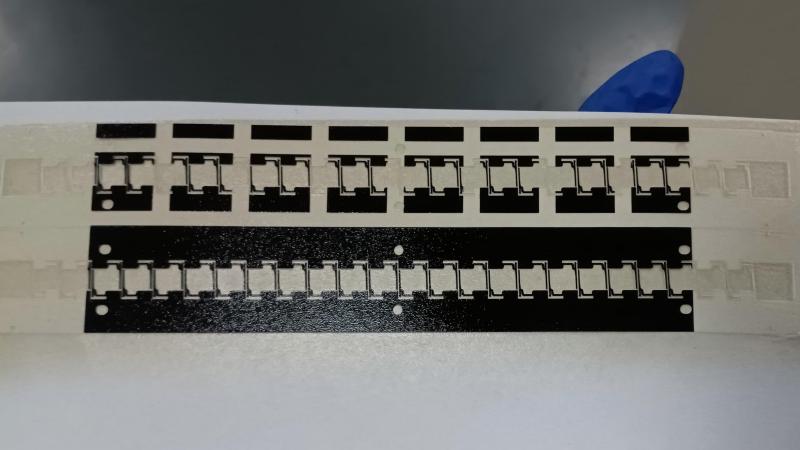
The TGV (Through Glass Via) chip adapter board achieves the synergy of insulation, conductivity, heat dissipation, and protection through multi-layer composite coatings, serving as an “invisible guardian” for the interconnection between glass substrates and metals.
Core coating types and materials
Insulation/passivation coating (basic guarantee)
-Silicon oxide SiO ₂: PVD/CVD deposition, thickness 0.1-2 μ m, providing electrical isolation and moisture barrier
-Silicon nitride Si ∝ N ₄: dense (<1nm pores), blocking water vapor and ions, enhancing mechanical strength
-Polyimide PI: coating curing, insulation temperature resistance (>250 ℃), flexibility, suitable for stress buffering
-Al ₂ O ∝: ALD deposition (50-200nm), atomic level uniformity, high-frequency insulation and passivation
Metal seed layer (conductive bridge)
-Ti/Cu or Cr/Cu: Sputtering (50-200nm) enhances glass metal bonding and serves as a plating substrate
-Ni-P alloy: chemical plating, uniformly covering high aspect ratio (10:1) through holes, high adhesion strength
Thermal management coating (performance critical)
-Thermal conductive silicone grease/gel: fill the gap, thermal resistance<0.1 ℃ · in ²/W, improve heat dissipation efficiency
-Graphene/carbon nanotube coating: high thermal conductivity (~1500W/m · K), achieving rapid in-plane thermal diffusion
-Metal heat dissipation layer: Cu/Al thin film (1-5 μ m), expands the heat dissipation area and reduces thermal resistance
Stress buffering coating (reliability guarantee)
-Low modulus PI: coated on the edge of TGV opening (5-10 μ m) to alleviate stress concentration caused by the CTE difference between Cu and glass (17ppm/℃ vs 3ppm/℃)
-Composite buffer layer: PI/SiO ₂ alternating, balancing insulation and flexibility to prevent glass cracking
The four core functions of coatings
Electrical Insulation and Circuit Protection
-Isolate adjacent TGVs from surface circuits to prevent leakage and short circuits
-Shielding electromagnetic interference to ensure high-speed signal integrity (loss)< 0.3dB@220GHz )
-As an insulation barrier between chips and metal interconnects, it prevents electrochemical corrosion
Metalization and Interconnection Enhancement
-The seed layer provides a conductive substrate for electroplating, ensuring uniform filling of metals such as Cu
-Enhance the adhesion between glass and metal (>1.0kN/m) to prevent interface delamination
-Realize conformal coverage in deep holes (depth to diameter ratio>10:1) to ensure defect free metallization
Thermal management optimization
-Build efficient heat dissipation channels and control chip temperature (<70 ℃)
-Relieve heat concentration caused by low thermal conductivity (1.1W/m · K) of glass
-Reduce thermal stress and prevent structural failure caused by temperature fluctuations
Mechanical reinforcement and environmental protection
-Passivation layer enhances bending strength (>50MPa) and prevents microcrack propagation
-Sealed structure blocks water vapor (WVTR<0.01g/m ² · day) and oxygen, extending lifespan (>10 years)
-As a physical barrier, it prevents chemical erosion and mechanical damage
Coating Collaboration: From Single Function to System Level Solutions
TGV coating forms a “multi-layer composite protective network”, and each layer works together:
1. Bottom insulation layer: SiO ₂/Si ∝ N ₄, providing basic electrical isolation
2. Intermediate functional layer: seed layer+conductive metal (Cu), achieving vertical interconnection
3. Stress relief layer: low modulus materials such as PI to alleviate interfacial stress
4. Surface protective layer: Si ∝ N ₄/PI composite passivation, balancing environmental and mechanical protection
Summary
TGV coating is a bridge connecting glass substrate and metal, which significantly improves device performance and reliability through the synergy of insulation, conductivity, heat dissipation, and protection. With the expansion of 2.5D/3D packaging and AI accelerated chip applications, coating technology is evolving towards ultra-thin, high thermal conductivity, and high integration, becoming a key support for breaking through performance bottlenecks.
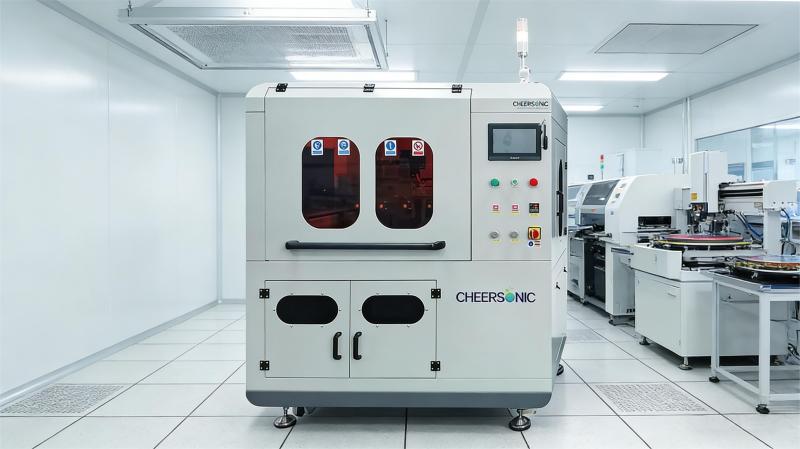
Ultrasonic spraying is a key preparation process for the coating of TGV chip transfer plates, accurately matching their high integration and high reliability packaging requirements. This process can uniformly deposit insulating passivation materials such as SiO ₂, Si ∝ N ₄, PI, etc., forming a dense protective layer to achieve circuit isolation and water oxygen barrier; Suitable for low modulus stress buffering coatings, effectively alleviating stress concentration caused by the difference in CTE between glass and metal, and avoiding substrate cracking. Its atomization accuracy is high, the coating thickness deviation is less than ± 5%, and it can form conformal coverage on the surface of high aspect ratio TGV through holes, with strong adhesion and low porosity. At the same time, the low-temperature process does not damage the glass substrate, ensuring signal integrity and heat dissipation efficiency, providing stable coating support for high-end applications such as 2.5D/3D packaging and AI acceleration chips, and helping the adapter board achieve high interconnect density and long life.
About Cheersonic
Cheersonic is the leading developer and manufacturer of ultrasonic coating systems for applying precise, thin film coatings to protect, strengthen or smooth surfaces on parts and components for the microelectronics/electronics, alternative energy, medical and industrial markets, including specialized glass applications in construction and automotive.
Our coating solutions are environmentally-friendly, efficient and highly reliable, and enable dramatic reductions in overspray, savings in raw material, water and energy usage and provide improved process repeatability, transfer efficiency, high uniformity and reduced emissions.
Chinese Website: Cheersonic Provides Professional Coating Solutions