
Food Manufacturing Coating | Anti-Microbial & Barrier Coatings for Food Packaging
As the ready-to-eat food industry rapidly expands, food preservation, safety, and eco-friendly packaging have become central concerns. Antimicrobial coatings, functional additive coatings, and barrier coatings—key surface treatment technologies in food manufacturing—are transforming storage durations and consumption safety of prepared foods, balancing product quality with sustainable production.
Functional coatings in food manufacturing are primarily categorized into three types: antimicrobial coatings, functional additive coatings, and barrier coatings. Each is tailored to specific applications and can be applied directly onto food surfaces or sprayed onto packaging substrates.
Antimicrobial coatings play a vital role in ensuring the hygiene and safety of ready-to-eat foods. Typically formulated with ingredients compliant with food-contact safety standards, these coatings inhibit the growth of bacteria, mold, and other microorganisms on packaging surfaces or food exteriors, thereby delaying spoilage. For ready-to-eat meals, baked goods, and processed meats, applying antimicrobial coatings to inner packaging walls reduces microbial proliferation at the packaging interface, lowering contamination risks during storage, transportation, and retail display. Most formulations use natural, edible components that comply with food contact regulations, ensuring no adverse effects on flavor or food safety.
Functional additive coatings are commonly used for modifying food surfaces. These coatings form protective films that help retain moisture, prevent sticking, and resist oxidation. For example, in pastries, confectionery, and pre-prepared fruits and vegetables, such coatings lock in moisture, preventing surface cracking and discoloration due to oxidation, thus maintaining consistent appearance and texture. Mostly made from edible materials, these coatings are safe for consumption along with the food itself, aligning well with modern trends toward lightweight, minimally-processed ready-to-eat products.
Barrier coatings represent the most widely used functional films in food packaging. Oxygen, water vapor, and carbon dioxide are primary drivers of food deterioration. Barrier coatings create a dense, thin layer on packaging substrates that significantly reduce gas permeability, blocking external moisture and oxygen while also containing internal aromas. Traditional packaging films often require complex multilayer structures, resulting in high material costs and complicated manufacturing processes. In contrast, advanced thin-layer barrier coatings enable efficient performance on paper-based or biodegradable film substrates, supporting compostable packaging and aligning with global efforts to reduce plastic usage.
The choice of coating technology directly affects coating uniformity, raw material efficiency, and production stability. Ultrasonic spraying enables the precise application of ultra-thin, uniform functional coatings, minimizing overspray waste and meeting the precision requirements of low-viscosity food-grade coatings. Conventional high-pressure spraying often leads to uneven thickness and significant material splatter, whereas fine atomization techniques produce continuous, complete films even on flexible films and irregular substrates. This makes them ideal for continuous roll-to-roll food packaging lines as well as small-batch R&D samples.
Compliance is paramount in food manufacturing coatings. All coating materials must meet relevant food-contact regulations; formulations must exclude harmful substances, and migration levels must remain within established limits. From formulation development and pilot testing to full-scale production, extensive safety, barrier performance, and antimicrobial efficacy tests are required to ensure stable coating performance under various temperature and humidity conditions, without delamination or migration that could contaminate food.
Current industry trends show that biodegradable substrates combined with environmentally friendly functional coatings are gradually replacing traditional multi-layer plastic packaging. An increasing number of manufacturers are adopting natural, bio-based coating materials that deliver antimicrobial and barrier functions while ensuring full biodegradability at end-of-life, balancing commercial value with environmental responsibility. As the ready-to-eat food market continues to grow, ongoing innovation in coating formulations and spray technologies will further extend shelf life in more cost-effective and sustainable ways, helping to reduce food waste.
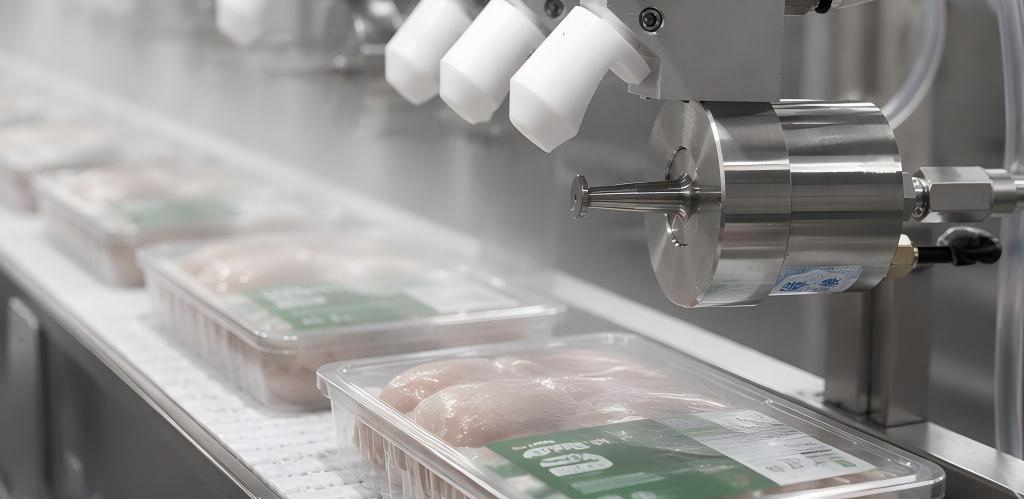
Food Manufacturing and Packaging Technology
Food Manufacturing and Packaging Technology Functional food manufacturing coating [...]
To reach our anytime via email please fill out the form below with your request and a company representative will reply to you. To find your local CHEERSONIC representative to connect directly click your region in the contact drop down menu.
Contact CHEERSONIC For immediate assistance please contact us the corporate headquarters during business hours at 6:00 am – 22:00 pm.
Tel: 0571-87910406
- Mobile: +86 15869049660
- Email: Market2@cheersonic.com
Add: 11-13 Chuangye Road, Changkou, Fuyang, Hangzhou, Zhejiang, China
