
Flux Spraying Production Line System
Flux Spraying Production Line System – Ultrasonic Spray Fluxing – Cheersonic
In modern electronic manufacturing, the reliability and quality of printed circuit boards (PCBs) directly determine the performance and lifespan of the final electronic products. As a key link in the PCB production process, flux coating technology has a decisive impact on the subsequent soldering quality, including solder joint integrity, conductivity stability, and corrosion resistance during long-term use. Traditional manual brushing, immersion, or rolling coating processes, although meeting production needs in a certain historical stage, generally have problems such as difficulty in controlling coating uniformity, large fluctuations in flux usage, limited production efficiency, and easy generation of bubbles or uneven thickness due to improper operation. With the continuous development of electronic components towards miniaturization, high density, and high performance, the traditional processes mentioned above are no longer able to meet the increasingly advanced production technology requirements. Therefore, a flux quantitative spraying technology based on ultrasonic principles has emerged and gradually been integrated into fully automated PCB production lines, becoming an important technical means to improve the quality and efficiency of board manufacturing.
This article explores an ultrasonic flux spraying system integrated into a fully automated production line. This system is mainly aimed at rectangular printed circuit boards with a specification size of approximately 114mm × 144mm, achieving precise, uniform, and controllable flux coating. Next, the system will be elaborated in detail from several aspects, including its working principle, core structure composition, main performance advantages, and its integration and application value in the production line.
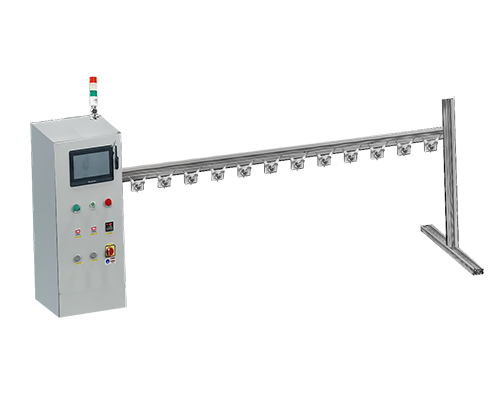
The core technical principle of this spraying system is to use ultrasonic effect to achieve atomization and spraying of flux liquid. The core vibration device inside the system, driven by electrical signals, vibrates mechanically at a frequency higher than the human ear, causing the flux delivered to the vibration surface through a dedicated supply pipeline to quickly break into extremely fine and uniform droplets. These droplets are rectified and focused by a special structure inside the system to form a stable, dense and evenly distributed spray like coating. Compared with the traditional spraying method relying on air pressure or mechanical pressure, this technology can achieve more accurate control of atomized particle size, spray angle and discharge amount. The system is usually equipped with a high-precision metering pump, which can control the flux output in a closed-loop manner according to a preset program, ensuring that the amount of soldering aid received by each circuit board passing through the spraying area strictly meets the process standards, and eliminating soldering defects caused by excessive or insufficient flux from the source.
In terms of hardware structure, this set of ultrasonic spraying system integrated in the production line is mainly composed of the following core modules: first, the ultrasonic generation and spray generation module, which is the core to achieve efficient atomization of flux; Next is the high-precision fluid supply and metering module, responsible for ensuring that the flux is delivered to the atomization unit at a stable and accurate flow rate; The third is the motion control and mechanical transmission module, which is usually designed as a gantry or robotic arm structure, capable of precise scanning movement above the surface of the circuit board according to a preset trajectory, ensuring that there are no blind spots in the spraying coverage; The fourth is the process sensing and closed-loop control module, which can realize the dynamic adjustment and optimization of the process by integrating a variety of sensors to monitor the spray status, flow, pressure and other key parameters in real time, and feedback the data to the central control system; Finally, there is the enclosure sealing and exhaust gas treatment module. A good sealing design not only protects the internal precision components from dust and moisture in the workshop environment, but also effectively collects and processes trace volatile substances that may be generated during the spraying process, meeting the environmental requirements of clean production.
The technical advantages demonstrated by applying this system to the production of circuit boards with a size specification of approximately 114mm x 144mm are particularly significant. Firstly, in terms of coating quality, the system can achieve extremely high uniformity of the film layer, avoiding local over thickness or over thinness, which is crucial for ensuring the uniformity of the solder joints formed during subsequent reflow soldering or wave soldering processes. Secondly, in terms of material utilization, due to the use of precise measurement and directional spraying technology, compared to traditional immersion processes, excessive use and waste of flux can be significantly reduced, while also reducing the burden and cost of subsequent cleaning due to excessive flux residue. Again, in terms of production adaptability, the system has a high degree of flexibility. By modifying the parameters in the control program, it can quickly adapt to production tasks of different sizes or types of fluxes, greatly reducing the adjustment time during product line changes. Finally, in terms of production line integration and automation, the system can seamlessly integrate with the production line control system through standard industrial communication protocols, achieving production rhythm synchronization, data exchange, and centralized monitoring. It is an essential key link in building an intelligent and unmanned PCB production workshop.
In summary, the ultrasonic flux spraying system integrated into the printed circuit board production line provides strong technical support for improving the process level and product quality of the electronic manufacturing industry with its precise coating control, excellent uniformity performance, efficient material utilization, and excellent production line integration capability. Facing a circuit board with a specification standard of 114mm × 144mm, this system can stably and reliably complete high-quality flux coating tasks. With the deepening of the Industry 4.0 concept and the continuous development of intelligent manufacturing, such process equipment with high precision, high flexibility, and high automation features will play an increasingly important role in the future electronic manufacturing field, and promote the entire industry to move towards a more efficient, reliable, and environmentally friendly direction.
About Cheersonic
Cheersonic is the leading developer and manufacturer of ultrasonic coating systems for applying precise, thin film coatings to protect, strengthen or smooth surfaces on parts and components for the microelectronics/electronics, alternative energy, medical and industrial markets, including specialized glass applications in construction and automotive.
Our coating solutions are environmentally-friendly, efficient and highly reliable, and enable dramatic reductions in overspray, savings in raw material, water and energy usage and provide improved process repeatability, transfer efficiency, high uniformity and reduced emissions.
Chinese Website: Cheersonic Provides Professional Coating Solutions