
Electrochemical Technology for CO₂ Capture
Electrochemical Technology for CO₂ Capture | Ultrasonic Coating Technologies for Electrolyzers | Cheersonic
Against the backdrop of the current global push for carbon neutrality, electrochemical carbon capture technologies driven by renewable electricity have gradually become a research hotspot in the carbon management field, owing to their environmental friendliness and controllable energy consumption. This technology uses clean electrical energy as the primary energy input and achieves efficient CO₂ capture and conversion through a series of electrochemical reactions, showing broad application prospects in future carbon reduction pathways. However, despite its great potential, existing electrochemical carbon capture systems still face several technical bottlenecks, including relatively low capture efficiency, high sensitivity to oxygen in the operating environment, and complex system architectures that hinder scalable deployment.
To address these challenges, researchers have recently proposed a novel electrochemical carbon capture architecture based on the coupling of the oxygen/water (O₂/H₂O) redox couple. This design employs a modular solid-electrolyte reactor to construct a continuously operating electrochemical carbon capture process. Its core mechanism lies in using the oxygen reduction reaction (ORR) and the oxygen evolution reaction (OER) to establish a closed redox cycle. In this system, dilute CO₂ molecules are efficiently adsorbed at the highly alkaline cathode catalyst interface and further converted into carbonate ions; subsequently, on the anode side, the carbonate ions are neutralized by regulating the proton flux, and finally, a high‑purity CO₂ gas stream (purity exceeding 99%) is output from the solid‑electrolyte intermediate layer. This process achieves continuous operation from capture to release, requires no additional chemical reagents throughout the entire reaction pathway, and produces no by‑products, demonstrating excellent closed‑loop operation characteristics.
Experimental results show that this solid‑electrolyte‑based electrochemical carbon capture reactor excels in several key performance metrics: its carbon capture rate can reach 440 mA cm⁻², equivalent to 0.137 mmolCO₂ min⁻¹ cm⁻², or 86.7 kg of CO₂ processing capacity per square meter per day; simultaneously, the system exhibits a high Faradaic efficiency, exceeding 90% based on the carbonate pathway; and in simulated flue gas environments, its CO₂ removal efficiency also surpasses 98%. In addition, the technology features relatively low specific energy consumption, with an initial energy requirement of approximately 150 kJ/molCO₂, indicating promising practical application prospects and industrialization potential.
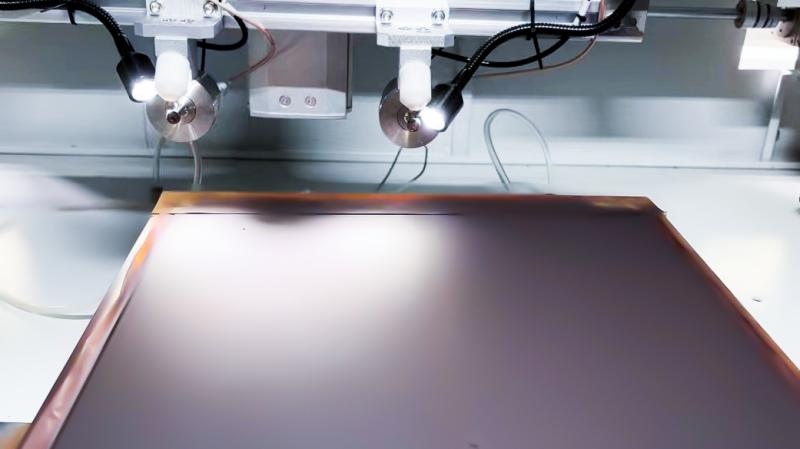
In terms of fabricating key reactor components, the construction of a highly alkaline cathode catalyst layer is crucial for enhancing interfacial CO₂ adsorption capacity. To this end, ultrasonic spray coating technology can be employed to uniformly deposit highly active catalysts onto the cathode membrane surface. This method uses high‑frequency ultrasonic vibration to atomize the catalyst slurry into micron‑sized droplets, which are then uniformly deposited onto the electrode surface under gas flow guidance, forming a catalytic layer with high specific surface area and favorable porous structure. This highly uniform catalyst coating helps strengthen gas‑solid interfacial contact efficiency, promotes CO₂ mass transfer and reaction kinetics at the electrode/electrolyte interface, and thus significantly improves the overall carbon capture performance of the electrochemical system.
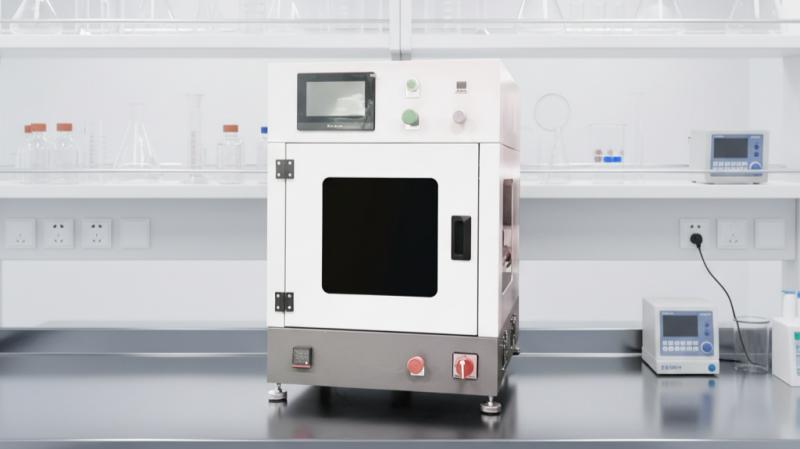
In summary, the modular solid‑electrolyte reactor integrating the oxygen/water redox couple offers an efficient, clean, and continuously operable technological route for electrochemical carbon capture. Combined with advanced material preparation techniques such as ultrasonic spray coating, the electrode structure is further optimized and reaction efficiency is enhanced. With continued progress in materials science and electrochemical engineering, such systems are expected to play a significant role in carbon capture scenarios in high‑emission industries such as power generation, steelmaking, and cement production, providing key technological support for building a low‑carbon energy system.
About Cheersonic
Cheersonic is the leading developer and manufacturer of ultrasonic coating systems for applying precise, thin film coatings to protect, strengthen or smooth surfaces on parts and components for the microelectronics/electronics, alternative energy, medical and industrial markets, including specialized glass applications in construction and automotive.
Our coating solutions are environmentally-friendly, efficient and highly reliable, and enable dramatic reductions in overspray, savings in raw material, water and energy usage and provide improved process repeatability, transfer efficiency, high uniformity and reduced emissions.
Chinese Website: Cheersonic Provides Professional Coating Solutions
