Design of AEM Electrolytic Water Membrane Electrode
Currently, the technology of hydrogen production through anion exchange membrane (AEM) electrolysis of water has attracted much attention, and many university researchers have discussed and exchanged ideas with the author on the preparation technology of related membrane electrodes (MEA). Based on this, this article systematically reviews existing research data, with theoretical knowledge as the main focus. In practical applications, it is necessary to continuously explore and comprehend specific operations, for reference only by relevant practitioners.
The core of membrane electrode assembly (MEA) formation lies in the rational deposition of catalyst, which can be divided into two technical paths: one is to directly deposit the catalyst on the surface of the ion membrane, namely catalyst coated membrane (CCM) technology; Another type is to deposit catalysts on substrate materials, known as Catalyst Coated Substrate (CCS) technology. In the anion exchange membrane electrolysis of water (AEMWE) system, the substrate used for CCS technology is usually a gas diffusion layer (GDL) or a porous transport layer (PTL).
The wet preparation of catalyst coatings is a relatively mature process, which involves dissolving catalyst powder and ionic polymer in a suitable solvent to form a uniformly dispersed and stable slurry, and then loading the slurry onto the surface of GDL through spraying or brushing. To solve the problems of material waste and high solvent consumption in wet processes, dry thin film deposition technology has become a research focus, such as chemical vapor deposition (CVD), atomic layer deposition (ALD), ion beam sputtering deposition (IBD), and magnetron sputtering (PVD), all of which belong to this new type of process.
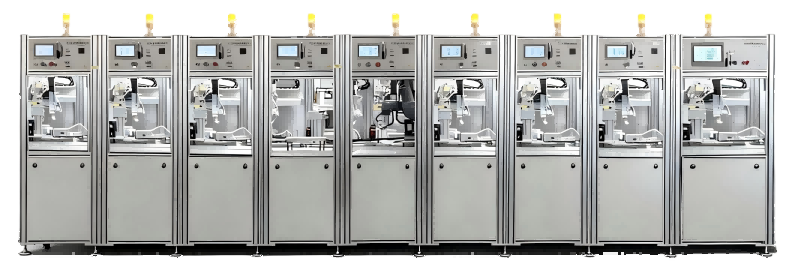
Ultrasonic spraying provides an efficient solution for AEM catalyst coating, which atomizes the slurry into uniform droplets of 10-50 μ m through 20-120kHz high-frequency vibration, and accurately deposits them on the membrane or GDL/PTL substrate. The coating uniformity exceeds 95%, the thickness can be controlled between 20nm-100 μ m, and the raw material utilization rate reaches over 90%. Mild spraying avoids membrane damage, dense coating improves ion conductivity efficiency, reduces interface resistance, adapts to non precious metal catalysts, and provides support for the large-scale production of AEMWE.
From the perspective of process characteristics, CCS technology facilitates the preparation of structurally stable and performance stable catalyst layers by directly loading catalyst slurry onto the substrate; The advantage of CCM technology lies in optimizing the interface contact state between the catalyst layer and the ion membrane, thereby improving ion conduction efficiency and reducing interface contact resistance. However, CCM technology has obvious limitations, as the catalyst deposition process may affect the chemical stability of the ion membrane and cause physical changes such as swelling on the membrane surface.
The performance of MEA prepared by CCM and CCS processes is relatively complex, and many factors such as membrane material stability, compatibility between ionomers and membranes, and deposition process parameters can lead to differences in results. The performance of MEAs prepared by different processes in AEMWE single cells largely depends on the operating temperature, catalyst type (precious metal and non precious metal), and electrolyte characteristics. Previous studies have shown that the combination of CCM cathode and CCS anode can achieve better performance, but the anode prepared by CCM process is prone to catalyst particle delamination, leading to a decrease in battery stability.
An effective solution to the interface contact resistance problem between the anode and ion exchange membrane in CCS process is to add a microporous layer (MPL) between PTL and MEA, and improve the interface conductivity efficiency through structural optimization. Due to the involvement of multiple variables in the preparation of MEA and catalyst layers, systematic experimental methods such as Design of Experiments (DOE) are required to determine key preparation parameters. Some research results in the fields of proton exchange membrane electrolysis of water (PEMWE) and fuel cells (FC) can be transferred and applied to AEMWE research. In addition, combining molecular dynamics modeling of MEA components with experimental verification can accelerate the technological development in this field.

The hot pressing process is an important step in the preparation of MEA, which can enhance the interface bonding between the catalyst layer and the AEM membrane, but may lead to dehydration of the membrane material. The setting of hot pressing temperature should focus on the glass transition temperature (Tg) of AEM film and ion conductive polymer (AEI). Unlike the gas feed scenario of fuel cells, AEMWE systems (especially liquid feed types) require precise control of hot pressing conditions to avoid excessive compression of membrane materials. The typical hot pressing parameter range is temperature 120-195 ℃, time 50-300 seconds, and pressure 2-200 kg/cm ².
The optimization of MEA components also needs to address water management issues to avoid membrane drying or flooding. Proton exchange membrane (PEM) based fuel cells and electrolyzed water systems have developed mature solutions to similar problems, but in alkaline environments, the imbalance in water generation and consumption between the anode and cathode of AEMWE is more prominent than in acidic environments. When using 1 mole KOH alkaline solution as the electrolyte, there is sufficient supply of OH ⁻ required for the anodic oxygen evolution reaction (OER); In the pure water feeding scenario, the OH ⁻ required for OER is completely dependent on the water splitting reaction at the cathode.
From the perspective of electrochemical reaction stoichiometry, for every 1 mole of product water generated by the anode in the AEMWE system, the cathode consumes 2 moles of water; In the PEMWE system, the anode consumes 1 mole of water, while the cathode consumes no water. Although the anode of AEMWE generates moisture, the anode inlet mode has become the mainstream choice for the current AEM electrolysis water system. This mode can reduce the separation process of water and hydrogen, and improve the purity of the electrolysis product hydrogen. However, research has shown that the dual cycle equilibrium mode of supplying electrolytes to both the cathode and anode simultaneously can achieve better battery performance and higher operating current density, while reducing the risk of anode dehydration and enhancing water transfer efficiency to the cathode.
One of the future technological development directions of AEMWE is to develop customized and structurally ordered membrane electrode components and transport layer structures, which can achieve innovative optimization of electrode structures by precisely controlling the distribution of liquids and gases in specific areas. This goal can be achieved through various technological pathways, such as adjusting the layered porosity of the catalyst layer along the direction of the electrode surface, or using hydrophobic or hydrophilic modifiers to functionally modify the material surface. In addition, the optimization of liquid flow rate and KOH concentration, as parameters closely related to actual system design, still requires further research.
About Cheersonic
Cheersonic is the leading developer and manufacturer of ultrasonic coating systems for applying precise, thin film coatings to protect, strengthen or smooth surfaces on parts and components for the microelectronics/electronics, alternative energy, medical and industrial markets, including specialized glass applications in construction and automotive.
Our coating solutions are environmentally-friendly, efficient and highly reliable, and enable dramatic reductions in overspray, savings in raw material, water and energy usage and provide improved process repeatability, transfer efficiency, high uniformity and reduced emissions.
Chinese Website: Cheersonic Provides Professional Coating Solutions
