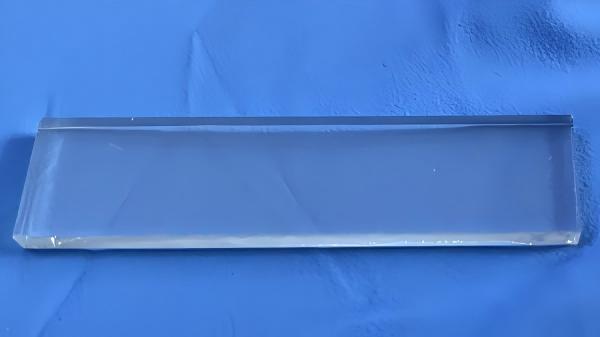
Coating on Glass Based Sealing Loading Plate
Coating on Glass Based Sealing Loading Plate – Ultrasonic Coating – Cheersonic
As the core substrate of high-end electronic packaging (such as semiconductor chips, 5G communication, AI computing equipment, etc.), glass based packaging carriers need to be coated with coatings that meet the packaging requirements of “high frequency, high density, low loss, and high reliability”. The coatings are mainly divided into two categories: functional coatings and auxiliary coatings. The materials, characteristics, and functions of each type of coating are as follows:
Core functional coating (determining the core performance of the carrier board)
1. Metal conductive coating
- Common materials: copper (Cu), nickel (Ni), gold (Au), silver (Ag), or alloys (such as Ni-P, Cu Sn)
- Core function: To achieve conductive interconnection between the chip and the carrier board, as well as between the carrier board and external circuits, while also assuming the function of heat dissipation
– Copper coating: a mainstream choice that combines high conductivity (suitable for high-frequency signal transmission), good thermal conductivity (disperses chip working heat), and low cost. Through graphic etching, it forms precision lines (line width/spacing can be as low as micrometers) to meet the wiring requirements of high-density packaging;
– Nickel coating: often used as an intermediate transition layer to enhance the adhesion between the copper layer and subsequent coatings (such as gold layer), while preventing oxidation of the copper layer;
– Gold/silver coating: used for the “bonding area” or “contact pins” on the surface of the carrier board, with extremely low contact resistance, excellent oxidation resistance and wear resistance, ensuring the reliability and long-term stability of chip bonding (such as gold wire ball bonding).
2. Dielectric insulation coating
- Common materials: Polyimide (PI), Epoxy Resin, SiO ₂ (Silicon Dioxide), Si ∝ N ₄ (Silicon Nitride), BT Resin, etc
- Core function: To achieve insulation isolation between lines, optimize the dielectric performance of the carrier board, and protect the lines at the same time
– Low dielectric constant (Dk) characteristics: reduce signal attenuation and crosstalk during high-frequency signal transmission (especially suitable for high-frequency scenarios such as 5G and millimeter waves), glass has excellent dielectric properties, and low Dk coatings can further reduce overall packaging losses;
– Insulation and protection: isolate adjacent metal lines to avoid short circuits, while blocking the intrusion of moisture and impurities, and protecting precision lines from corrosion;
– Surface leveling: Fill in the concave and convex gaps of metal lines to form a flat surface, providing a foundation for subsequent packaging processes such as chip mounting and secondary wiring.
3. Passivation/protective coating
- Common materials: silicon nitride (Si ∝ N ₄), aluminum oxide (Al ₂ O ∝), polyimide (PI), benzocyclobutene (BCB)
- Core function: Enhance the environmental stability and service life of the carrier board
– Corrosion resistance: It blocks oxygen, moisture, acid and alkali substances in the air from corroding metal circuits and glass substrates, avoiding circuit oxidation and substrate aging;
– Mechanical protection: resist mechanical stress during the packaging process (such as mounting, cutting, welding) and friction and impact during use, and protect the integrity of the internal circuit structure;
– High temperature resistance: adapted to the reflow soldering process after chip packaging (usually at a temperature of 150-260 ℃), without deformation, cracking, or performance degradation.
Auxiliary coating (ensuring process stability and adaptability)
1. Adhesive promoting coating (primer/transition layer)
- Common materials: titanium (Ti), chromium (Cr), titanium tungsten alloy (TiW), silane coupling agent
- Core function: To solve the “adhesion problem” between glass substrates and metal/dielectric coatings
The glass surface is smooth and chemically inert, and direct deposition of metal or dielectric coatings is prone to peeling and detachment. This coating greatly enhances the bonding strength of subsequent coatings through chemical bonding (such as reaction between silane coupling agents and glass surface hydroxyl groups) or physical anchoring, ensuring that the substrate does not fail in harsh environments such as high and low temperature cycling and wet heat aging.
2. Anti reflection/shading coating
- Common materials: composite layer of titanium oxide (TiO ₂), zirconium oxide (ZrO ₂) and SiO ₂, black resin
- Core function: Adapt to optical related packaging scenarios (such as optoelectronic chips, sensor packaging)
- Reduce light reflection: Avoid external light interference with the internal optical components of the chip (such as photodetectors and lasers);
- Light shielding protection: blocks stray light from entering the interior of the package, improving the transmission efficiency and stability of optical signals.
3. Welding aid coating
- Common materials: lead-free solder (Sn Ag Cu), tin bismuth alloy (Sn Bi), organic flux film
- Core function: Optimize the soldering process between the carrier board, chip, and PCB board
- Reduce welding temperature: minimize damage to glass substrates and chips caused by high temperatures;
- Improve solder wetting: Ensure even spreading of solder, form reliable welding joints, and avoid virtual soldering and false soldering.
The core value and application adaptation of coatings
The coating design of glass based packaging carrier board needs to closely match the application scenario:
- High frequency communication (5G/6G), AI chips: focus on “low Dk/Df dielectric coating+high conductivity metal coating” to reduce signal loss;
- Automotive electronics and industrial control: emphasizing “high reliability passivation coating+high temperature resistant soldering coating”, suitable for extreme temperature and humidity environments;
- Optoelectronic packaging: focuses on “anti reflection/light shielding coating+low stress bonding layer” to ensure optical performance and structural stability.
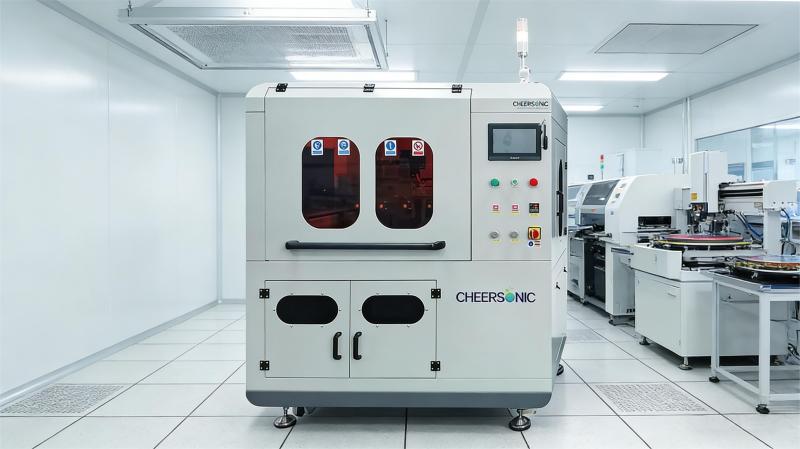
Ultrasonic spraying technology has significant advantages in the coating process of glass based substrates – it can achieve high-precision coating at the micrometer level, with high coating uniformity (thickness deviation<± 5%), low porosity, and can adapt to various coating materials such as metal paste, dielectric resin, flux, etc., especially suitable for substrates with high flatness and precision requirements such as glass based substrates, providing process support for the stability of coating performance.
About Cheersonic
Cheersonic is the leading developer and manufacturer of ultrasonic coating systems for applying precise, thin film coatings to protect, strengthen or smooth surfaces on parts and components for the microelectronics/electronics, alternative energy, medical and industrial markets, including specialized glass applications in construction and automotive.
Our coating solutions are environmentally-friendly, efficient and highly reliable, and enable dramatic reductions in overspray, savings in raw material, water and energy usage and provide improved process repeatability, transfer efficiency, high uniformity and reduced emissions.
Chinese Website: Cheersonic Provides Professional Coating Solutions