
Coating Heparin on Hemodialysis Filtration Membrane
Chronic kidney disease has become an increasingly prominent global public health challenge, affecting approximately 11% to 13% of the global population. According to statistics, there are currently about 3 million end-stage kidney disease patients receiving kidney replacement therapy to maintain their lives, and it is expected that this number will climb to 10 million by 2030. Renal dysfunction leads to the accumulation of metabolic waste (i.e. uremic toxins) in the body, which should be normally excreted by the kidneys in a healthy state. Blood purification therapy (HD) is a key medical method for treating this type of disease, which can effectively remove accumulated uremic toxins and excess water while retaining important components in the blood. As a core component of purification equipment, the performance of blood dialysis filtration membrane directly determines the effectiveness and efficiency of treatment. This type of membrane material can filter out water-soluble toxins with a molecular weight below 500 Da in the patient’s blood, as well as larger toxin molecules with a molecular weight between 500 and 32000 Da. Among them, the removal of medium molecular weight toxins (with a molecular weight of about 350 to 50000 Da) has always been one of the technical difficulties. In addition, in terms of improving blood purification performance, filter membranes still face many challenges in terms of flux performance, toxin clearance rate, blood compatibility, and material dissolution.
Structure and performance characteristics of filter membrane
The ultrafiltration membrane used for blood dialysis filtration mainly adopts a hollow fiber structure, which can be divided into cellulose (natural source) and synthetic polymer based on the material source. Cellulose membrane was the main material for early hollow fiber blood filters, but its application in the market gradually decreased due to its limited blood compatibility and flux performance. To overcome the limitations of such materials, various synthetic polymer membranes have been developed for the dialysis field, including polymethyl methacrylate, polyacrylonitrile, polyester polymers, and polysulfone materials. Among these materials, filter membranes based on polysulfone materials have gradually become the mainstream choice for clinical dialysis due to their lower patient mortality rate and better blood compatibility. Currently, about 90% of hemodialysis membranes are made of this type or its derivatives.
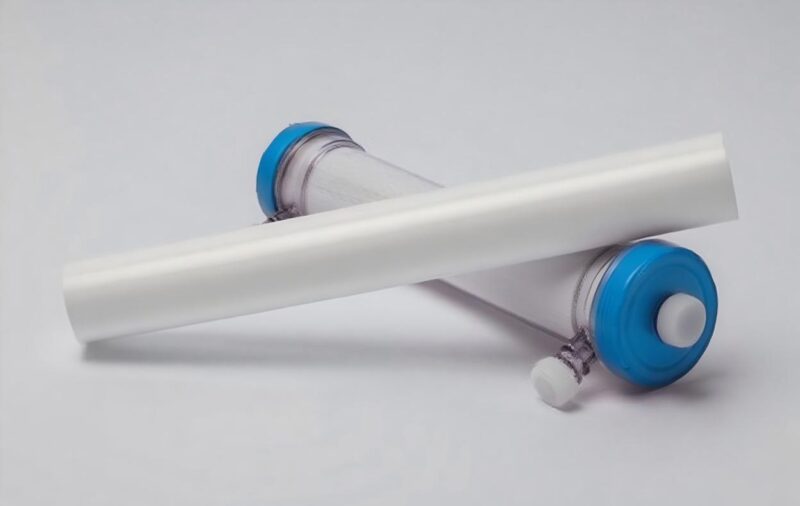
The permeation flux and retention performance of membranes are often difficult to balance, and the two often exhibit a trade-off relationship. An important requirement for current filtration membranes is to enhance their ability to remove medium molecular weight toxins while increasing dialysis flux. The membrane structure has the most significant impact on water permeability, with the flux of ultrafiltration membranes proportional to the fourth power of the average pore size. Therefore, small changes in pore size can significantly affect water permeability. However, increasing the pore size often reduces the membrane’s retention rate of toxins. Therefore, the rational design and regulation of membrane microstructure is the key to balancing flux and retention performance. When preparing hollow fiber ultrafiltration membranes, polysulfone materials usually use a dry spray wet spinning process based on non solvent induced phase separation. In this process, additives play a crucial role in regulating the microstructure of the membrane. Due to the differences in Hansen solubility parameters and molecular weight, the phase transition rates of different additives in polymer solutions vary, resulting in the formation of diverse pore structures.
In addition, core liquid parameters, coagulation bath conditions, pore fluid flow rate, air gap length, and winding speed are all important means of regulating membrane structure. Among them, the setting of air gap is particularly crucial for controlling the membrane morphology, and the reasonable selection of air gap conditions can help improve the separation performance of the membrane.
Biocompatibility and dissolution behavior of filter membranes
Currently, blood purification therapy tends to prolong the contact time between the patient’s blood and the filter membrane, such as implementing nighttime dialysis. Therefore, membrane materials with good selectivity, anti pollution, and long-term stable blood compatibility are needed. Improving the hydrophilicity of the membrane helps to reduce protein adsorption when it comes into contact with blood, thereby enhancing its anti fouling ability and blood compatibility. Common modification methods include blending modification, surface coating, and grafting modification.
Heparin has become the most widely used hydrophilic modified substance due to its excellent anticoagulant properties. In addition, substances such as tannic acid and dopamine have been shown to significantly reduce the contact angle of the membrane and enhance its hydrophilic properties.
In practical applications, in addition to focusing on the improvement effect of hydrophilic modification on membrane stability, it is also necessary to comprehensively consider the feasibility of industrial implementation. Based on this, blending modification has more advantages due to its simple process. Common blending additives include polyvinylpyrrolidone or polyethylene glycol. For example, the introduction of polyvinylpyrrolidone can significantly improve the hydrophilicity of the membrane, reducing the contact angle of certain polymer membranes from 88 ° to 51 °. However, during the ultrafiltration process, blood flow and the resulting shear force may cause the physically blended hydrophilic additives to be eluted from the membrane matrix. If these eluents accumulate in internal organs, they may pose potential risks such as allergies or anaphylactic shock. To reduce the elution of additives, gamma rays can be used to crosslink polyvinylpyrrolidone, thereby reducing its release during long-term dialysis. Another study has prepared a blood dialysis filtration membrane with good anti fouling and blood compatibility by introducing polyvinylpyrrolidone and vinyltriethoxysilane into a polymer solution for in-situ crosslinking polymerization, combined with non solvent induced phase separation technology. The modified membrane material exhibits lower protein adsorption and dissolution. On the other hand, using large molecule based amphiphilic copolymers as additives is also an effective strategy to reduce dissolution. The amphiphilic copolymers currently being studied include poly (vinylpyrrolidone) – block poly (methyl methacrylate) – block poly (vinylpyrrolidone), poly (dimethylsiloxane) – block methoxy polyethylene glycol, polysulfone polyethylene oxide random copolymers, as well as brush copolymers of polyethylene glycol and polydimethylsiloxane.
Furthermore, bulk modification of film-forming polymers can effectively suppress dissolution behavior. For example, zwitterionic modified polyether sulfones, polyethylene glycol polysulfone polyethylene glycol block copolymers, etc. have been shown to reduce dissolution to a certain extent. It is worth noting that in amphiphilic copolymers, hydrophilic segments tend to migrate to the membrane surface during phase separation, effectively inhibiting protein and platelet adsorption and adhesion through post-treatment methods such as selective swelling. Therefore, amphiphilic block copolymers are considered one of the ideal materials for achieving precise separation and high-performance filtration membranes.
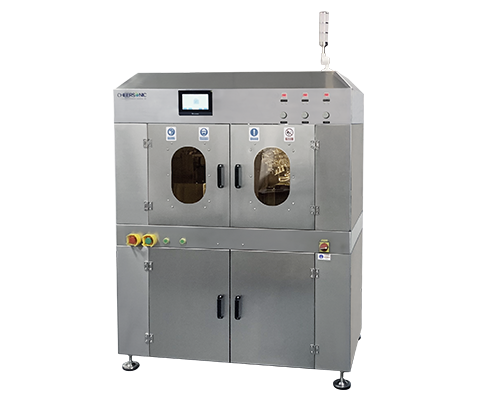
Ultrasonic coating equipment is used to coat heparin on ultrafiltration membranes for hemodialysis filtration
Ultrasonic coating equipment is a key technology for solving coagulation problems in hemodialysis ultrafiltration membranes, with significant advantages compared to traditional methods such as immersion coating and spray coating. It generates 1-50 micron droplets through high-frequency vibration at 20-40kHz, forming a uniform heparin coating with a deviation of ± 5% on the membrane surface. The drug utilization rate exceeds 95%, and the low-temperature process can retain the biological activity of heparin.
In terms of process, it is necessary to first modify the polysulfone/polyether sulfone membrane plasma to enhance the binding force, and then adjust the spraying distance of 10-30cm and the flow rate of 0.1-2mL/min. After low-temperature drying, the coating can prolong the dynamic clotting time (PTT) by 2-3 times. Preclinical data shows that this coating can reduce platelet adhesion by 60% -80%, thrombus formation by over 86%, and does not require systemic anticoagulation, reducing the risk of bleeding.
The current challenge lies in balancing coating and membrane pore patency (overcoating or reducing water flux by 10% -20%), and the initial cost of the equipment is relatively high. In the future, it is necessary to optimize the process to achieve scale, in order to promote it as the core preparation technology for anticoagulant dialysis membranes.
About Cheersonic
Cheersonic is the leading developer and manufacturer of ultrasonic coating systems for applying precise, thin film coatings to protect, strengthen or smooth surfaces on parts and components for the microelectronics/electronics, alternative energy, medical and industrial markets, including specialized glass applications in construction and automotive.
Our coating solutions are environmentally-friendly, efficient and highly reliable, and enable dramatic reductions in overspray, savings in raw material, water and energy usage and provide improved process repeatability, transfer efficiency, high uniformity and reduced emissions.
Chinese Website: Cheersonic Provides Professional Coating Solutions