
Catalyst Coating Process onto Membrane
Catalyst Coating Process onto Membrane – Catalyst Deposition – Cheersonic
In the field of new energy device fabrication, ultrasonic spraying technology, leveraging its precision and controllability, has emerged as a core solution for efficient deposition of catalyst coatings on membrane substrates. It is widely applied in pivotal scenarios such as fuel cells and hydrogen production via water electrolysis. This technology utilizes high-frequency acoustic energy to achieve fine atomization and uniform deposition of catalyst slurry, effectively overcoming the bottlenecks associated with traditional spraying processes.
The core principle of this technology is to utilize piezoelectric transducers to convert high-frequency sound waves into mechanical energy, enabling the catalyst slurry to form a uniform liquid film at the nozzle and break down into micron-sized droplets. Guided by a low-pressure airflow, these droplets are precisely deposited onto the membrane surface (such as proton exchange membranes, water electrolysis membranes, etc.). Compared to traditional high-pressure spraying, this technology avoids droplet splashing and damage to the membrane substrate, achieving the preparation of ultra-thin coatings at the nanoscale, with the coating thickness deviation controlled within ±5%.
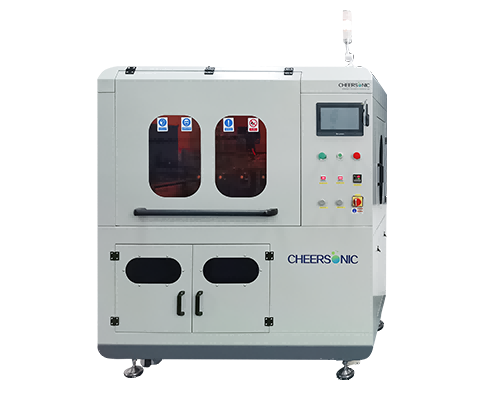
The technological advantages are particularly significant: Firstly, the material utilization rate is high, with directional droplet delivery achieving a utilization rate of over 80%, a 50% improvement compared to traditional processes, significantly reducing the consumption cost of precious metal catalysts such as platinum and iridium. Secondly, the coating uniformity is excellent, enabling the formation of a continuous and dense catalytic layer, ensuring consistency in the three-phase reaction interface of the membrane electrode, and enhancing the power density and stability of the device. Thirdly, the process is flexible and controllable, allowing precise regulation of thickness ranging from 10nm to 10μm by adjusting parameters such as ultrasonic power and spraying speed, thus adapting to different membrane substrate requirements.
The standard process comprises four key steps: firstly, the catalyst, binder, and dispersant are mixed in proportion and subjected to ultrasonic dispersion to form a non-agglomerated slurry; secondly, the membrane substrate undergoes dust removal and plasma pretreatment to enhance surface adhesion; thirdly, parameters such as ultrasonic power ranging from 50 to 150W and spraying speed between 5 and 20mm/s are set, and spraying is completed at a substrate temperature of 45-60℃; finally, drying, curing, and hot pressing treatments are carried out to achieve a firm composite of the catalytic layer and the membrane.
This technology has now become a key preparation process for core components such as membrane electrodes for proton exchange membrane fuel cells and hydrogen production devices through water electrolysis, significantly enhancing device performance and mass production consistency. In the future, with the development of the new energy industry, its application potential in areas such as carbon dioxide electroreduction and sensor preparation will be further unleashed, providing core technical support for the preparation of high-end energy materials.
About Cheersonic
Cheersonic is the leading developer and manufacturer of ultrasonic coating systems for applying precise, thin film coatings to protect, strengthen or smooth surfaces on parts and components for the microelectronics/electronics, alternative energy, medical and industrial markets, including specialized glass applications in construction and automotive.
Our coating solutions are environmentally-friendly, efficient and highly reliable, and enable dramatic reductions in overspray, savings in raw material, water and energy usage and provide improved process repeatability, transfer efficiency, high uniformity and reduced emissions.
Chinese Website: Cheersonic Provides Professional Coating Solutions