
Application of Fuel Cell Catalyst Layer and Ultrasonic Spraying Technology
As a highly efficient and clean energy conversion device, the performance and lifespan of a fuel cell directly determine its commercial viability. The catalyst layer, as a core component of the fuel cell, is a key factor influencing these two critical indicators. The quality of the catalyst layer depends not only on the selected catalytic material itself but also on its microstructure design. Only a catalyst layer with uniformity, good dispersion, and efficient mass transfer capabilities can fully utilize the activity of the catalytic material, improve the energy conversion efficiency of the fuel cell, and extend its long-term stable operating life.

Uniformity is a fundamental requirement for the catalyst layer, meaning that the catalytic material can be evenly distributed throughout the coating, avoiding localized areas of excessively high or low concentration. If the catalyst layer is unevenly distributed, areas with excessively high concentrations are prone to overly vigorous reactions and heat accumulation, accelerating material aging; while areas with excessively low concentrations cannot effectively participate in the electrochemical reaction, leading to a decline in the overall performance of the fuel cell and even localized failure. Good dispersion ensures that the catalytic particles maintain an appropriate spacing, preventing particle agglomeration, maximizing the specific surface area of the catalytic material, and exposing more active sites to the reaction environment, thereby improving the rate and efficiency of the catalytic reaction.
Besides uniformity and dispersion, the mass transfer efficiency of the catalyst layer is crucial to fuel cell performance. During fuel cell operation, a continuous supply of reactant gases (such as hydrogen and oxygen) and timely removal of reaction products (such as water) are required. This necessitates a catalyst layer with a suitable porous microstructure to provide smooth channels for mass transport. If the mass transfer channels are obstructed, reactant gases cannot reach the active sites in time, and reaction products cannot be smoothly removed, leading to hindered catalytic reactions. This not only reduces power generation efficiency but may also damage the catalyst layer due to product accumulation, shortening the fuel cell’s lifespan. Therefore, designing and fabricating a catalyst layer with an optimized porous structure is one of the core tasks for improving the overall performance of fuel cells.
In the catalyst layer fabrication process, the choice of coating technology is critical, directly determining the microstructure and performance of the catalyst layer. Ultrasonic spraying technology, as a high-precision coating preparation method, effectively solves the problems of uneven coating, particle agglomeration, and unreasonable pore structure inherent in traditional spraying technologies due to its unique working principle, providing a reliable guarantee for the precise preparation of the catalyst layer. This technology utilizes the vibrational energy of ultrasound to break down the catalyst slurry into tiny, uniform droplets. These droplets are then precisely delivered to the substrate surface via airflow, forming a dense and uniform coating.
Compared to traditional spraying techniques, ultrasonic spraying offers precise control over the coating morphology, particularly in the construction of porous microstructures. By adjusting parameters such as ultrasonic frequency, slurry concentration, and spraying speed, the porosity, pore size, and pore connectivity of the coating can be flexibly controlled, thereby creating a porous structure optimal for mass transfer requirements. This optimized porous structure not only ensures rapid diffusion of reactant gases to the catalytic active sites but also allows for the timely removal of moisture generated during the reaction, preventing moisture accumulation and damage to the catalyst layer.
For proton exchange membrane fuel cells (PEMFCs), the flexibility of the catalyst layer is also crucial. During fuel cell operation, the proton exchange membrane undergoes deformation due to temperature changes and humidity fluctuations. Insufficient flexibility in the catalyst layer can lead to cracking and detachment, causing catalyst layer failure and consequently affecting the fuel cell’s lifespan. Catalyst layers prepared using ultrasonic spraying technology can effectively maintain good flexibility while ensuring coating density and mass transfer efficiency through optimized microstructure and bonding methods. This allows the coating to adapt to the deformation of the proton exchange membrane, preventing cracking and further extending the lifespan of the fuel cell.
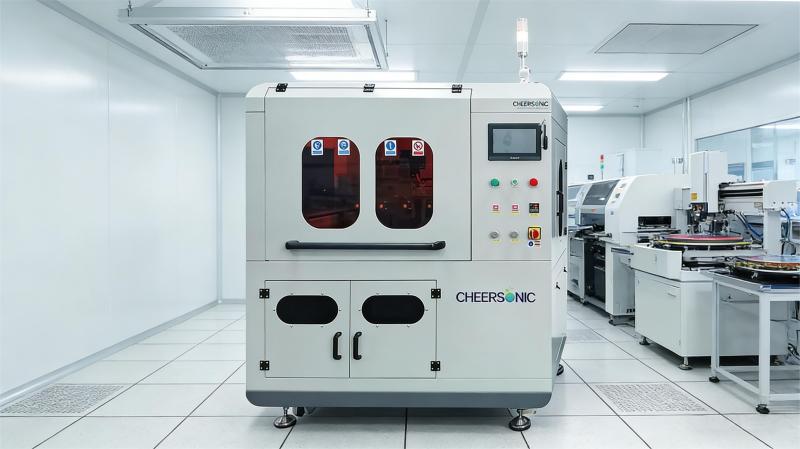
In summary, the uniformity, dispersion, and efficient mass transfer capacity of the catalyst layer are crucial to the performance and lifespan of fuel cells. Ultrasonic spraying technology, with its precise coating control capabilities, can effectively prepare catalyst layers that meet these requirements, especially excelling in constructing optimized porous microstructures and maintaining catalyst layer flexibility. With continuous technological advancements, ultrasonic spraying technology will play an increasingly important role in fuel cell catalyst layer preparation, providing strong support for the commercial application of fuel cells.
About Cheersonic
Cheersonic is the leading developer and manufacturer of ultrasonic coating systems for applying precise, thin film coatings to protect, strengthen or smooth surfaces on parts and components for the microelectronics/electronics, alternative energy, medical and industrial markets, including specialized glass applications in construction and automotive.
Our coating solutions are environmentally-friendly, efficient and highly reliable, and enable dramatic reductions in overspray, savings in raw material, water and energy usage and provide improved process repeatability, transfer efficiency, high uniformity and reduced emissions.
Chinese Website: Cheersonic Provides Professional Coating Solutions