Advantages of Catalyst Spraying onto Membranes
Advantages of Catalyst Spraying onto Membranes – Cheersonic
Ultrasonic spraying technology, with its core advantage of high-frequency ultrasonic atomization, brings process innovation to catalyst preparation, effectively breaking through the pain points of poor uniformity, waste of active components, and weak coating adhesion in traditional coating methods. This technology atomizes the catalyst precursor liquid into uniformly sized micrometer sized droplets, which settle gently without strong droplet impact. It can form ultra-thin, dense, and crack free uniform catalytic coatings on the surfaces of various catalytic carriers such as honeycomb ceramics, metals, and porous carbon.
The spraying process is carried out at low temperature and pressure, which can preserve the catalytic activity of metal active components, enzyme based catalysts and other thermosensitive materials to the greatest extent possible, avoiding component deactivation caused by high temperature. The equipment can accurately control the spray flow rate, atomization frequency, and movement speed, achieving precise control of catalyst loading and coating thickness. The consistency between batches is extremely high, greatly reducing the waste of precious metal catalysts such as platinum and palladium and lowering production costs.
This process is suitable for industrial continuous production and widely used in the preparation scenarios of vehicle exhaust purification catalysts, industrial exhaust gas treatment catalytic materials, fuel cell electrode catalysts, photocatalytic materials, etc. It significantly improves the dispersion of active components, catalytic efficiency, and service life of catalysts, meeting the production requirements of high efficiency, environmental protection, and energy conservation in the modern catalytic field.
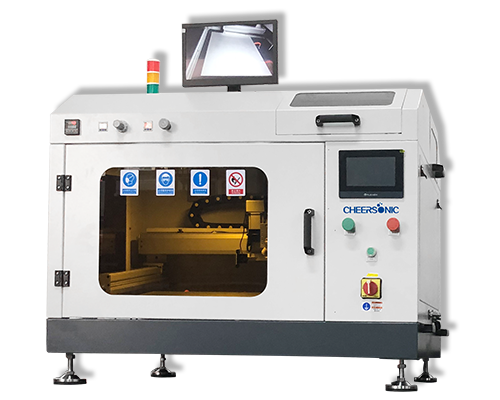
Spraying catalysts onto membranes offers several advantages, including:
1. Uniformity:
Uniform Catalyst Distribution: Spraying technology ensures a uniform distribution of the catalyst on the membrane, forming a homogeneous catalytic layer. This is crucial for efficient catalytic reactions, as a uniform catalyst distribution ensures consistent reaction rates across the membrane surface, improving overall catalytic efficiency and performance. For example, in the membrane electrode assembly (MEA) of a fuel cell, a uniform catalyst coating allows for a more complete reaction between hydrogen and oxygen, enhancing cell performance.
Uniform and Controllable Thickness: The thickness of the catalyst coating on the membrane can be precisely controlled. Depending on the application requirements, the desired catalyst coating thickness can be achieved by adjusting spraying parameters such as spraying speed and the number of sprays. This helps optimize the catalytic reaction while avoiding adverse effects on membrane performance and lifespan due to excessively thick or thin coatings.
2. Production Efficiency:
Rapid Preparation: Spraying is a relatively fast coating method, allowing catalysts to be applied to the membrane quickly, significantly improving production efficiency. Especially for large-scale production, spraying technology enables rapid catalyst coating, meeting market demands.
Applicability to Various Membrane Materials and Shapes:Spray coating technology is suitable for both planar membranes and membranes with complex shapes. For membranes of different materials, good catalyst coating results can be achieved by selecting appropriate catalyst solutions and spray coating processes. This broad applicability gives spray coating technology a significant advantage in catalytic applications for various membrane materials.
3. Cost-Related Advantages:
Simple Equipment: Spray coating requires relatively simple equipment and processes. Compared to other catalyst coating methods, such as chemical vapor deposition, spray coating technology has lower equipment costs, reducing production input costs.
High Material Utilization:Spray coating technology allows for better control of catalyst usage, reducing material waste. Precise spray control ensures uniform catalyst coating on the membrane, avoiding uneven coating that results in localized excessive or insufficient catalyst, thus improving catalyst utilization and reducing material costs.
4. Performance Enhancement:
Excellent Adhesion:The sprayed catalyst forms excellent adhesion to the membrane surface and is not easily detached. This ensures the stability of the catalyst on the membrane, allowing it to maintain good catalytic performance during long-term use. For example, in high-temperature or high-humidity environments, strong adhesion ensures that the catalyst will not detach from the membrane due to environmental factors, guaranteeing the continuous progress of the catalytic reaction.
Multi-layer coating is possible: Multiple layers of catalyst can be sprayed onto the membrane as needed, achieving combinations or gradient distributions of different catalysts. This multi-layer structure can improve the selectivity and efficiency of catalytic reactions, meeting the needs of complex reaction systems. For example, in some photocatalytic reactions, by spraying different photocatalysts in multiple layers, the light absorption range can be broadened, improving photocatalytic efficiency.
About Cheersonic
Cheersonic is the leading developer and manufacturer of ultrasonic coating systems for applying precise, thin film coatings to protect, strengthen or smooth surfaces on parts and components for the microelectronics/electronics, alternative energy, medical and industrial markets, including specialized glass applications in construction and automotive.
Our coating solutions are environmentally-friendly, efficient and highly reliable, and enable dramatic reductions in overspray, savings in raw material, water and energy usage and provide improved process repeatability, transfer efficiency, high uniformity and reduced emissions.
Chinese Website: Cheersonic Provides Professional Coating Solutions