Triclosan Antibacterial Coating Technology for Absorbable Surgical Sutures: Ultrasonic Spray Coating Equipment and Continuous Thread Processing
1. Project Background: Applying Triclosan Coatings to Absorbable Sutures
Absorbable surgical sutures are widely used in medical applications requiring temporary tissue support.
To introduce specific antibacterial functionality, manufacturers may consider incorporating antibacterial active ingredients such as triclosan into coatings applied to the suture surface.
Manufacturing triclosan antibacterial coatings involves formulation development, coating deposition, solvent removal, and product quality validation.
For companies seeking automated production, an ultrasonic spray coating system can be integrated with a continuous thread-processing mechanism to create a coating line for absorbable antibacterial sutures.
The objective is not merely to deposit triclosan on the suture surface but also to control antibacterial agent loading, coating uniformity, material compatibility, and manufacturing repeatability.
2. Basic Composition of Triclosan Antibacterial Coatings
Triclosan is an organic compound with antibacterial activity.
In suture coating formulations, additional components may include film-forming polymers, solvents, or other auxiliary materials.
The specific formulation must be developed according to the suture substrate, antibacterial objectives, and medical device requirements.
2.1 The Role of Triclosan
Triclosan can inhibit bacterial growth by interfering with fatty acid synthesis in certain bacteria.
However, bacterial susceptibility to triclosan varies among microorganisms.
Its antibacterial effectiveness depends on local concentration, exposure time, and release behavior.
2.2 The Role of Film-Forming Polymers
Some coating systems may use polymers to help retain active ingredients on the suture surface.
The film-forming polymer must be compatible with the suture substrate and meet the mechanical and biological requirements of the intended product.
2.3 The Role of the Solvent System
Solvents are used to dissolve or disperse coating components and enable the coating liquid to be delivered through the spray equipment.
Different absorbable polymers have different solvent resistance characteristics. A suitable solvent system must therefore be identified through compatibility testing.
A general-purpose organic solvent formulation should not be applied directly to all types of absorbable sutures.
3. Why Consider Ultrasonic Spray Coating?
Ultrasonic spray coating uses high-frequency vibration at the nozzle to atomize a liquid. A controlled gas stream then directs the droplets toward the target substrate.
Compared with conventional dip coating, ultrasonic spray coating can control coating liquid input through a precision delivery system and adjust deposition through spray path, line speed, and number of coating passes.
For triclosan-coated absorbable sutures, potential benefits include:
- Precision liquid delivery.
- Support for multiple thin-layer deposition passes.
- Integration with continuous thread-processing systems.
- The ability to investigate different coating loadings.
- Easier establishment of recordable and repeatable process parameters.
However, for thin sutures, spray droplet capture efficiency may be relatively low, and actual deposition must be measured experimentally.
4. Components of an Ultrasonic Antibacterial Suture Coating System
4.1 Precision Unwinding System
The unwinding system continuously feeds the untreated suture into the coating process.
It must prevent excessive stretching, tangling, and surface damage.
4.2 Tension Control System
Tension stability directly affects thread positioning and coating repeatability.
For absorbable sutures of different diameters and materials, an appropriate tension range should be established based on actual mechanical properties.
4.3 Ultrasonic Spray Coating Module
The coating module includes an ultrasonic nozzle, precision liquid delivery system, and necessary gas-flow control components.
Single-nozzle, multi-nozzle, or multi-angle spray configurations can be investigated according to suture diameter and spray coverage.
4.4 Drying System
The drying system removes volatile components from the coating liquid.
Temperature, residence time, and exhaust conditions must be compatible with the suture material and coating formulation.
4.5 Rewinding System
The rewinding system must maintain stable tension and prevent insufficiently dried coatings from contacting guide rollers or adjacent suture sections in ways that create defects.
4.6 Control and Inspection System
Depending on process requirements, the system can monitor line speed, liquid flow rate, tension, drying temperature, and equipment operating conditions.
Offline or online coating quality inspection can be added where necessary.
5. Continuous Ultrasonic Spray Coating Process for Triclosan Coatings
Step 1: Confirm the Suture Substrate
First, identify the absorbable suture’s polymer type, diameter, monofilament or braided structure, surface condition, and allowable processing conditions.
Different substrates may require different surface treatments and coating formulations.
Step 2: Develop the Coating Solution
Develop a coating solution containing triclosan and suitable carrier materials according to the intended antibacterial functionality.
Important factors include solution stability, solvent compatibility, viscosity, and suitability for spraying.
Step 3: Conduct Ultrasonic Atomization Tests
Deliver the coating liquid to the ultrasonic nozzle and observe atomization stability, spray characteristics, and any clogging or abnormal deposition.
At this stage, compatibility between the equipment and liquid formulation should be confirmed before formal suture coating trials.
Step 4: Perform Continuous Thread Spray Coating
Feed the suture through the tension control system and into the spray region.
Control line speed, liquid delivery, and spray angle to deposit the coating liquid onto the suture surface.
For cylindrical sutures, circumferential coverage uniformity is particularly important.
If spraying from one direction does not provide adequate coverage, multi-angle spraying or multiple coating stations can be investigated.
Step 5: Apply Controlled Drying
After spraying, the coated suture undergoes controlled drying.
The drying process must balance adequate solvent removal with protection of the absorbable polymer.
Excessive heating may affect suture performance, while insufficient drying may cause coating adhesion between adjacent thread sections or unacceptable residual solvent levels.
Step 6: Rewind and Inspect the Coated Sutures
After coating, the suture is rewound, and representative samples are collected for analysis.
Depending on product design requirements, coating loading, uniformity, adhesion, antibacterial activity, and mechanical properties should be evaluated.
6. Key Factors Affecting Triclosan Coating Quality
6.1 Suture Diameter and Surface Structure
Fine sutures require more precise spray positioning and careful attention to material utilization.
Braided sutures also require consideration of coating liquid penetration into the spaces between fibers.
6.2 Actual Triclosan Loading
The amount of coating liquid supplied to the spray system is not equal to the mass of triclosan deposited on the suture.
Actual loading must be determined using appropriate analytical methods.
6.3 Circumferential Coating Uniformity
Sutures are cylindrical substrates.
Different sides of the suture should be inspected for significant coating differences or locally uncoated regions.
6.4 Coating Adhesion and Detachment
The coating should maintain appropriate stability under intended processing and use conditions.
For sutures, friction during tissue passage and knot tying must also be considered.
6.5 Substrate Mechanical Properties
Coating and drying must not cause unacceptable reductions in tensile strength or undesirable changes in flexibility and knot performance.
6.6 Triclosan Release and Antibacterial Effectiveness
Triclosan release behavior may be influenced by coating materials, coating thickness, substrate structure, and environmental conditions.
Appropriate testing should be conducted according to the intended product application.
7. How Should the Ultrasonic Spray Coating Process Be Validated?
A three-stage validation approach is recommended.
Stage 1: Coating Feasibility
Confirm that the coating liquid can be atomized consistently, the suture can move continuously through the spray region, and the coating can be dried under the specified conditions.
Stage 2: Coating Quality
Evaluate coating consistency through loading analysis, microscopic inspection, mechanical testing, and other appropriate methods.
Stage 3: Medical Device Performance
Conduct antibacterial activity testing, biocompatibility evaluation, sterilization compatibility studies, packaging stability assessment, and other necessary validation activities according to the product’s intended use.
These evaluations should align with applicable medical device regulations and quality management requirements.
8. How Should Ultrasonic Spray Coating and Dip Coating Be Compared?
Both dip coating and ultrasonic spray coating may be feasible manufacturing methods for triclosan-coated absorbable sutures.
Dip coating generally facilitates complete wetting of the suture but may produce greater liquid penetration and requires careful control of excess liquid removal and drying.
Ultrasonic spray coating allows manufacturers to investigate coating loading through precision liquid delivery and multiple thin-layer deposition passes, but it must address droplet capture efficiency and circumferential coverage on small-diameter sutures.
Comparative sample testing is recommended using the same suture material and target coating loading.
Evaluation criteria may include coating uniformity, antibacterial agent loading, material utilization, drying time, mechanical properties, and process repeatability.
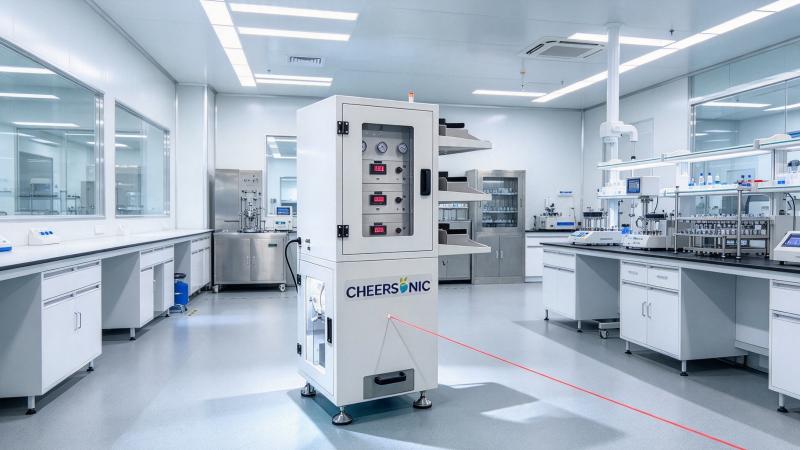
9. Cheersonic Ultrasonic Spray Coating Equipment for Antibacterial Sutures
For medical device manufacturers developing triclosan-coated absorbable sutures, an ultrasonic spray coating system integrated with continuous thread-processing equipment may be considered.
Depending on project requirements, the equipment concept may include:
- Precision liquid delivery and ultrasonic spray coating modules.
- Continuous suture unwinding and rewinding systems.
- Low-tension thread transport mechanisms.
- Multi-angle spray coating stations.
- Controlled drying and solvent exhaust systems.
- Process parameter recording and quality inspection interfaces.
The equipment configuration should be developed according to the suture material, diameter, coating formulation, target loading, and production speed rather than relying on unverified universal process parameters.
Cheersonic can discuss antibacterial suture coating projects with customers and evaluate the feasibility of ultrasonic spray coating through sample coating trials.
For more information about coating equipment solutions, visit:
Conclusion
Triclosan antibacterial coating on absorbable surgical sutures is a multidisciplinary technology involving polymer materials, antibacterial active ingredients, precision coating, and medical device quality control.
Integrating ultrasonic spray coating equipment with continuous thread-processing systems provides a manufacturing approach worth investigating for automated antibacterial suture coating.
Through appropriate coating formulation development, process optimization, and sample validation, manufacturers can further evaluate whether this technology meets their product quality and production requirements.