
Ultrasonic Spray Coating Machine for Microfluidic Adhesive
Ultrasonic Spray Coating Machine for Microfluidic Adhesive
In core fields such as microfluidic chip manufacturing, bio-microreactor fabrication, and MEMS device processing, microfluidic adhesives, with their excellent high aspect ratio, high temperature and chemical resistance, and outstanding molding precision, have become core consumables for the fabrication of high-end microfluidic devices. They are also key supports for realizing complex microchannel structures and high-precision mold forming. Microfluidic adhesives are epoxy resin-based negative photoresists, specifically designed for microfluidics and soft lithography processes. They utilize a high-purity resin system and a special solvent ratio, offering a wide viscosity range. A single coating can achieve a layer thickness of 1-200μm, compatible with i-line (365nm) light source exposure. After exposure, they can form a high aspect ratio structure with vertical sidewalls. After curing, the adhesive film is dense and hard, possessing extremely strong acid and alkali resistance and etching resistance, while also exhibiting good substrate adhesion. It is compatible with various substrates such as silicon wafers, glass, and polymers, and is widely used in high-precision applications. Microfluidic adhesives are particularly suitable for high-end manufacturing applications requiring extremely high uniformity and structural precision in applications such as microfluidic chips, bioreactors, PDMS mold fabrication, and dry etching masks. These applications place stringent demands on the accuracy and gentleness of the spraying process. Cheersonic ultrasonic spraying machines, with their core advantages of high precision, low damage, and high adaptability, perfectly meet the needs of microfluidic adhesive spraying, providing core equipment support for improving the quality and efficiency of related processes and achieving large-scale mass production.
The characteristics of microfluidic adhesives and the requirements of microfluidic and soft lithography processes place extremely stringent standards on spraying equipment. As a high-performance negative photoresist, microfluidic photoresist undergoes a cross-linking reaction after exposure and post-baking to form a stable film insoluble in the developer. Its core coating requirements focus on three main aspects: First, a uniform and dense coating is required, necessitating precise control of the film thickness to accommodate a wide coating range of 1-200μm with a deviation ≤±0.1μm and uniformity exceeding 98%. Defects such as pinholes, bubbles, and slurry agglomeration must be avoided—these defects can lead to uneven heating and exposure during baking, affecting the film polymerization rate and compromising the precision of the microfluidic channels and the integrity of the mold. Simultaneously, a smooth film surface is essential to meet the requirements for high aspect ratio structure fabrication and prevent structural deviations during subsequent PDMS replication. Second, low damage and low stress are crucial for micro-coating. Microfluidic adhesives have high viscosity and are sensitive to impact and high temperatures. The spraying process must be gentle and non-impact, avoiding damage to the adhesive’s molecular structure and substrate adhesion. This prevents cracking and peeling during development and curing, and avoids pinholes and orange peel defects caused by rapid solvent evaporation. It also improves the wetting performance of the adhesive film on various substrates, preventing edge shrinkage. Thirdly, it is precise and controllable, enabling selective coating and accurate adaptation to substrates of different sizes and non-planar or textured wafers. It eliminates coating buildup, adapts to its high viscosity characteristics and the requirements of the entire soft lithography process, balances coating efficiency and process consistency, and meets semiconductor clean production standards, avoiding the introduction of impurities that could affect film quality and subsequent process stability.
Traditional microfluidic adhesive spraying processes (spin coating, air spraying, manual coating) have many shortcomings and are difficult to adapt to its characteristics and the needs of large-scale mass production. While spin coating can achieve a certain degree of uniformity, it is only suitable for planar wafers, with a material utilization rate of less than 5%, resulting in over 95% waste of the microfluidic adhesive. It is also prone to the “edge bead effect,” causing edge thickening, making it unsuitable for non-planar substrates and complex microstructures. High-speed rotation can exacerbate adhesive layer stress, leading to cracking during curing and failing to meet the precision requirements of high aspect ratio structures. Air spraying relies on high-pressure airflow atomization, resulting in uneven droplet size, pinholes, and bubbles. High-pressure impact can damage the adhesive layer’s density, and dilution is required for good coverage. It also lacks precise thickness control, resulting in poor uniformity and making it unsuitable for thick adhesive coatings. Furthermore, high-pressure airflow can introduce impurities, affecting film cleanliness. Manual coating is inefficient, producing poor coating uniformity and consistency, prone to missed areas and build-up, and prone to substrate contamination. It is only suitable for small-batch laboratory research and development, unsuitable for large-scale mass production, and cannot guarantee product consistency.
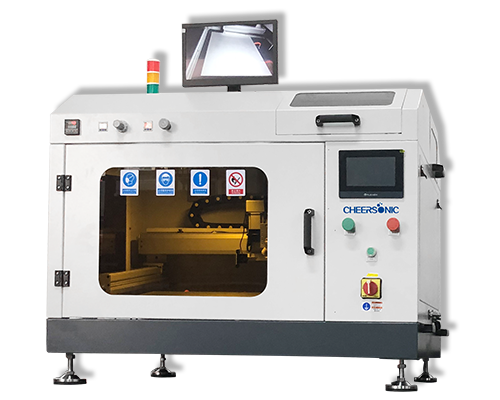
Cheersonic ultrasonic spray coating machine addresses the characteristics and process challenges of microfluidic adhesives by leveraging its core high-frequency atomization technology for specialized optimization. It combines key aspects of microfluidics and soft lithography processes to create customized solutions, completely breaking through traditional process bottlenecks. The equipment converts industrial frequency electricity into a 40-150kHz high-frequency electrical signal via an ultrasonic generator, which is then converted into high-frequency mechanical vibration by a piezoelectric ceramic transducer. Utilizing the ultrasonic cavitation effect, it deagglomerates particle clusters in the slurry, avoiding defects such as pinholes and particles caused by agglomerates. Stable atomization is achieved without excessive dilution, forming uniform droplets of 0.1-5 micrometers. The atomized particles are fine and uniform, perfectly suited for wide-range coating applications (1-200μm) and the fabrication of high aspect ratio structures. Guided by a low-pressure carrier gas, droplets gently deposit onto the substrate surface without high-pressure impact or high-temperature generation. This maximizes the preservation of the microfluidic adhesive’s high-temperature resistance, chemical resistance, and high aspect ratio, reducing internal stress in the adhesive layer and avoiding pinholes and orange peel issues caused by rapid solvent evaporation. Simultaneously, it effectively eliminates defects such as pinholes, bubbles, and build-up, improving the adhesion and wetting properties between the adhesive layer and the substrate. This results in a dense, uniform, and smooth high-quality adhesive layer, laying a solid foundation for subsequent processes such as exposure, post-baking, development, and PDMS mold replication.
For the spraying needs of microfluidic adhesives, Cheersonic ultrasonic spraying machines demonstrate four core advantages, helping companies improve mass production quality and efficiency. Firstly, it offers extremely high coating precision, accurately controlling the thickness and distribution of the adhesive layer with a deviation of ≤±2% and uniformity exceeding 98%. This ensures the accuracy of the vertical sidewalls of high aspect ratio structures, adapting to a wide range of coating needs from 1-200μm and improving the yield of microfluidic channels and molds. Secondly, it features low-damage compatibility. Low-pressure, gentle atomization technology avoids damage to the adhesive properties and substrate, reducing adhesive layer stress and avoiding defects such as pinholes and edge shrinkage. It eliminates the need for excessive adhesive dilution, meeting the high viscosity characteristics and clean production requirements, and is suitable for coating non-planar substrates. Thirdly, it boasts high material utilization, exceeding 95%, significantly reducing microfluidic adhesive waste and saving substantial consumable costs compared to traditional spin coating processes, aligning with green and low-carbon production principles. Fourthly, it offers excellent mass production adaptability, supporting automated continuous spraying and cleanroom compatibility. It can seamlessly integrate into large-scale microfluidic and MEMS production lines, adapting to different viscosity grades and various substrates, overcoming the problems of low efficiency, high loss, and poor consistency associated with traditional processes.
Currently, Cheersonic ultrasonic spraying machines are widely used in microfluidic adhesive spraying scenarios, covering core areas such as microfluidic chip manufacturing, PDMS mold preparation, MEMS devices, and bioreactors. This helps companies solve the pain points of traditional spraying processes, achieving improved microfluidic adhesive coating quality and breakthroughs in the mass production of related products. As a leading company in the field of ultrasonic electronic equipment, Cheersonic Ultrasonic has been deeply involved in microfluidic spraying for many years, keeping abreast of industry technology trends and providing customized spraying solutions. These solutions cover the entire process, including equipment selection, process parameter optimization, and slurry adaptation, helping customers fully leverage the core advantages of their microfluidic adhesives. In the future, Cheersonic Ultrasonic will continue to optimize equipment performance to meet the demands of microfluidic processes upgrading to more refined and efficient levels, injecting strong momentum into the high-quality development of the microfluidics and MEMS industries.

About Cheersonic
Cheersonic is the leading developer and manufacturer of ultrasonic coating systems for applying precise, thin film coatings to protect, strengthen or smooth surfaces on parts and components for the microelectronics/electronics, alternative energy, medical and industrial markets, including specialized glass applications in construction and automotive.
Our coating solutions are environmentally-friendly, efficient and highly reliable, and enable dramatic reductions in overspray, savings in raw material, water and energy usage and provide improved process repeatability, transfer efficiency, high uniformity and reduced emissions.
If you have any technical questions, customization demands, or procurement inquiries about ultrasonic atomization nozzles, feel free to contact our professional sales and technical team for detailed parameters, customized solutions, and industry application support.
Email: market2@cheersonic.com
