
Ultrasonic spraying machine for spraying photoresist
Ultrasonic spraying machine for spraying photoresist -Cheersonic
In core fields such as semiconductor lithography, micro-nano fabrication, and MEMS device manufacturing, lithography is the core step in pattern transfer. Development, as a crucial link in the lithography process, directly determines the clarity and integrity of the lithographic pattern, thus affecting the performance and yield of the final product. The core definition of development is the wet chemical treatment of exposed photosensitive material to produce a visible image. Specifically in lithography, this involves selectively removing the exposed photoresist coating through wet chemical treatment, thereby revealing the desired lithographic pattern. The quality of the photoresist coating is deeply intertwined with the development effect. A high-quality photoresist coating is a prerequisite for efficient development and precise pattern formation. Cheersonic ultrasonic spraying machines, with their core advantages of high precision, high uniformity, and low damage, perfectly meet the needs of photoresist spraying, laying a solid foundation for the development process and helping companies improve the efficiency of the entire lithography process.
The core principles and operational logic of the development process require precise control based on the type of photoresist. Positive photoresist development is currently the most widely used development mode in the industry. Taking most positive photoresist as an example, the core principle of development is that the dissolution rate of the exposed photoresist film in a weakly alkaline developer increases by two to three orders of magnitude, resulting in rapid dissolution and removal. Meanwhile, the photoresist in unexposed areas dissolves at a very low rate, remaining intact and ultimately forming a clear lithographic pattern. This selective dissolution characteristic places extremely high demands on the uniformity of the photoresist coating—uneven film thickness, pinholes, or air bubbles will lead to inconsistent dissolution rates during development, resulting in problems such as burrs at the pattern edges, residual photoresist, or over-dissolution, directly affecting lithographic accuracy. Simultaneously, the development process must select an appropriate development method based on the photoresist thickness, substrate type, and pattern accuracy requirements to ensure a balance between development effect and production efficiency.
Depending on how the developer contacts the substrate, the developing process is mainly divided into three categories: immersion developing, spin-spray developing, and wetting developing. Each method is suitable for different photoresist coating scenarios, and their effectiveness depends on a high-quality photoresist coating. Immersion developing is the most basic developing method. The substrate coated with photoresist is immersed in the developer, and the photoresist is selectively dissolved through the immersion penetration of the developer. It is simple to operate and has a low cost, making it suitable for photoresist coating scenarios with thicker thickness and lower pattern complexity. However, it has extremely high requirements for the uniformity of the photoresist layer; if the photoresist layer is uneven, it will lead to uneven development. Spin-spray developing involves rotating the substrate at high speed while spraying the developer. Centrifugal force is used to make the developer uniformly cover the substrate surface. It has high developing efficiency and good uniformity, making it suitable for mid-to-high-end photolithography scenarios. It requires a photoresist coating with uniform thickness and strong adhesion to prevent the photoresist layer from falling off during high-speed rotation. Wetting developing involves wetting the substrate surface with the developer without high-speed rotation, resulting in less damage to the photoresist layer. It is suitable for fragile substrates and thin photoresist coating scenarios. It also depends on the uniformity and density of the photoresist layer to ensure uniform penetration of the developer.
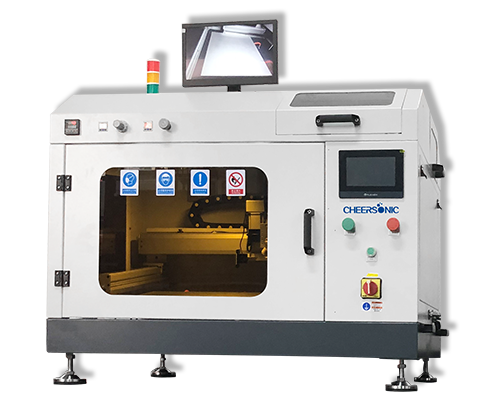
In current photolithography production, traditional photoresist spraying processes (spin coating, air spraying) have many shortcomings, making it difficult to meet the core requirements of the developing process and becoming a bottleneck restricting the developing effect and photolithography yield. Although spin coating can achieve a certain degree of uniformity, the material utilization rate is less than 40%, resulting in a large amount of photoresist being wasted. High-speed rotation can easily aggravate the stress of the photoresist layer, leading to cracking and residual photoresist during development, and it cannot meet the developing requirements of photoresist of different thicknesses. Air spraying relies on high-pressure airflow atomization, resulting in uneven droplet size, which easily produces pinholes and bubbles, leading to inconsistent dissolution rates during development and pattern distortion. High-pressure impact can also damage the photoresist structure, affecting the developing effect. The nozzle is prone to clogging, resulting in high maintenance costs. Manual coating is inefficient, with poor coating uniformity and consistency. After development, it is prone to problems such as uneven edges and excessive residual photoresist, making it only suitable for small-batch research and development in the laboratory and unable to meet the needs of large-scale production.
Cheersonic ultrasonic spray coating machine addresses the core needs of the developing process and the pain points of photoresist spraying. Utilizing high-frequency atomization technology, it has undergone specialized optimization and incorporates customized solutions tailored to the process requirements of various developing methods, providing high-quality photoresist layer support for the developing process. The equipment converts industrial frequency electricity into a 40-150kHz high-frequency electrical signal via an ultrasonic generator, which is then converted into high-frequency mechanical vibration by a piezoelectric ceramic transducer. Utilizing the ultrasonic cavitation effect, it breaks down photoresist particle clusters, avoiding defects such as pinholes and bubbles caused by agglomerates. Stable atomization is achieved without excessive dilution, forming fine droplets of 0.01-3 microns. The atomized particles have high uniformity, allowing for precise control of the photoresist layer thickness and adapting to the different thickness requirements of various developing methods. Guided by low-pressure carrier gas, droplets are gently deposited on the substrate surface. There is no high-pressure impact or high temperature generated throughout the process, which can maximize the preservation of the photoresist’s photosensitive properties and structural integrity, reduce the internal stress of the resist layer, improve the adhesion between the resist layer and the substrate, and form a dense, uniform, and smooth high-quality resist layer. This ensures uniform dissolution rate during development and avoids problems such as residual resist and pattern distortion. It is compatible with three development methods: immersion, spin-jet, and wetting.
Addressing the photoresist coating needs of the developing process, Cheersonic ultrasonic coating machines offer four core advantages, helping companies improve the overall yield of the photolithography process. First, high coating precision: Accurate control over the thickness and distribution of the photoresist layer, with a deviation of ≤±1% and uniformity exceeding 98%, provides a uniform and dense photoresist layer for the developing process, ensuring selective and uniform dissolution during development and improving pattern accuracy. Second, low-damage adaptability: Low-pressure gentle atomization technology avoids damage to the photoresist structure, reduces layer stress, and prevents cracking and peeling. It adapts to photoresist of different thicknesses and various developing methods, meeting diverse production needs. Third, high material utilization: Reaching over 95%, significantly reducing photoresist waste. Combined with optimized developing processes, this further reduces production costs. Fourth, excellent mass production adaptability: Supporting automated continuous coating and cleanroom compatibility, it can seamlessly integrate into large-scale photolithography production lines, working collaboratively with various developing equipment. This solves the problems of low efficiency, high loss, and poor consistency in traditional coating processes, helping to improve developing efficiency and photolithography yield.
Currently, Cheersonic ultrasonic coating machines are widely used in various photoresist coating scenarios, adapting to different developing processes such as immersion developing, spin-spray developing, and wetting developing. They cover core areas such as semiconductor manufacturing, micro-nano fabrication, and MEMS device fabrication, helping companies solve developing problems caused by traditional coating processes and achieving efficient integration of photoresist coating and developing processes. As a leading company in the field of ultrasonic electronic equipment, Cheersonic Ultrasonic has been deeply involved in photolithography coating for many years, keeping abreast of the development trends of developing processes and photolithography technology. It can provide customized coating solutions, covering the entire process from equipment selection and process parameter optimization to adapting photoresist layers to different developing methods, helping customers fully leverage the core efficiency of the developing process. In the future, Cheersonic Ultrasonic will continue to optimize equipment performance to meet the needs of developing processes upgrading to more refined and efficient processes, injecting strong momentum into the high-quality development of my country’s semiconductor and micro-nano fabrication industries.
About Cheersonic
Cheersonic is the leading developer and manufacturer of ultrasonic coating systems for applying precise, thin film coatings to protect, strengthen or smooth surfaces on parts and components for the microelectronics/electronics, alternative energy, medical and industrial markets, including specialized glass applications in construction and automotive.
Our coating solutions are environmentally-friendly, efficient and highly reliable, and enable dramatic reductions in overspray, savings in raw material, water and energy usage and provide improved process repeatability, transfer efficiency, high uniformity and reduced emissions.
If you have any technical questions, customization demands, or procurement inquiries about ultrasonic atomization nozzles, feel free to contact our professional sales and technical team for detailed parameters, customized solutions, and industry application support.
Email: market2@cheersonic.com