
Precision Coating Equipment for Drug-Coated Balloons and Coronary Stent Development
Ultrasonic Balloon Catheter Coating System: Precision Coating Equipment for Drug-Coated Balloons and Coronary Stent Development
1. Product Overview: What Is an Ultrasonic Balloon Catheter Coating System?
An Ultrasonic Balloon Catheter Coating System is a precision coating equipment solution designed for surface coating applications involving medical devices.
The system can be used to investigate the controlled deposition of drug coatings onto balloon catheter surfaces. Depending on its configuration, it may also be adapted for other cardiovascular interventional devices, including coronary stents.
For companies developing drug-coated cardiovascular medical devices, ultrasonic spray coating offers a precision deposition technology worth evaluating.
Typical applications include:
- Paclitaxel-coated balloon catheters.
- Drug-coated balloons (DCBs).
- Drug-eluting stents (DESs).
- Sirolimus and other limus-based drug-eluting stents.
- Functional drug coatings on cardiovascular interventional devices.
- Coating formulation screening and prototype preparation during medical device development.
For research-oriented customers, the value of the equipment extends beyond simply applying a coating solution to a device surface.
It also provides a platform for investigating the relationship between coating parameters and final product quality.
2. Why Do Drug-Coated Balloons Require Precision Coating Equipment?
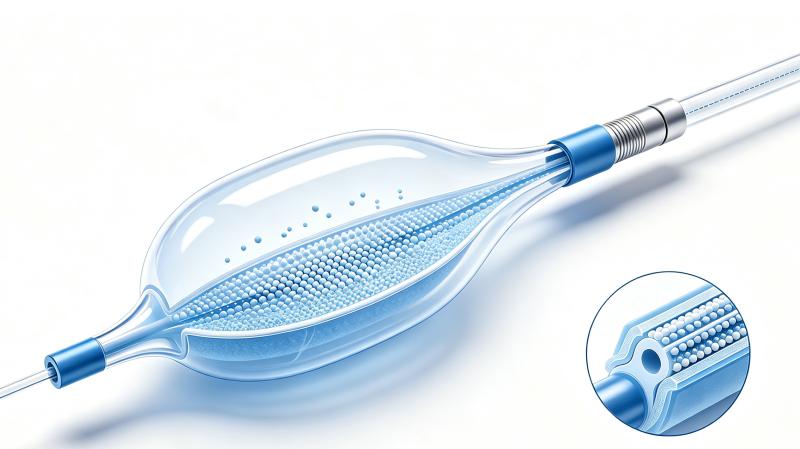
A drug-coated balloon is a vascular interventional device with a drug-containing coating on its balloon surface.
In certain clinical applications, the coating is designed to transfer drug to the target tissue during balloon inflation.
Therefore, balloon coatings must be evaluated not only for drug loading but also for their behavior during device delivery, folding, inflation, and contact with the target tissue.
For paclitaxel-based balloon coatings, developers typically investigate several important factors.
2.1 Drug Loading Control
The amount of drug deposited onto the balloon must meet the intended product design requirements.
During development, researchers can investigate how coating solution concentration, liquid delivery rate, and number of spray passes influence drug loading per unit area.
However, actual drug loading must be measured using an appropriately validated analytical method. It cannot be determined solely from the amount of liquid supplied by the coating equipment.
2.2 Coating Uniformity
A balloon catheter is a flexible device with a curved surface.
Coating distribution may be influenced by balloon geometry, rotation, spray distribution, and drying conditions.
Particular attention may be required for the balloon body, shoulders, ends, and different circumferential positions.
2.3 Coating Adhesion and Particle Shedding
The drug coating must maintain appropriate integrity during the intended handling and delivery process.
For drug-coated balloons, the coating must retain sufficient drug during delivery while enabling the intended drug transfer at the treatment site.
These two requirements may involve important formulation and process trade-offs.
2.4 Drying and Drug Solid-State Properties
Drying conditions may influence the solid-state form, crystallization behavior, and surface microstructure of the drug.
For paclitaxel coatings, such changes may affect mechanical stability and drug transfer behavior.
Therefore, drying should be considered an important part of drug coating development rather than simply a solvent removal step.
3. How Does Ultrasonic Spray Coating Work for Balloon Catheters?
Ultrasonic spray coating uses high-frequency vibration at the nozzle to atomize a suitable coating liquid into droplets.
A controlled gas flow then directs the droplets toward the target surface.
For balloon coating applications, the equipment can combine a precision liquid delivery system, balloon rotation mechanism, and programmable motion platform to investigate controlled deposition.
3.1 Precision Coating Solution Delivery
A metering system controls the amount of coating solution supplied to the nozzle.
Researchers can investigate the influence of liquid delivery rate on coating loading and uniformity.
3.2 Balloon Rotation and Nozzle Movement
The balloon rotates while the nozzle moves relative to its surface, allowing the spray to cover the intended coating region.
Rotation speed, axial scanning speed, and spray path can be adjusted as process development variables.
3.3 Multiple Thin-Layer Spray Passes
For compatible formulations, multiple thin-layer spray passes can be investigated to gradually achieve the target drug loading.
However, subsequent passes may rewet previously deposited material, so spray passes and drying conditions must be optimized together.
3.4 Controlled Drying
Appropriate drying conditions should be investigated based on the compatibility of the drug, excipients, solvents, and balloon substrate.
Unvalidated high temperatures or excessive airflow should be avoided because they may affect drug properties or balloon materials.
4. Can the System Also Be Used for Coronary Drug-Eluting Stents?
Some customers developing drug-coated balloons also need to investigate drug coatings for coronary stents.
Coronary stents typically have complex mesh-like structures.
Their coatings must cover the intended strut surfaces while avoiding undesirable bridging, accumulation, and other coating defects.
For limus-based drug-eluting stents, formulations may contain an active drug, polymer carrier, and solvent system.
Typical research objectives include:
- Drug and polymer loading on stent surfaces.
- Coating coverage across stent struts.
- Coating thickness and surface morphology.
- Coating adhesion and mechanical durability.
- Drug release behavior.
- Coating integrity after stent crimping and expansion.
Balloon catheters and coronary stents require different holding, rotation, and coating configurations.
Therefore, equipment intended for both applications may require dedicated fixtures, motion control arrangements, and process settings.
A system capable of coating balloons should not automatically be assumed to meet all stent coating requirements without modification.
5. Recommended Equipment Configuration for R&D Applications
For customers primarily focused on research, process development, and prototype production, the following equipment capabilities should be considered.
Precision Low-Flow Liquid Delivery
Supports investigation of different coating solution concentrations and liquid delivery conditions.
Programmable Rotation and Scanning
Allows researchers to investigate balloon or stent rotation speed, spray distance, scanning speed, and number of coating passes.
Interchangeable Device Fixtures
Accommodates balloon catheters and stents with different lengths, diameters, and structures.
Formulation Compatibility Assessment
Evaluates the suitability of wetted components, nozzles, and sealing materials for the selected drugs, excipients, polymers, and solvents.
Process Parameter Recording
Records key experimental conditions to support process comparison and repeatability studies.
Appropriate Safety and Environmental Controls
Depending on the hazards associated with the drug and solvent system, appropriate local exhaust ventilation, enclosure, solvent vapor management, and operator protection should be considered.
An R&D coating system is not automatically a GMP-qualified manufacturing system.
If the equipment will eventually be used for regulated medical device production, equipment qualification, process validation, and quality management requirements must be addressed according to the intended application.

6. Why Should R&D Customers Start with Ultrasonic Spray Coating Trials?
For companies still screening drug formulations and developing coating processes, immediately selecting large-scale production equipment may introduce unnecessary uncertainty.
A more practical development approach is to proceed through several stages.
Stage 1: Confirm whether the drug coating formulation is suitable for ultrasonic atomization.
Stage 2: Evaluate coating coverage on representative balloon or stent surfaces.
Stage 3: Investigate the relationship between drug loading, coating uniformity, and drying conditions.
Stage 4: Evaluate samples through appropriate adhesion, particle shedding, drug release, or drug transfer testing.
Stage 5: Once a suitable process window has been established, investigate repeatable prototype production.
This approach helps customers identify material and process risks before scaling up.
7. Cheersonic Ultrasonic Balloon Catheter Coating System
For customers developing paclitaxel-coated balloons and limus-based coronary drug-eluting stents, Cheersonic ultrasonic spray coating equipment can be considered as a candidate platform for R&D and process development.
Customers are encouraged to provide:
- Balloon or stent dimensions and structure.
- Drug type and coating formulation.
- Solvent system and relevant safety requirements.
- Target drug loading.
- Number of samples required per experiment.
- Process parameters to be investigated.
- Future prototype production requirements.
Based on this information, nozzle selection, liquid delivery, motion control, device fixtures, and drying configurations can be discussed.
Learn more about Cheersonic coating equipment solutions:
https://cheersonic-liquid.com/en/ultrasonic-coating-equipment-solutions/
Conclusion
An Ultrasonic Balloon Catheter Coating System can provide a precision coating platform for the development of drug-coated balloons and coronary drug-eluting stents.
Its primary value lies in helping researchers investigate the relationship between drug loading, coating uniformity, drying behavior, and final coating quality.
For customers focusing on R&D, process development, optimization, and prototype production, feasibility testing with representative formulations and device samples is recommended before selecting the final equipment configuration.
