
Analysis of Mainstream Flow Battery Technologies and Key Characteristics
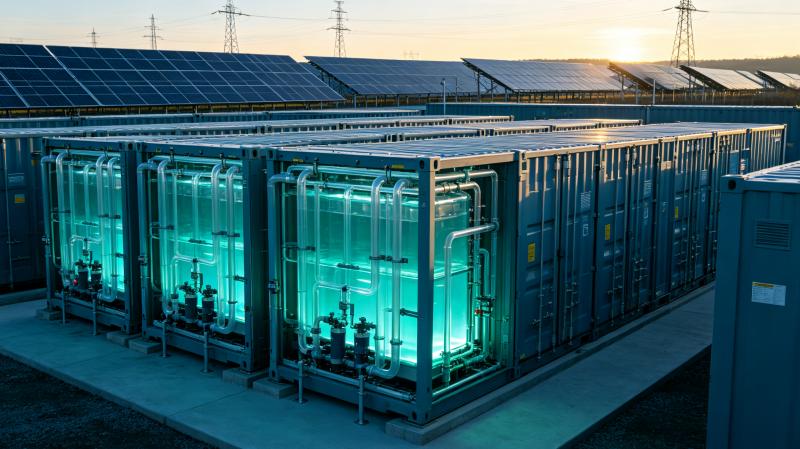
Flow batteries are a type of large-scale energy storage technology based on the electrochemical reactions of redox couples. Their core principle involves dissolving active materials in an electrolyte and circulating the fluid between the battery stack and storage tanks to achieve the reversible conversion of electrical and chemical energy. These batteries offer significant advantages—such as the ability to decouple energy capacity from power output, long cycle life, and high safety—making them a key technology for applications like grid-scale energy storage and renewable energy integration. Current mainstream technologies fall into three categories: all-vanadium flow batteries, zinc-based flow batteries, and iron-based flow batteries. Their specific characteristics are outlined below:
All-Vanadium Flow Battery (VRFB)
The all-vanadium flow battery is currently the most commercially mature flow battery technology. It utilizes vanadium ions in different oxidation states as active materials, with both positive and negative electrolytes consisting of vanadium-based sulfuric acid solutions.
Key Advantages
1. No Cross-Contamination: Since the active materials at both electrodes are different oxidation states of the same element, any mixing of electrolytes does not generate new impurities, fundamentally ensuring cycle stability.
2. Long Cycle Life: During charge and discharge, the electrodes serve merely as reaction substrates without significant structural degradation. Cycle life exceeds 10,000 cycles—with some products surpassing 20,000 cycles—and the operational lifespan exceeds 15 years.
3. Flexible Charge/Discharge Performance: Supports deep charging and discharging (up to 100% depth of discharge). Power and capacity can be designed independently, allowing for flexible adjustments to storage tank volume or the number of battery stacks based on specific energy storage needs.
4. High Safety: The electrolyte is an aqueous solution, posing no risk of fire or explosion. Additionally, the vanadium-ion electrolyte is chemically stable, facilitating easy transport and storage.
Limitations
Vanadium is a scarce metal subject to significant price volatility. Electrolyte costs account for 40%–50% of the total battery cost, which to some extent limits large-scale adoption.
Typical Application Scenarios
Grid peak-shaving and valley-filling, energy storage for renewable energy plants (solar PV and wind power), large-scale industrial and commercial energy storage projects, and emergency backup power supplies.
Zinc-based Flow Batteries
Zinc-based flow batteries are a technology utilizing zinc ions as the core active species. They comprise several subtypes—such as zinc-iron, zinc-bromine, and zinc-manganese—which differ in their positive electrode redox couples, though all rely on redox reactions at the negative electrode.
Key Advantages
1. Low resource costs: Zinc is abundant in the Earth’s crust and significantly cheaper than vanadium; the overall battery cost is 20%–30% lower than that of all-vanadium flow batteries.
2. High energy density: Zinc possesses a high electrochemical equivalent, and the concentration of zinc-based electrolytes is adjustable over a wide range. Consequently, the battery energy density can reach 40–80 Wh/kg, surpassing that of all-vanadium flow batteries (20–40 Wh/kg).
3. Excellent reaction kinetics: Zinc ions exhibit rapid redox reaction rates at the electrode surface, resulting in high charge-discharge efficiency and fast response times.
Limitations
1. Zinc dendrite issues: During charging and discharging, zinc tends to deposit on the negative electrode surface, forming dendrites that can puncture the separator and cause short circuits, thereby severely impacting cycle life.
2. Toxicity and corrosiveness in certain systems: Taking zinc-bromine flow batteries as an example, elemental bromine is highly corrosive and toxic, placing stringent demands on the sealing and corrosion resistance of components such as battery casings and piping. Additionally, bromide ions are prone to side reactions with zinc, which reduces the battery’s coulombic efficiency.
Typical Application Scenarios
Cost-sensitive scenarios requiring medium-scale energy storage, such as distributed energy storage, user-side energy storage, and small-scale microgrid energy storage.
Iron-based Flow Batteries
Iron based flow batteries are a technological route that uses iron ions as the core active material, mainly including two types: iron chromium flow batteries and all iron flow batteries
1. Iron-Chromium Flow Batteries
- Advantages: Abundant and low-cost iron and chromium resources result in battery costs significantly lower than those of all-vanadium flow batteries; the aqueous system offers high safety, making it suitable for large-scale energy storage.
- Limitations: Chromium ions are toxic, posing environmental risks; the use of different active materials for the positive and negative electrodes leads to potential cross-contamination and performance degradation; energy efficiency is slightly lower than that of all-vanadium flow batteries.
2. All-Iron Flow Battery
- Redox Couples: Both positive and negative electrodes utilize the $\ce{Fe^{2+}/Fe^{3+}}$ redox couple; the potential difference between the electrodes is achieved by adjusting the electrolyte pH or adding complexing agents.
- Advantages: Completely avoids heavy metal pollution, offering excellent environmental friendliness; abundant iron resources provide a significant cost advantage, making it a highly promising low-cost energy storage technology.
- Limitations: The potential difference between electrodes is small, resulting in low output voltage; reaction kinetics are slow, requiring catalysts to enhance reaction rates; currently in the R&D and optimization stage, with cycle stability needing improvement.
Typical Application Scenarios
Large-scale energy storage projects that are cost-sensitive and have strict environmental requirements, such as microgrids in remote areas and energy storage systems paired with photovoltaic power plants (note: all-iron flow batteries have not yet been commercialized on a large scale).

Ultrasonic Spraying for Flow Battery Electrodes
Ultrasonic spraying is an advanced process for the efficient fabrication of flow battery electrodes. It uses high-frequency ultrasonic vibration to atomize electrode slurry into ultrafine droplets (1–50 μm), which are uniformly deposited onto porous substrates like graphite felt to create functional coatings with high precision and consistency.
This technology enables precise control of coating thickness (1–10 μm) and gradient structure design, significantly enhancing electrode hydrophilicity, conductivity, and catalytic activity while reducing interfacial impedance and mass transfer resistance. Compared to traditional spraying, material utilization exceeds 85%, drastically reducing the consumption of precious metals and vanadium-based materials; the coatings exhibit strong adhesion and excellent cycle stability, with a detachment rate of less than 5% after 1,000 cycles. Operating at ambient temperature and pressure without high-temperature damage, this approach is compatible with various flow battery systems—such as all-vanadium and zinc-based chemistries—and balances performance enhancement with cost reduction at scale, making it a core solution for electrode modification and stack performance optimization.
About Cheersonic
Cheersonic is the leading developer and manufacturer of ultrasonic coating systems for applying precise, thin film coatings to protect, strengthen or smooth surfaces on parts and components for the microelectronics/electronics, alternative energy, medical and industrial markets, including specialized glass applications in construction and automotive.
Our coating solutions are environmentally-friendly, efficient and highly reliable, and enable dramatic reductions in overspray, savings in raw material, water and energy usage and provide improved process repeatability, transfer efficiency, high uniformity and reduced emissions.
If you have any technical questions, customization demands, or procurement inquiries about ultrasonic atomization nozzles, feel free to contact our professional sales and technical team for detailed parameters, customized solutions, and industry application support.
Email: market2@cheersonic.com