Lithium‑ion Battery Separator Coating
Application of Ultrasonic Spraying Technology in Lithium‑ion Battery Separator Coating
In the lithium-ion battery manufacturing system, the separator, as the core component separating the positive and negative electrodes and ensuring ion conduction, directly determines the battery’s cycle life, safety performance, and energy density. Coating modification is a key means to improve the overall performance of the separator, and ultrasonic spraying technology, with its advantages of precision, controllability, high efficiency, and environmental friendliness, has become one of the core processes for preparing lithium-ion battery separator coatings. This technology achieves ultra-fine atomization and uniform deposition of the slurry through high-frequency vibration, effectively solving the pain points of uneven coating and material waste in traditional spraying processes, providing technical support for the mass production of high-end lithium-ion batteries.

The core principle of ultrasonic spraying is to use a piezoelectric ceramic transducer to convert high-frequency electrical energy into mechanical vibration, causing the liquid coating slurry to break into uniform droplets of 1-50μm under the action of vibration energy. These droplets are then directionally transported to the surface of the separator substrate by a low-speed carrier gas, and after drying and curing, a dense and uniform functional coating is formed. Unlike traditional pressure spraying, which relies on high-pressure airflow atomization, this technology employs a non-contact processing method, avoiding mechanical stress damage to the flexible separator substrate. Furthermore, by adjusting the vibration frequency (20kHz-150kHz), droplet size can be precisely controlled, providing flexible flexibility for adjusting the coating’s microstructure.
Compared to traditional spraying processes, ultrasonic spraying exhibits significant advantages in lithium-ion battery separator coating preparation. Firstly, it offers excellent coating uniformity, controlling the separator coating thickness deviation within ±0.5μm and reducing porosity uniformity error to ±1%, effectively preventing imbalances in the battery’s internal electric field distribution caused by uneven coating and improving battery performance consistency. Secondly, it boasts extremely high material utilization; the atomization process eliminates high-pressure airflow losses, increasing material utilization to 85%-95%, significantly reducing the consumption costs of conductive materials, binders, and other precious metal slurries. Thirdly, it boasts strong process compatibility, adapting to various types of slurries such as water-based and solvent-based slurries. It can meet the different functional requirements of separator modification, including ceramic coatings and polymer coatings. Furthermore, the spraying parameters can be precisely controlled, adapting to separator substrates of varying thicknesses. Fourthly, it exhibits outstanding green and environmentally friendly characteristics, requiring no high-pressure air assistance and reducing solvent evaporation by 30%-50%, aligning with the low-carbon manufacturing trend in the lithium battery industry.
The process control of ultrasonic spraying for preparing lithium battery separator coatings requires focus on three core aspects. In the slurry preparation stage, the viscosity, rheological properties, and particle dispersibility of the slurry must be strictly controlled. Optimizing the stirring speed and time ensures uniform dispersion of conductive materials, binders, and other components, avoiding coating defects caused by particle agglomeration. In the spraying parameter optimization stage, the coordinated adjustment of coating speed, carrier gas flow rate, spraying distance, and vibration frequency is crucial. For example, for ceramic coatings, reducing the coating speed and increasing the vibration frequency achieves dense deposition of the coating while ensuring pore connectivity to guarantee ion conduction efficiency. During the environmental control phase, the temperature and humidity of the spraying environment must be stabilized within a reasonable range to avoid changes in slurry viscosity caused by temperature fluctuations and moisture absorption defects in the coating due to excessive humidity.
The application of this technology significantly improves the overall performance of lithium-ion battery separators. Ceramic-coated separators prepared by ultrasonic spraying can achieve heat resistance exceeding 200℃, effectively suppressing thermal shrinkage at high temperatures and reducing the risk of battery short circuits. Polymer coatings improve the electrolyte wettability of the separator, enhance ion transport rates, and significantly enhance the battery’s rate performance and cycle life. In practical applications, coated separators prepared using this technology can increase lithium-ion battery cycle life by more than 30% and reduce the defect rate by 15%, making them particularly suitable for high-end battery systems such as high-nickel cathodes and silicon-carbon anodes.
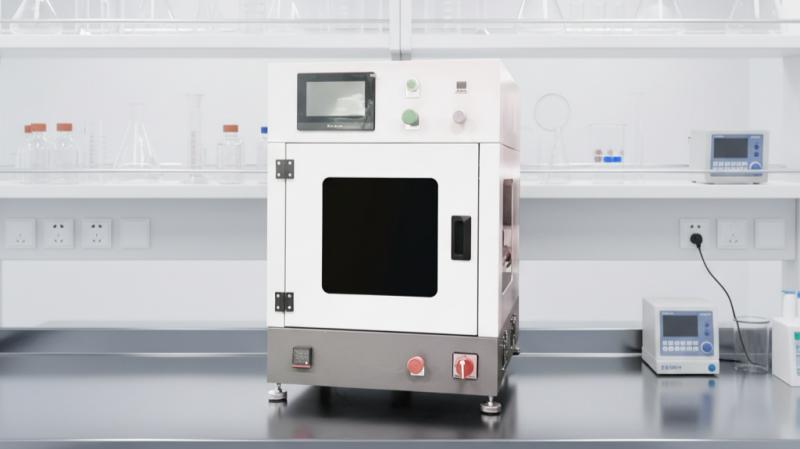
In the future, as lithium-ion batteries develop towards higher energy density and higher safety, ultrasonic spraying technology will be upgraded towards intelligence and higher efficiency. By introducing an online monitoring system and intelligent control algorithms, real-time feedback and adaptive parameter adjustment of coating thickness and porosity can be achieved. At the same time, the improvement of equipment frequency and width will further enhance mass production efficiency, promote its large-scale application in the field of lithium battery separator coating, and provide core technical support for the high-quality development of the new energy storage industry.
About Cheersonic
Cheersonic is the leading developer and manufacturer of ultrasonic coating systems for applying precise, thin film coatings to protect, strengthen or smooth surfaces on parts and components for the microelectronics/electronics, alternative energy, medical and industrial markets, including specialized glass applications in construction and automotive.
Our coating solutions are environmentally-friendly, efficient and highly reliable, and enable dramatic reductions in overspray, savings in raw material, water and energy usage and provide improved process repeatability, transfer efficiency, high uniformity and reduced emissions.
If you have any technical questions, customization demands, or procurement inquiries about ultrasonic atomization nozzles, feel free to contact our professional sales and technical team for detailed parameters, customized solutions, and industry application support.
Email: market2@cheersonic.com