
Ultrasonic Spraying of Iridium-Based Composite Coated Ti Anode
Ultrasonic spraying of iridium-based multi-component composite coating titanium anode
The titanium-based iridium-based multi-component mixed metal oxide coated anode is currently the most outstanding industrial electrode product in the field of oxygen evolution reaction (OER) in acidic systems. Using industrially pure TA1 or TA2 titanium as the substrate, the anode leverages the excellent mechanical properties, corrosion resistance, and structural stability of titanium under high current impact, laying a solid foundation for long-term reliable operation. Its core performance stems from the multi-component composite catalytic coating—with iridium dioxide (IrO₂) as the core active component, combined with tantalum (Ta), tin (Sn), manganese (Mn), ruthenium (Ru), and various rare earth metal oxides. Through the synergistic effect of these components, a balanced optimization of electrocatalytic activity, chemical stability, and service life is achieved. Iridium dioxide provides excellent oxygen evolution catalytic activity and conductivity, effectively reducing the oxygen evolution overpotential; tantalum oxide enhances the coating’s chemical inertness and corrosion resistance, suppressing iridium dissolution loss; and doping with transition metals and rare earth elements further optimizes the crystal structure, increasing the number of oxygen vacancies and active sites.
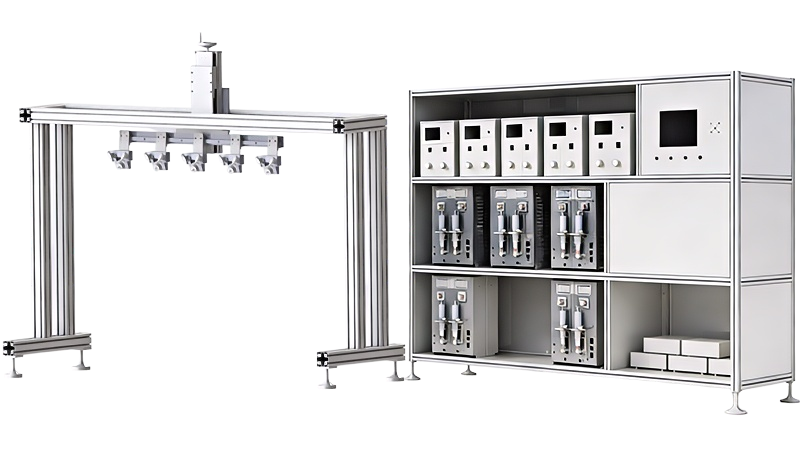
At the manufacturing process level, ultrasonic spraying technology has become the preferred solution for processing this type of anolyte coating. Its core principle is to use high-frequency ultrasonic vibration to atomize a precursor slurry containing precious metal salts into micron-sized uniform droplets, which are then precisely delivered to the titanium substrate surface via a low-pressure carrier gas. After high-temperature sintering, a continuous, dense, and strongly bonded metal oxide catalytic coating is formed. Compared to traditional manual brushing, mechanical roller coating, or air spraying processes, ultrasonic spraying exhibits comprehensive technological advantages.
Firstly, there is a significant improvement in coating uniformity and precision. Traditional brushing methods struggle to avoid problems such as uneven coating thickness, numerous pinhole defects, and oxide particle agglomeration, resulting in limited electrochemical active area and unstable service life for the anode. In contrast, the micron-sized uniform droplets formed by ultrasonic spraying spread evenly on the substrate surface, and after thermal decomposition, the oxide particles are uniform in size, effectively increasing the electrochemical active surface area. Coating thickness deviation can be controlled within a very small range, eliminating defects such as pinholes and localized accumulation, significantly improving the adhesion between the coating and the substrate. Ultrasonic spraying can also precisely control the coating amount and iridium loading, which is particularly important for expensive precious metal materials. Secondly, it offers adaptability for large-scale production. Ultrasonic spraying employs a non-contact deposition method, avoiding mechanical damage and making it particularly suitable for uniform coating of large-area or irregularly shaped titanium substrates. In actual production, this process can cover titanium anode plates up to 1.65 meters wide and 1.65 meters long, achieving uniform coating of ultra-large anode plates in a single pass. Combined with a multi-nozzle array coating design and an automated conveying system, ultrasonic spraying technology effectively solves the pain points of poor quality consistency and low efficiency in mass production using traditional processes.
Furthermore, it offers advantages in material utilization and cost. Traditional air spraying achieves less than 40% utilization of precious metal materials, resulting in a serious waste of scarce resources such as iridium and ruthenium. Ultrasonic spraying achieves a coating utilization rate of over 90%, significantly reducing the loss of precious metal precursors. In addition, the titanium substrate can be repeatedly coated; after coating failure, performance can be restored simply by removing the old coating and recoating, further reducing the total life-cycle cost.
In summary, ultrasonically sprayed iridium-based multi-component composite coated titanium anodes, with their precise and controllable coating process, excellent coating quality, and large-scale preparation capability covering ultra-large titanium electrode plates of 1.65m × 1.65m, have become an indispensable core electrode material in acidic oxygen evolution reaction scenarios in modern electrochemical industry.
About Cheersonic
Cheersonic is the leading developer and manufacturer of ultrasonic coating systems for applying precise, thin film coatings to protect, strengthen or smooth surfaces on parts and components for the microelectronics/electronics, alternative energy, medical and industrial markets, including specialized glass applications in construction and automotive.
Our coating solutions are environmentally-friendly, efficient and highly reliable, and enable dramatic reductions in overspray, savings in raw material, water and energy usage and provide improved process repeatability, transfer efficiency, high uniformity and reduced emissions.
Chinese Website: Cheersonic Provides Professional Coating Solutions
