
Pt Loading & Hot Pressing for Ultrasonic Spray PEMFC Electrodes
Pt loading-dependent effects of hot pressing on ultrasonic-sprayed membrane electrodes for PEM fuel cells
With the acceleration of the transition to clean energy, proton exchange membrane fuel cells have become the core technology for hydrogen utilization due to their advantages of zero emissions and high energy efficiency, and have broad application prospects in fields such as transportation and power generation. As the core component of fuel cells, the preparation process of membrane electrodes directly determines the output performance and service life of the cell.

Among them, ultrasonic spraying combined with catalyst coated film technology is the mainstream preparation scheme for high-performance membrane electrodes, while the hot pressing post-treatment process has a key impact on the electrode interface structure and mass transfer efficiency. At present, there is still controversy in the academic community regarding the hot pressing process, and few studies have systematically explored low platinum loading membrane electrodes, which hinders the development of low-cost and high-performance fuel cell technology.
This article conducts a systematic study on the influence of hot pressing parameters on the performance of ultrasonic spray membrane electrodes under different platinum loadings. The electrochemical properties and microstructural changes of conventional platinum loading (0.48 mg · cm ⁻ ²) and low platinum loading (0.12 mg · cm ⁻ ²) membrane electrodes under different hot pressing pressures, temperatures, and durations are compared and analyzed. Twenty sets of membrane electrode samples were prepared by regulating the pressure of 0-0.6 MPa, temperature of 90-170 ℃, and hot pressing time of 1-10 minutes. Combined with electrochemical testing and microscopic characterization, the mechanism and optimal parameters of the hot pressing process were clarified.
The research results indicate that the effect of hot pressing on the performance of membrane electrodes is significantly dependent on platinum loading, with 0.24 mg · cm ⁻ ² being the critical threshold for the transformation of hot pressing effect. For conventional high platinum loading membrane electrodes, moderate hot pressing can effectively optimize electrode performance: a suitable pressure of 0.4 MPa can reduce Ohmic impedance and mass transfer impedance. Under conditions exceeding the glass transition temperature of Nafion resin, the electrochemical active area can be increased by 40.10%~57.42%. The optimal hot pressing parameters determined by the experiment are 0.4 MPa, 150 ℃, and 3 minutes. Under this condition, the peak power density of the battery can be increased by more than 12%. However, excessively long hot pressing time can cause negative effects. 10 minutes of hot pressing can lead to the thermal decomposition of ionomers, hinder proton transport in the catalytic layer, and cause significant degradation of battery performance.
On the contrary, the hot pressing process has a negative effect on low platinum loading film electrodes. The catalytic layer of the low platinum membrane electrode is thinner and has a looser structure. During the hot pressing process, pore collapse is prone to occur, damaging gas transmission channels and reducing catalyst activity, ultimately leading to a decline in battery performance. This conclusion also explains the core reason for the contradictions in previous related research conclusions.
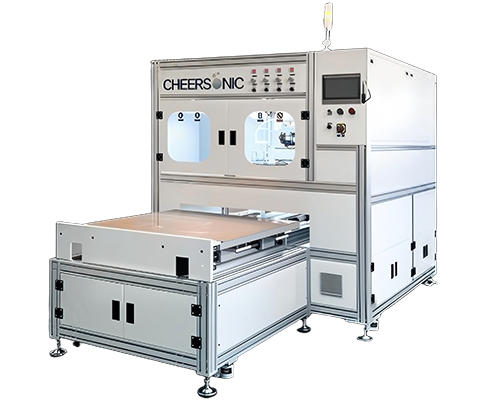
This study clarifies the coupling law between hot pressing process and platinum loading, defines the critical conditions for process adaptation, fills the gap in the research of hot pressing process for low platinum membrane electrodes, provides accurate process guidance for the industrial preparation of ultrasonic spray membrane electrodes, and helps fuel cells achieve high-performance and low-cost industrial development.
About Cheersonic
Cheersonic is the leading developer and manufacturer of ultrasonic coating systems for applying precise, thin film coatings to protect, strengthen or smooth surfaces on parts and components for the microelectronics/electronics, alternative energy, medical and industrial markets, including specialized glass applications in construction and automotive.
Our coating solutions are environmentally-friendly, efficient and highly reliable, and enable dramatic reductions in overspray, savings in raw material, water and energy usage and provide improved process repeatability, transfer efficiency, high uniformity and reduced emissions.
Chinese Website: Cheersonic Provides Professional Coating Solutions