Ultrasonic Spraying Optical Prism Film Coating
Innovation in Precision Coating Technology
In the field of modern optical manufacturing, precision coating technology is a key link in improving the performance of optical components. Ultrasonic spraying technology, as an advanced coating deposition method, is playing an increasingly important role in the preparation of optical thin films. This technology atomizes the coating liquid into micrometer sized uniform particles through high-frequency ultrasonic vibration, achieving precise coating of optical substrates. It is particularly suitable for surface treatment of complex geometric shapes of optical components such as prisms and lenses.
Technical principles and process characteristics
Ultrasonic spraying technology is based on the ultrasonic vibration energy generated by piezoelectric transducers, which converts liquids into small and uniform atomized particles. Its operating frequency is usually between 20kHz and 200kHz, capable of producing fine droplets with diameters between 10-50 microns. Compared with traditional spraying methods, this technology has several significant advantages:
1. Coating uniformity: The atomized particles generated by ultrasonic vibration have uniform size and distribution, which can form a thin film layer with controllable thickness and high consistency, meeting the strict requirements of optical coatings for uniformity.
2. High material utilization rate: The directional spraying ability reduces material waste, especially suitable for expensive coating materials such as specific metal oxides or polymer composites.
3. Adapt to complex geometric surfaces: Fine atomized particles can uniformly cover all surfaces of the prism, including edges and angular areas, solving the problem of traditional methods being difficult to uniformly coat complex shapes.
4. Low temperature process characteristics: Due to the absence of high-temperature evaporation process, it is suitable for temperature sensitive optical substrate materials, reducing deformation or damage caused by thermal stress.
Application of Prism Anti reflective Coating
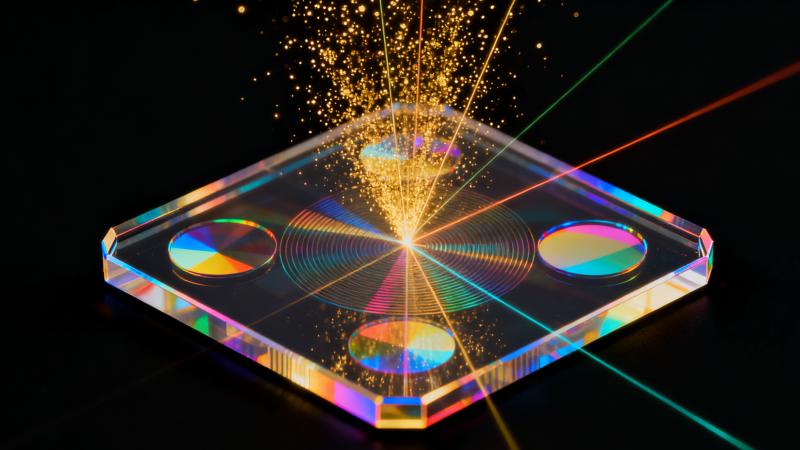
During the process of refraction and reflection, optical prisms generate approximately 4% -8% light reflection loss on each surface due to the difference in refractive index between the material and air. For polyhedral prisms, this cumulative loss is particularly significant. Anti reflection film (anti reflection film) can effectively reduce surface reflection and improve light transmission efficiency through the principle of interference cancellation.
Ultrasonic spraying technology exhibits unique advantages in the preparation of prism anti reflective films:
Preparation of multilayer film structure: Modern anti reflective films typically adopt a multilayer film structure, with each layer having a specific refractive index and thickness. Ultrasonic spraying technology can accurately control the thickness and composition of each layer of coating, achieve an ideal gradient refractive index distribution, and reduce reflection in a wide wavelength range.
Uniformity and adhesion: Prism surfaces usually have complex geometric shapes, and traditional spin coating or dip coating methods are difficult to ensure uniformity on all surfaces. Ultrasonic spraying can achieve uniform coating at multiple angles through a programmable motion control system, ensuring consistent film thickness on each surface of the prism. At the same time, fine atomized particles have lower momentum when in contact with the substrate, reducing surface damage and improving film adhesion.
Material compatibility: This technology is applicable to a variety of anti reflective film materials, including metal oxide sols such as silica, titanium dioxide, and alumina, as well as various organic-inorganic hybrid materials, providing flexible choices for different application scenarios.
Application of Prism Reflective Film Coating
For prism surfaces that require high reflectivity, such as the inclined surface of a right angle prism or specific areas of a beam splitter prism, a reflective film coating is crucial. Both metal reflective films (such as aluminum and silver) and dielectric reflective films can be coated with high quality through ultrasonic spraying technology.
Preparation of metal reflective film: By dispersing metal nanoparticles in an appropriate solvent to form a stable suspension, ultrasonic spraying can uniformly deposit these nanoparticles, forming a continuous and dense metal thin film. Optimization of process parameters can control the grain size and density of thin films, directly affecting reflectivity and durability.
Preparation of dielectric high reflection film: Based on the principle of interference, dielectric high reflection film is composed of alternating high and low refractive index materials. Ultrasonic spraying technology achieves high reflectivity at specific wavelengths by depositing different materials layer by layer and precisely controlling the optical thickness of each layer to be λ/4. This layer by layer construction method is particularly suitable for preparing complex membrane systems that require precise control of the number of layers and thickness.
Localized selective coating: For prisms that only require partial surface reflection, the directional and controllable properties of ultrasonic spraying enable precise localized coating, reducing material waste and simplifying subsequent cleaning processes.
Process optimization and quality control
To achieve high-quality prism film coating, multiple process parameters need to be comprehensively considered:
Atomization parameter control: Ultrasonic frequency, amplitude, and liquid flow rate directly affect the size and distribution of atomized particles. Smaller droplets typically form smoother and denser films, but require longer coating times.
Motion path planning: Based on the geometric characteristics of prisms, design optimized nozzle motion trajectories to ensure uniform coverage of all surfaces, especially in the edge and vertex areas.
Environmental condition management: Clean room environment, temperature, humidity, and airflow control are crucial for avoiding dust pollution and ensuring coating quality.
Online monitoring and feedback: An integrated thickness measurement system (such as an optical interferometer) is used to monitor coating growth in real-time, forming a closed-loop control system to ensure that the film thickness accurately reaches the design value.
Post treatment process: Depending on the characteristics of the coating material, appropriate curing, annealing, or UV treatment may be required to enhance the mechanical strength and optical stability of the film.
Technological advantages and industry impact
The application of ultrasonic spraying technology in the field of optical prism coating has brought various technological improvements:
Improving the performance of optical systems: By reducing surface reflection losses and using high-quality anti reflective film prisms, the transmittance can be increased from 92% -95% to over 99.5%, significantly improving the overall efficiency and signal-to-noise ratio of the optical system.
Enhance product consistency: The automated spraying process reduces human factors and achieves high repeatability and consistency in mass production, making it particularly suitable for large-scale optical component manufacturing.
Support for new optical designs: This technology makes the preparation of multi-layer complex film systems more feasible, providing greater freedom for advanced optical system design, such as the implementation of wideband anti reflection, specific wavelength reflection, and other functions.
Environmental and Economic Benefits: Compared to traditional vacuum coating, ultrasonic spraying typically consumes less energy, does not require a high vacuum environment, and significantly improves material utilization, reducing production costs and environmental impact.
Application Expansion and Future Prospects
In addition to traditional anti reflective and reflective films, ultrasonic spraying technology has more extended applications in the field of prism functional coatings:
Hydrophobic and anti fouling coating: adding a functional protective layer on the surface of the optical film layer to improve the environmental adaptability and cleaning and maintenance convenience of the prism.
Fluorescence and color conversion layer: Adding a fluorescent coating to special application prisms to achieve wavelength conversion function.
Conductive transparent film: provides transparent conductive coatings such as ITO for optical prisms that require anti-static or electromagnetic shielding.
With the development of nano materials, functional sol gel systems and intelligent coating technologies, ultrasonic spraying technology will continue to play an important role in the field of optical manufacturing. In the future, by combining with digital manufacturing technology and artificial intelligence optimization algorithms, this technology is expected to achieve a higher degree of automation and intelligence, providing more precise, efficient, and environmentally friendly coating solutions for optical prisms and other precision optical components.
In summary, ultrasonic spraying technology provides an efficient, precise, and highly adaptable solution for the preparation of thin film coatings for optical prisms, demonstrating significant advantages in improving optical system performance, reducing production costs, and promoting new optical designs. It has become an indispensable and important technology in modern optical manufacturing.
About Cheersonic
Cheersonic is the leading developer and manufacturer of ultrasonic coating systems for applying precise, thin film coatings to protect, strengthen or smooth surfaces on parts and components for the microelectronics/electronics, alternative energy, medical and industrial markets, including specialized glass applications in construction and automotive.
Our coating solutions are environmentally-friendly, efficient and highly reliable, and enable dramatic reductions in overspray, savings in raw material, water and energy usage and provide improved process repeatability, transfer efficiency, high uniformity and reduced emissions.
Chinese Website: Cheersonic Provides Professional Coating Solutions