
Ultrasonic Spraying Cathode Electrode
Research and Application of Ultrasonic Spray Coating Machine for Cathode Electrodes
In high-end industries such as new energy and electronic manufacturing, the coating quality of cathode electrodes directly determines the core performance and service life of devices. Traditional spray coating processes suffer from drawbacks such as poor coating uniformity, low material utilization, and risk of substrate damage, making them unsuitable for the fabrication of precision cathode electrodes. Ultrasonic spray coating machines, with their unique high-frequency vibration atomization principle, achieve high precision, high efficiency, and high stability in cathode electrode coating, becoming one of the core technologies in the current precision coating field. They are widely used in the cathode fabrication of products such as lithium-ion batteries, fuel cells, and solid-state electrolyte devices.
Core Principle of Ultrasonic Spray Coating Machine for Cathode Electrodes
The core logic of ultrasonic spray coating machines for cathode electrodes is to utilize high-frequency ultrasonic vibration to achieve precise atomization and accurate deposition of the cathode slurry. This differs from the forced atomization mode of traditional high-pressure airflow spraying, offering a gentler and more controllable process. The core components of the equipment include an ultrasonic transducer, atomizing nozzles, a slurry supply system, a motion control system, and a temperature and humidity control system. These components work together to complete the entire cathode electrode coating process.
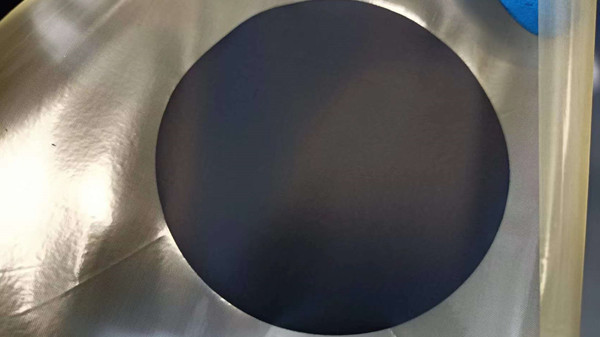
During operation, the ultrasonic transducer converts electrical energy into high-frequency mechanical vibrations, typically between 20kHz and 200kHz, with the specific frequency adjustable based on the cathode slurry characteristics and coating requirements. This high-frequency vibration is transmitted to the cathode slurry through a nozzle, causing it to break down into uniform micron- or even nano-sized droplets under surface tension. The droplet size can be controlled within the 5-50μm range, with a uniform distribution, effectively avoiding droplet agglomeration and splashing problems common in traditional spraying. The atomized droplets, aided by a low-pressure carrier gas, are precisely deposited onto the cathode substrate surface at a stable speed, forming a dense and uniform coating. The entire process is non-contact spraying, eliminating the need for high-pressure airflow impact, effectively protecting the structural integrity of the cathode substrate, and is particularly suitable for fragile substrates or ultra-thin coating applications.
Compared to traditional spraying processes, ultrasonic spraying’s atomization process does not rely on high pressure, resulting in lower droplet kinetic energy and less rebound and splashing during deposition. This not only improves coating uniformity but also significantly reduces slurry waste, offering a significant cost advantage for the preparation of cathode electrodes containing precious metal catalysts. Meanwhile, by precisely controlling parameters such as vibration frequency, slurry supply speed, and spraying distance, coating thickness can be precisely controlled from the nanometer to the micrometer level, meeting the performance requirements of different types of cathode electrodes.
Key Process Considerations for Ultrasonic Spraying of Cathode Electrodes
The process stability of ultrasonic spraying of cathode electrodes directly determines the coating quality. Precise control is required around three core aspects: slurry compatibility, parameter adjustment, and substrate pretreatment. Combining the material characteristics and performance requirements of the cathode electrode, the process parameter combination should be optimized to achieve optimal coating performance.
Optimization of Cathode Slurry Compatibility
The characteristics of the cathode slurry are fundamental to the spraying effect. Its viscosity, solid content, surface tension, and dispersibility must be compatible with the ultrasonic spraying process; otherwise, problems such as poor atomization, coating cracking, and peeling may occur. Generally, the viscosity of the cathode slurry is recommended to be controlled within the range of 10-100 cP. The solid content should be adjusted according to the slurry composition and coating thickness requirements. Excessive solid content will lead to atomization difficulties, while insufficient solid content will easily result in coating sagging and excessive porosity. For cathode slurries containing nanoparticles, ultrasonic pretreatment is necessary. Adding an appropriate amount of surfactant optimizes rheological properties, effectively solving the nanoparticle agglomeration problem, ensuring uniform slurry dispersion, preventing nozzle clogging during atomization, and improving coating density and adhesion. Furthermore, the surface tension of the slurry must match the surface energy of the substrate. If necessary, surface modification of the substrate can be performed to enhance the adhesion between the slurry and the substrate, reducing the risk of coating peeling.
Control of Core Spraying Parameters
The core parameters of ultrasonic spraying include ultrasonic frequency, amplitude, slurry supply speed, spraying distance, movement speed, and substrate temperature. These parameters are interdependent and require coordinated optimization to achieve the best spraying effect.
Ultrasonic frequency directly determines droplet size. High-frequency vibration can generate finer droplets, suitable for ultra-thin coating preparation. A frequency of 100-150kHz is typically suitable for most cathode catalyst slurries. Amplitude affects atomization intensity; excessive amplitude can lead to droplet splashing, while insufficient amplitude results in incomplete atomization. Adjustment must be made flexibly according to the slurry viscosity and solid content. The slurry supply speed and the travel speed must be precisely matched. Too fast a supply speed or too slow a travel speed will result in an excessively thick coating and sagging, while the opposite will result in an excessively thin coating and missed areas. Coordinated control of both is key to controlling the uniformity of coating thickness, and the coating thickness deviation can be controlled within ±3%.
The spraying distance is generally controlled between 50-150mm. Too close a distance can lead to coating buildup, while too far a distance can cause droplets to disperse, affecting coating uniformity. The substrate temperature must be matched with the solvent evaporation rate. Too high a temperature can cause pinholes and cracks in the coating, while too low a temperature will result in slow solvent evaporation, affecting coating drying efficiency and density. The substrate temperature is usually controlled between 40-80℃, depending on the type of slurry solvent. Furthermore, the carrier gas flow rate must be gentle and stable to avoid excessive airflow causing droplet deviation and affecting deposition accuracy.
Substrate Pretreatment Process
The surface condition of the cathode substrate directly affects the adhesion and bonding strength of the coating. The core purpose of pretreatment is to remove oil, impurities, and oxide layers from the substrate surface, improve surface roughness and surface energy, and ensure full bonding between the slurry and the substrate. Common pretreatment methods include ultrasonic cleaning, plasma treatment, and chemical etching, with the specific method chosen based on the substrate material (e.g., aluminum foil, carbon fiber, proton exchange membrane).
For example, aluminum foil substrates commonly used in lithium-ion battery cathodes require ultrasonic cleaning to remove surface oil and oxide film, followed by drying to prevent residual moisture from affecting coating performance. For carbon fiber substrates, plasma treatment can enhance surface activity, strengthen the bond between the slurry and the substrate, and protect the mechanical integrity of the carbon fibers, which is particularly important for the fabrication of composite cathodes in structural batteries. The pretreated substrate must be sprayed promptly to avoid secondary contamination and ensure the stability of coating quality.
Technical Advantages of Ultrasonic Spraying for Cathode Electrodes
Compared to traditional spraying, dip coating, and electrophoretic deposition processes, ultrasonic spraying machines exhibit significant technical advantages in cathode electrode coating, not only improving coating quality but also reducing production costs and meeting the needs of large-scale production.
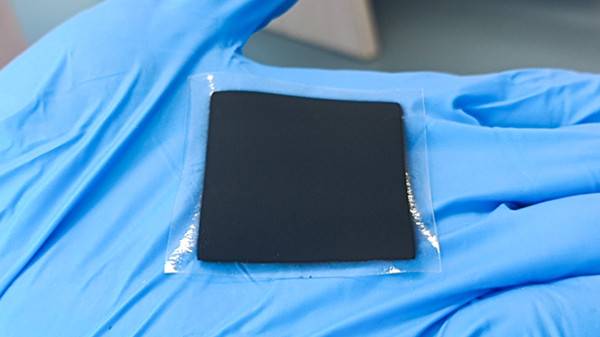
Firstly, excellent coating uniformity and consistency. Ultrasonic spraying produces uniform droplet size and precise deposition, effectively avoiding defects such as streaks, pinholes, and missed coatings common in traditional processes. The coating thickness uniformity error can be controlled within 5%, ensuring good consistency across different batches and guaranteeing the electrochemical performance stability of the cathode electrode. For example, in the preparation of PEM water electrolysis for hydrogen production cathodes, ultrasonic spraying achieves uniform distribution of platinum catalyst, fully exposing active sites, reducing the overpotential of the hydrogen evolution reaction, and improving electrolysis efficiency.
Secondly, material utilization is significantly improved. Traditional spraying processes can result in material waste exceeding 15%, while ultrasonic spraying, through precise control of droplet spray direction and flow rate, can increase material utilization to over 85%-95%. This is particularly suitable for the preparation of cathode electrodes containing precious metal catalysts such as platinum and iridium, significantly reducing precious metal consumption and effectively lowering production costs. For example, in PEM electrolyzer cathode spraying, ultrasonic spraying can increase platinum catalyst utilization to over 95%, significantly alleviating the cost pressure caused by the scarcity of precious metals.
Thirdly, non-contact spraying protects the substrate structure. Ultrasonic spraying eliminates the need for high-pressure airflow impact, representing a gentle, non-contact coating process. This effectively protects the structural integrity of fragile substrates (such as proton exchange membranes and ultrathin metal foils), preventing substrate damage. Simultaneously, it reduces internal stress within the coating, lowering the risk of cracking and peeling, and extending the service life of the cathode electrode.
Fourthly, it offers high process flexibility and wide applicability. Ultrasonic spraying is suitable for various cathode material systems, including polymer solutions, metal oxide slurries, and precious metal catalyst slurries, achieving high-quality coating. Furthermore, it can adapt to substrates of different sizes and shapes, meeting both small-scale laboratory research needs and large-scale industrial production requirements through multi-nozzle array parallel spraying. It is suitable for cathode fabrication needs in various fields such as power batteries, energy storage batteries, and fuel cells.
Technical Challenges and Optimization Directions for Ultrasonic Spraying of Cathode Electrodes
Although ultrasonic spraying technology has significant advantages in cathode electrode coating, it still faces some technical challenges in practical applications. These challenges need to be addressed gradually through process optimization and equipment upgrades to further improve the applicability and stability of the technology.
Regarding technical challenges, the first is the difficulty of adapting to high-viscosity slurries. For cathode slurries with a viscosity exceeding 500 cP, ultrasonic atomization is challenging, easily leading to uneven atomization and nozzle clogging, thus limiting the application of some high-solids-content, high-viscosity slurries. Secondly, there is the challenge of balancing drying efficiency and coating quality. When spraying thick coatings, delayed solvent evaporation can easily cause defects such as pinholes and bubbles, while excessively increasing the drying temperature may lead to coating cracking. Furthermore, the initial investment cost of equipment is high, and the coating speed for large areas is lower than that of traditional roller coating processes, requiring further optimization in some large-scale production scenarios.
To address these challenges, optimization can be carried out in three directions. First, the synergistic optimization of slurry formulation and atomization system involves optimizing the rheological properties of high-viscosity slurries by adding dispersants and surfactants, while simultaneously improving nozzle structure to enhance atomization efficiency and solve the atomization challenges of high-viscosity slurries. Second, the development of a closed-loop drying system enables precise control of temperature and humidity. A multi-pass spraying + segmented drying approach balances drying efficiency and coating quality, preventing defects. Third, equipment structure upgrades reduce investment costs through modular design and employ multi-nozzle array parallel spraying technology to increase the speed of large-area coating and adapt to the needs of large-scale production.
Furthermore, with the development of intelligent technologies, AI real-time monitoring and adaptive feedback systems can be introduced to adjust spraying parameters in real time, promptly correcting deviations during the spraying process and further improving the stability of coating quality. Simultaneously, combining SEM characterization and electrochemical testing (such as EIS and LSV) allows for precise evaluation of the coating’s microstructure and electrochemical performance, providing data support for process optimization.
Application Scenarios and Development Prospects
Currently, ultrasonic spraying technology for cathode electrodes has been widely applied in various fields such as new energy and electronics manufacturing. In the field of lithium-ion batteries, ultrasonic coatings can be used to prepare high-nickel cathodes, silicon-carbon anodes, and solid electrolyte coatings, improving energy density, charging efficiency, and cycle life through precise coating. In the field of fuel cells, they can be used to coat the cathode catalyst layer of PEM electrolyzers, enabling efficient utilization of platinum catalysts, reducing hydrogen production energy consumption, and promoting the development of the green hydrogen industry. In the field of structural batteries, they can be used to coat carbon fiber composite cathodes, ensuring coating uniformity while protecting the mechanical integrity of the carbon fibers, achieving integration of energy storage and structural support.
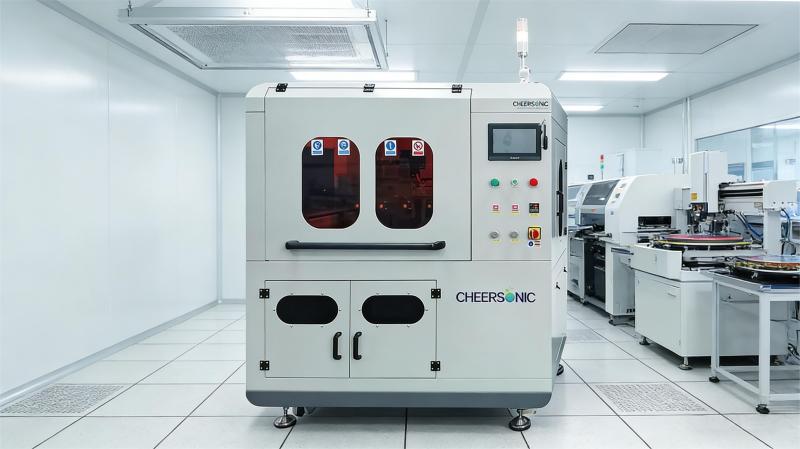
In the future, with the rapid development of the new energy industry, the requirements for coating precision, material utilization, and production efficiency of cathode electrodes will continue to increase. Ultrasonic spraying technology will develop towards greater precision, efficiency, and intelligence. On the one hand, it will further optimize atomization technology and process parameters, expand the adaptability range of high-viscosity, high-solids-content slurries, and improve the preparation capabilities of thick and ultra-thin coatings. On the other hand, it will promote the deep integration of ultrasonic spraying equipment and automated production lines, realizing an integrated process of spraying, drying, and testing, improving production efficiency and product consistency. Meanwhile, with the research and application of low-cost alternative materials, ultrasonic spraying technology will further reduce production costs, promote its widespread application in more high-end fields, and provide strong support for the green development of the new energy industry.
Conclusion: Ultrasonic spraying machines, with their unique technological advantages, effectively solve many pain points of traditional cathode electrode coating processes, becoming a core technology for precision cathode preparation. By optimizing slurry formulations, controlling process parameters, and upgrading equipment structures, coating quality and production efficiency can be further improved to meet the application needs of different fields. In the future, with continuous technological innovation and breakthroughs, ultrasonic spraying technology will play an even more important role in the field of cathode electrode preparation, promoting the high-quality development of industries such as new energy and electronic manufacturing.
About Cheersonic
Cheersonic is the leading developer and manufacturer of ultrasonic coating systems for applying precise, thin film coatings to protect, strengthen or smooth surfaces on parts and components for the microelectronics/electronics, alternative energy, medical and industrial markets, including specialized glass applications in construction and automotive.
Our coating solutions are environmentally-friendly, efficient and highly reliable, and enable dramatic reductions in overspray, savings in raw material, water and energy usage and provide improved process repeatability, transfer efficiency, high uniformity and reduced emissions.
Chinese Website: Cheersonic Provides Professional Coating Solutions