
Ultrasonic Spraying for Medical TPU Catheters
Ultrasonic Spraying for Medical TPU Catheters – Cheersonic
In modern clinical medicine, medical catheters are core devices for interventional diagnosis and treatment, and their surface properties play a decisive role in treatment safety and patient comfort. Traditional catheter surface treatment processes generally suffer from uneven coating and weak adhesion, especially for catheters that require long-term placement or contact with sensitive tissues; poor surface quality can directly affect treatment outcomes. The emergence of ultrasonic spraying technology provides an efficient and reliable solution for surface modification of medical thermoplastic polyurethane (TPU) catheters, fully preserving the excellent properties of the TPU material itself while imparting superior clinical performance to the catheter through precise coating.
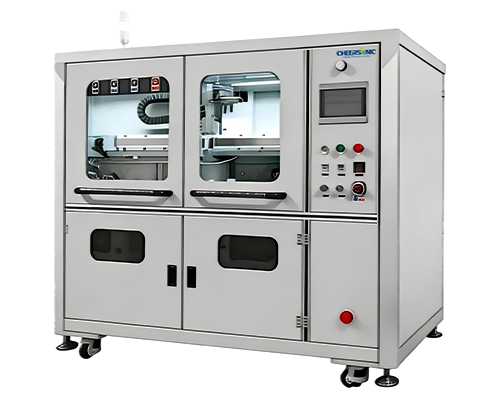
The core principle of ultrasonic spraying technology is to atomize the coating material using high-frequency ultrasonic vibration (typically between 20-150kHz). Unlike traditional pneumatic spraying, this technology does not rely on high-pressure airflow; instead, it converts electrical energy into mechanical vibration through an ultrasonic transducer, causing the sprayed liquid to form uniform droplets at the nozzle, ranging from micrometers to nanometers in size. This unique atomization method effectively avoids airflow disturbance to the droplets, ensuring that the droplets are deposited uniformly on the TPU catheter surface at a stable rate, ultimately forming a continuous coating with controllable thickness (generally adjustable to 5-50 μm). This coating not only eliminates common defects such as pinholes and sagging, but also perfectly conforms to the curved surface of the catheter, fundamentally solving the problem of uneven coating thickness on the catheter surface in traditional processes.
Medical-grade TPU material itself possesses superior performance advantages. It meets international medical device biosafety standards, is unlikely to trigger immune rejection or cytotoxicity after implantation, and is highly biocompatible with human tissue. Simultaneously, TPU material also boasts excellent elasticity and fatigue resistance, easily adapting to the complex physiological environment of the human body—for example, vascular catheters need to deform slightly with heartbeats, while urological catheters must withstand long-term immersion in urine and mechanical friction. However, pure TPU catheters still have certain shortcomings. For example, their surface friction is relatively high, which can easily cause tissue damage during insertion; and they lack antibacterial properties, increasing the risk of infection during catheter placement. Ultrasonic spraying technology can precisely address these shortcomings.
In the production process of ultrasonically sprayed medical TPU catheters, the pretreatment stage is crucial. First, plasma cleaning technology is used to remove oil, impurities, and micro-scratches from the catheter surface, while simultaneously activating the molecular activity of the TPU surface, significantly improving the adhesion between the coating and the substrate, and preventing coating peeling during subsequent use. Then, an appropriate coating material is selected based on specific clinical needs: for cardiovascular applications, heparin-modified antithrombotic coatings are often used, uniformly covering the catheter surface through ultrasonic spraying to reduce the adhesion of blood components to the catheter wall, thereby reducing the risk of thrombosis; for catheters used in pediatrics or for elderly patients, medical-grade lubricating coatings are often used. By precisely controlling the spraying thickness, the surface friction coefficient of the catheter is reduced by more than 60%, significantly reducing tissue irritation during insertion. During the spraying process, technicians continuously adjust the ultrasonic frequency, spraying distance (usually maintained at 10-30cm), and catheter rotation speed to ensure a consistent coating thickness both circumferentially and axially. Finally, a low-temperature curing treatment at 40-60℃ is applied to prevent high temperatures from damaging the TPU material’s properties, ensuring a stable bond between the coating and the TPU substrate.
Currently, medical TPU catheters treated with ultrasonic spraying are widely used in various clinical fields. In cardiovascular interventional therapy, TPU catheters with an antithrombotic coating can be safely used in coronary angiography or stent implantation surgery, effectively reducing intraoperative thrombotic complications. In urology, TPU catheters with an antibacterial lubricating coating significantly reduce the urinary tract infection rate in long-term indwelling patients, and the combination of the soft TPU material and smooth coating greatly improves patient comfort. In neurointerventional therapy, ultra-fine diameter (outer diameter down to 1-2mm) ultrasonically sprayed TPU catheters can smoothly pass through small intracranial blood vessels, and their precise coating avoids irritating nerve tissue, providing a safe guarantee for the diagnosis and treatment of brain diseases. From a clinical practice perspective, ultrasonic spraying technology not only significantly improves the performance of medical TPU catheters but also indirectly improves treatment outcomes and patient prognosis. Related data shows that TPU catheters with ultrasonically sprayed antibacterial coatings have a 40%-50% lower infection rate during indwelling compared to traditional catheters; while antithrombotic coated catheters reduce the risk of thrombosis-related complications in cardiovascular interventional procedures by more than 30%. With the continuous advancement of medical technology, ultrasonic spraying technology can be further combined with functional coating materials (such as smart responsive coatings), potentially enabling “on-demand drug delivery” or “real-time monitoring” functions for TPU catheters in the future, continuously expanding the application boundaries of medical catheters and providing stronger device support for the development of precision medicine.
About Cheersonic
Cheersonic is the leading developer and manufacturer of ultrasonic coating systems for applying precise, thin film coatings to protect, strengthen or smooth surfaces on parts and components for the microelectronics/electronics, alternative energy, medical and industrial markets, including specialized glass applications in construction and automotive.
Our coating solutions are environmentally-friendly, efficient and highly reliable, and enable dramatic reductions in overspray, savings in raw material, water and energy usage and provide improved process repeatability, transfer efficiency, high uniformity and reduced emissions.
Chinese Website: Cheersonic Provides Professional Coating Solutions