
Technical Analysis of Ultrasonic Spraying for Ceramic Slurry
Technical Analysis of Ultrasonic Spraying for Ceramic Slurry – Cheersonic
Ceramic coatings, with their excellent properties such as high hardness, high temperature resistance, and corrosion resistance, are widely used in new energy, electronic information, aerospace, and other fields. The core of ceramic coating preparation lies in achieving uniform spraying of the ceramic slurry. Ultrasonic spraying equipment, with its unique atomization principle, effectively overcomes many difficulties in the ceramic slurry spraying process, becoming a key technical solution to ensure coating quality.
Ceramic slurries are typically composed of ceramic powder, solvent, dispersant, and binder, and their inherent characteristics present a natural challenge to uniform spraying. Ceramic powders are mostly nano- or submicron-sized particles, which are prone to agglomeration. Uneven dispersion can lead to particle aggregation defects in the coating. Simultaneously, the slurry viscosity needs strict control; excessively high viscosity makes atomization difficult, while excessively low viscosity may cause coating sagging, both of which affect coating uniformity. Traditional spraying technologies, such as pressure spraying and two-fluid spraying, rely on high-pressure airflow to atomize the slurry, which easily leads to problems such as uneven droplet size and poor orientation. This not only makes it difficult to guarantee coating uniformity but also results in low material utilization and significant thermal impact on the substrate.
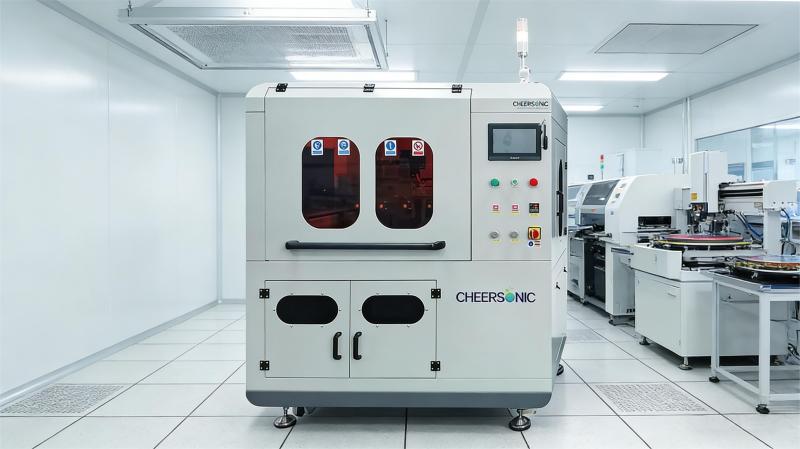
Ultrasonic spraying equipment, through its unique ultrasonic atomization principle, fundamentally solves the core problem of uniform ceramic slurry spraying. Its core operation utilizes a piezoelectric transducer to convert high-frequency electrical signals into mechanical vibrations of the same frequency. This vibration is transmitted to the atomization surface at the nozzle tip, causing the ceramic slurry flowing through it to form extremely fine capillary waves. When the vibration energy is sufficient, the droplets are violently torn apart at the wave crests, forming uniform droplets at the micron or even nanometer scale. Unlike traditional spraying technologies, ultrasonic spraying does not require high-pressure airflow for atomization. The droplets have strong orientation and a gentle flight speed, allowing for precise deposition on the substrate surface and effectively avoiding overspray and rebound losses.
Achieving uniform ceramic slurry spraying with ultrasonic spraying equipment relies on three key technologies. The first is optimized slurry pretreatment. By combining ball milling and ultrasonic dispersion, and with the appropriate selection of dispersants, the agglomeration of ceramic particles can be broken up to form a stable suspension slurry. Simultaneously, the slurry viscosity is strictly controlled within a suitable range to ensure consistent atomization. Secondly, precise parameter control is achieved. Droplet size can be controlled by adjusting the ultrasonic frequency; higher frequencies result in finer droplets. Precise setting of ultrasonic power, slurry flow rate, nozzle movement speed, and the distance between the nozzle and the substrate allows for precise control of coating thickness from nanometer to micrometer levels, with thickness uniformity error controlled within ±5%. Thirdly, substrate pretreatment and adaptation design are crucial. Cleaning, degreasing, and sandblasting roughen the substrate enhance the adhesion between the coating and the substrate. For complex three-dimensional substrates, optimizing the nozzle scanning mode achieves uniform coverage of difficult-to-treat areas such as grooves and edges.
Compared to traditional technologies, ultrasonic spraying equipment exhibits significant advantages in ceramic slurry spraying: material utilization can reach over 90%, significantly saving expensive ceramic materials; the room-temperature atomization process is friendly to heat-sensitive substrates, avoiding substrate deformation caused by high-temperature spraying; the coating surface is smooth and dense, without obvious defects, and has low porosity, fully leveraging the excellent properties of ceramic materials. Currently, this technology has been successfully applied in high-end fields such as solid oxide fuel cell electrolyte layer spraying, semiconductor device insulating ceramic coating preparation, and thermal barrier coating processing for aero-engine components.
With the development of materials science and automation technology, ultrasonic spraying equipment is evolving towards greater precision and intelligence. By integrating online detection and closed-loop control technologies, spraying parameters can be adjusted in real time, further improving coating uniformity and stability. In the future, this technology will continue to drive innovation in ceramic coating preparation processes, providing core support for the high-quality development of advanced manufacturing.
About Cheersonic
Cheersonic is the leading developer and manufacturer of ultrasonic coating systems for applying precise, thin film coatings to protect, strengthen or smooth surfaces on parts and components for the microelectronics/electronics, alternative energy, medical and industrial markets, including specialized glass applications in construction and automotive.
Our coating solutions are environmentally-friendly, efficient and highly reliable, and enable dramatic reductions in overspray, savings in raw material, water and energy usage and provide improved process repeatability, transfer efficiency, high uniformity and reduced emissions.
Chinese Website: Cheersonic Provides Professional Coating Solutions