
Preparing Microporous Carbon Copper Foil Conductive Coating
Ultrasonic Spraying Equipment for Preparing Microporous Carbon Copper Foil Conductive Coating
In the fields of new energy batteries, flexible electronics, etc., microporous carbon coated copper foil is gradually replacing traditional copper foil as the core material due to its excellent conductivity, high specific surface area, and good interface bonding characteristics as a high-performance conductive substrate. Ultrasonic spraying technology, with its non-contact precision coating advantages, has become an ideal process solution for preparing uniform and controllable microporous carbon coatings, effectively solving the technical problems of uneven coating, difficult porosity control, and low material utilization in traditional coating processes.
Core working principle
Ultrasonic spraying equipment achieves precise atomization and uniform deposition of carbon based slurry through high-frequency ultrasonic vibration (usually 20kHz-120kHz). The core process includes:
1. Ultrasonic atomization: The transducer converts electrical energy into high-frequency mechanical vibration, which acts on the carbon based slurry at the nozzle. Through the capillary wave breaking effect, the slurry is split into uniform small droplets of 1-50 μ m without the need for high-pressure airflow, avoiding droplet aggregation and splashing
2. Precise transmission: A very small amount of carrier gas (guide gas) gently transports the droplets to the surface of the copper foil at a low speed (<1m/s), with a non-contact design to avoid damaging the copper foil substrate
3. Formation of Micro porous Coating: Droplets spread evenly on the surface of copper foil and are heated and cured to form a three-dimensional micro porous structure with gradient porosity through process parameter control. Carbon particles are uniformly distributed to form a continuous conductive network
4. Roll to roll continuous preparation: Suitable for flexible copper foil substrate, achieving continuous and large-scale production, and the coating thickness uniformity CV value can be controlled within 3%
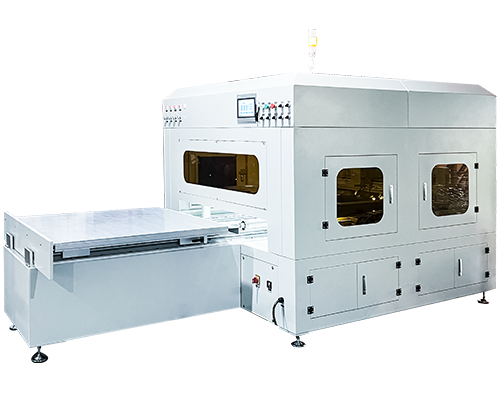
Complete process system configuration
1. Ultrasonic spraying unit: including high-frequency transducer, dedicated atomizing nozzle, precision flow control system (accuracy up to 0.01ml/min), responsible for stable atomization and quantitative conveying of slurry
2. Substrate processing unit: Copper foil surface cleaning (plasma/corona treatment), preheating system to improve the interface adhesion between the coating and the substrate
3. Drying and curing unit: segmented temperature controlled heating tunnel (usually 80-180 ℃ gradient heating), achieving rapid solvent evaporation and carbon coating densification, avoiding collapse of microporous structure
4. Online detection and control system: Coating thickness monitoring (optical/eddy current thickness measurement), porosity analysis, surface resistance testing, achieving closed-loop control of process parameters
5. Environmental recycling system: solvent recovery device, reduces VOC emissions, meets green production requirements
Key process parameters and control of microporous structure
Precise control of microporous structure:
– Porosity control: By adjusting the slurry formula (carbon particle size, binder ratio) and atomization parameters, the porosity can be precisely adjusted within the range of 20% -60%
– Pore size distribution: Control droplet size and drying rate to achieve controllable distribution of micropore diameters from submicron to several microns
– Gradient coating design: By combining multiple nozzles or dynamically adjusting parameters, gradient changes in coating thickness and porosity can be achieved, optimizing conductivity and electrolyte wettability
Performance advantages compared to traditional processes
Compared with traditional processes such as scraper coating, roller coating, and magnetron sputtering, ultrasonic spraying technology has significant advantages in preparing microporous coated carbon copper foil:
1. Coating uniformity: The droplet uniformity can reach over 95%, avoiding edge effects and stripe defects caused by scraper coating, especially suitable for the preparation of ultra-thin coatings (50-500nm)
2. Material utilization rate: up to 90% or more, far higher than traditional coating processes (usually<60%), significantly reducing the cost of using carbon materials such as graphene and carbon nanotubes
3. Controllability of microporous structure: The unique droplet deposition method easily forms a well connected three-dimensional microporous network, significantly increasing the specific surface area (more than 30% higher than traditional coatings), which is conducive to electrolyte penetration and charge transfer
4. Flexible adaptability: Non contact spraying is friendly to ultra-thin copper foil (below 6 μ m) and porous copper foil substrates, avoiding mechanical damage
5. Process flexibility: It can quickly switch between different carbon based slurries (graphene, carbon nanotubes, conductive carbon black, etc.) to achieve flexible preparation of multi formulation coatings
Performance indicators and typical application scenarios
Core performance indicators
- Surface resistance:<10m Ω/(when coating thickness is 0.5 μ m)
- Coating thickness: 50nm-2 μ m (continuously adjustable)
- Porosity: 30% -50% (optimization range)
- Interface bonding strength:>1N/cm (no detachment in tape test)
- Bending resistance:>1000 bending cycles (180 °), resistance change<5%
Typical application scenarios
1. Lithium ion battery negative electrode current collector: Micro porous carbon coating improves the interfacial bonding between copper foil and silicon carbon/graphite negative electrode material, inhibits electrolyte corrosion, and enhances battery cycle life (capacity retention rate increases by more than 10% after 1000 cycles)
2. supercapacitor electrode: high specific surface area microporous structure provides more electrochemical reaction sites and reduces equivalent series resistance
3. Flexible electronic devices: Ultra thin and flexible microporous carbon coated copper foil can be used as a conductive substrate for flexible circuits
4. Electromagnetic shielding material: The combination of continuous conductive carbon network and microporous structure provides excellent electromagnetic shielding performance
Challenge and Development Direction
1. Current challenge:
- The stable atomization technology of high solid content carbon based slurry still needs to be breakthrough
- Difficulty in controlling the uniformity of coatings with a large area (width>1000mm)
- The process cost needs to be further reduced to adapt to large-scale industrial production
2. Future development direction:
- Composite coating technology: preparation of multifunctional composite carbon coatings by combining nanomaterials such as MXene and metal nanoparticles
- Intelligent production: AI visual inspection and adaptive adjustment of process parameters to achieve zero defect production
- Green technology: development and application of water-based carbon based slurry to further reduce environmental costs
- Extreme working condition adaptation: research and development of high-temperature and corrosion-resistant carbon coatings, expanding their applications in high-end fields such as aerospace
Conclusion
Ultrasonic spraying technology, with its unique advantages of precision atomization and uniform deposition, provides an innovative solution for the high-performance, low-cost, and large-scale preparation of microporous carbon coated copper foil. With the increasing demand for high-performance conductive substrates in fields such as new energy batteries and flexible electronics, this technology will show broader application prospects in the preparation of carbon coating functional materials.
About Cheersonic
Cheersonic is the leading developer and manufacturer of ultrasonic coating systems for applying precise, thin film coatings to protect, strengthen or smooth surfaces on parts and components for the microelectronics/electronics, alternative energy, medical and industrial markets, including specialized glass applications in construction and automotive.
Our coating solutions are environmentally-friendly, efficient and highly reliable, and enable dramatic reductions in overspray, savings in raw material, water and energy usage and provide improved process repeatability, transfer efficiency, high uniformity and reduced emissions.