
Ultrasonic Spray Coating for Microporous Copper Foil
Microporous Copper Foil Prepared by Ultrasonic Spray Coating and Its Performance Characteristics
With the rapid development of new energy batteries, flexible electronics, and precision electrochemical devices, the structural optimization and performance upgrade of current collector materials have become crucial for improving device energy density, cycle life, and fast charging capabilities. Traditional dense copper foils, due to weak interfacial bonding, poor electrolyte wetting, and high weight ratio, struggle to meet the demands of high-power, long-life batteries. Ultrasonic spray coating, with its advantages of high-precision atomization, uniform film formation, gentle deposition, and controllable pore formation, has become the mainstream process for preparing high-performance microporous copper foil. Microporous copper foil prepared using ultrasonic spray coating achieves comprehensive optimization in structure and performance, providing more reliable substrate support for high-end batteries and electronic components. Its core performance characteristics are as follows:
First, the weight ratio of the foil is significantly reduced. Ultrasonic spraying can precisely control the porosity and pore distribution of the copper foil, reducing the actual amount of copper substrate used while ensuring conductivity and structural strength. Compared to conventional copper foil of the same thickness, microporous copper foil has a lower areal density, effectively reducing the overall weight of the battery and increasing the system energy density. It offers the dual benefits of lightweight design and high conductivity in power batteries, consumer electronics, and energy storage batteries.

Secondly, at the same compaction density, the porosity between the positive and negative electrode particles is larger. The uniform and interconnected microporous structure formed by ultrasonic spraying retains sufficient ion transport channels even after the electrode is rolled and formed. Larger particle gaps shorten the lithium-ion diffusion distance, reduce concentration polarization, significantly improve the battery’s fast-charging capability and rate performance, and allow the electrodes to maintain stable output under high current conditions.
Thirdly, the electrolyte retention capacity is significantly increased. The three-dimensional interconnected microporous network provides efficient storage and transport space for the electrolyte, improving the overall wetting speed and electrolyte retention capacity of the electrode. Sufficient electrolyte maintains a stable interfacial environment, reducing drying and polarization during battery cycling, and improving high and low temperature adaptability and cycle life.
Fourthly, the adhesion between the positive and negative electrode materials and the foil is significantly improved. Ultrasonic spraying creates a uniform microstructure and anchor points on the copper foil surface, allowing the electrode slurry to penetrate deep into the pores, resulting in a dual strengthening effect of mechanical interlocking and interfacial bonding. Compared to smooth copper foil, microporous copper foil has stronger adhesion to the active material, effectively reducing the risk of powder shedding and material loss due to expansion and contraction during charging and discharging, and improving the stability of the electrode structure.
Fifth, microporous foil is more flexible than conventional foil. The uniformly distributed micropores release internal material stress, reducing stress concentration during bending, making the copper foil more flexible and less brittle. This superior flexibility is more suitable for winding, stacking, and flexible device manufacturing processes, improving production yield and device reliability.
Finally, the tensile strength of the electrode is slightly reduced. The microporous structure reduces the overall continuous cross-sectional area of the copper foil, making the tensile strength of the electrode lower than that of dense copper foil. In practical applications, flexibility and mechanical properties can be balanced by optimizing pore size, porosity, spraying thickness, and substrate strength to meet the tension and forming requirements of large-scale production.
Overall, microporous copper foil prepared by ultrasonic spraying machines precisely addresses the pain points of traditional copper foil applications in high-end batteries due to its advantages such as lightweight, high wettability, strong bonding, and high flexibility. Against the backdrop of continuous upgrades in new energy vehicles, energy storage systems, flexible electronics, and precision electrochemical devices, this material will become a key support for improving battery energy density, cycle life, and safety. Ultrasonic spraying technology, with its high precision, high consistency, and high material utilization, continues to drive the development of microporous copper foil towards greater uniformity, stability, and suitability for high-end manufacturing.
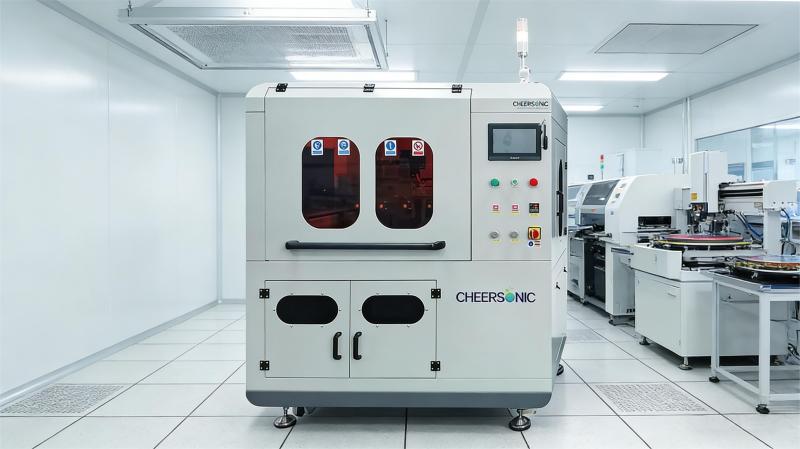
About Cheersonic
Cheersonic is the leading developer and manufacturer of ultrasonic coating systems for applying precise, thin film coatings to protect, strengthen or smooth surfaces on parts and components for the microelectronics/electronics, alternative energy, medical and industrial markets, including specialized glass applications in construction and automotive.
Our coating solutions are environmentally-friendly, efficient and highly reliable, and enable dramatic reductions in overspray, savings in raw material, water and energy usage and provide improved process repeatability, transfer efficiency, high uniformity and reduced emissions.