
Ultrasonic Spray Coating for CGM Sensor Coating
Ultrasonic Spray Coating for CGM Continuous Glucose Monitoring Sensor Coating: Process Challenges and Technological Breakthroughs
Continuous glucose monitoring (CGM) sensors are core devices for refined diabetes management. Their performance directly determines the accuracy, stability, and lifespan of blood glucose data, and the oxidase functional coating is a crucial element determining sensor quality. Current traditional preparation processes face multiple technical bottlenecks in enzyme coating uniformity, micro-droplet control, adhesion, and large-scale production, severely restricting the performance consistency and industrial cost control of CGM sensors. Ultrasonic spray coating machines, with their advantages of high-precision atomization, micro-droplet control, environmental adaptability, and mass production compatibility, provide a revolutionary solution to these challenges, becoming a core process support for high-end CGM sensor manufacturing.
I. Core Technical Challenges in Traditional CGM Sensor Oxidase Coating Preparation
Challenge 1: Uneven Distribution of Oxidase on the Electrode Surface, Leading to Poor Product Quality Consistency
As the biometric core of CGM sensors, the uniformity of oxidase distribution on the electrode surface directly determines the stability of the electrical signal output. Traditional processes such as dispensing, dip coating, and spin coating struggle to achieve uniform spreading of enzyme molecules within the microelectrode’s working area, often resulting in localized accumulation, edge enrichment, and central sparseness. Differences in enzyme layer thickness on the electrode surface directly lead to variations in response sensitivity and lifetime: areas with excessive enzyme are prone to signal overload and enhanced interference, while areas with insufficient enzyme exhibit sluggish response and elevated detection limits. Sensitivity differences between sensors in the same batch can exceed 20%, and lifetime fluctuations can exceed 30%, failing to meet the stringent accuracy requirements of clinical-grade CGM equipment. This ultimately results in low product yield, inconsistent quality, and difficulty in achieving uniform factory calibration.
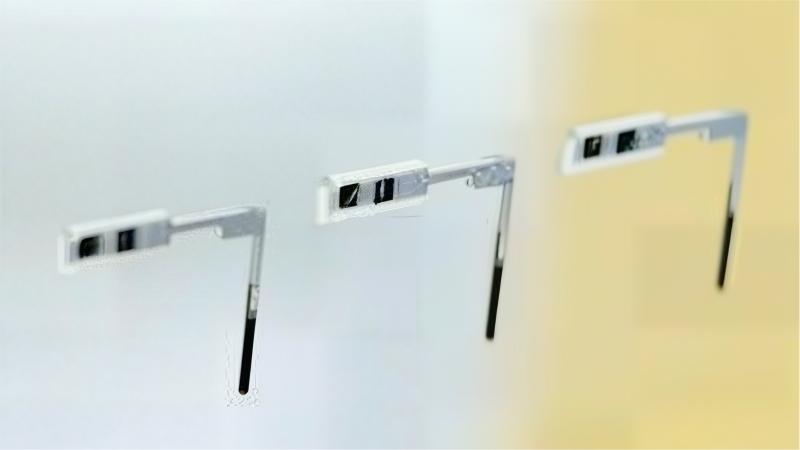
Challenge 2: Insufficient micro-volume control capability of traditional coating and dispensing equipment, leading to both material dissipation and quality fluctuations. Current oxidase coating generally relies on conventional dispensing equipment, which, limited by mechanical precision, fluid characteristics, and nozzle structure, cannot achieve precise control of ultra-micro enzyme droplets. Traditional dispensing droplet volumes are mostly in the nL range or larger, making it difficult to match the coating requirements of the micrometer-scale working area of microelectrodes, easily resulting in overspray, missed coating, and tailing. On the one hand, excessive spraying and non-targeted deposition result in a significant waste of high-value oxidase materials, with a material utilization rate of less than 60%, directly driving up production costs. On the other hand, droplet volume fluctuations and landing point offsets lead to inconsistent enzyme loading, further exacerbating sensor performance fluctuations and creating a vicious cycle of “insufficient accuracy—severe waste—unstable quality,” failing to meet the precision preparation requirements of biomedical coatings.
Challenge 3: Uneven enzyme layer distribution reduces electrode bonding strength and shortens sensor lifespan. Uneven deposition of oxidases on the electrode surface disrupts the interfacial bonding between the enzyme layer and the electrode substrate, leading to weak local bonding and easy detachment and inactivation of the enzyme layer. Areas with sparse enzyme molecules have small contact areas with the electrode, resulting in insufficient covalent bonding and physical adsorption strength, making them susceptible to erosion and dissolution in the subcutaneous interstitial fluid environment. Areas with accumulated enzyme layers are prone to internal stress concentration, leading to cracking and warping during long-term use, accelerating enzyme activity decay. Insufficient bonding strength directly shortens the effective response life of the electrode, causing early signal drift and decreased accuracy, making long-term stable monitoring impossible. This affects patient experience and reduces the market competitiveness of CGM products. Challenge 4: Insufficient Stability in Large-Scale Industrial Production Drives Up Sensor Manufacturing Costs
CGM sensors, as essential clinical consumables, require large-scale, high-efficiency, and highly consistent production. However, traditional processes have significant shortcomings in mass production: low single-unit capacity, narrow process parameter windows, and numerous manual intervention steps make it difficult to guarantee batch-to-batch stability. Simultaneously, low material utilization, insufficient yield, and high post-calibration costs result in persistently high unit sensor manufacturing costs. This contradiction between large-scale production and quality stability has become a key bottleneck restricting the widespread adoption of domestically produced CGM sensors, and also affects the industry’s overall cost reduction, efficiency improvement, and domestic substitution process.
II. Functional Advantages of Ultrasonic Spray Coating Machines in CGM Sensor Enzyme Coating Preparation
Addressing the four core challenges of traditional processes, ultrasonic spray coating machines offer comprehensive breakthroughs in atomization principles, control precision, environmental adaptability, and mass production design, providing a standardized, high-precision, and low-cost solution for CGM sensor oxidase coating preparation.
1. High-precision control of nozzle and enzyme application point for targeted and precise coating: The ultrasonic spraying machine is equipped with a micron-level motion control platform and intelligent positioning system, achieving nozzle movement accuracy ≤ ±1μm and enzyme application point position error ≤ ±5μm, precisely matching the size and shape of the microelectrode working area. The equipment supports custom coating paths and can perform non-contact targeted spraying on filamentary, sheet, and array electrodes, avoiding enzyme contamination of non-working areas. Spatially, it ensures that the oxidase is deposited only in the effective reaction area, completely solving the problems of application point misalignment and uneven coverage in traditional processes, laying the foundation for consistent sensor performance.
2. Precise control of pL-level droplets for coating uniformity CV < 1%: The ultrasonic spraying machine uses high-frequency ultrasonic vibration to atomize the oxidase solution into monodisperse pL-level ultrafine droplets. The droplet size distribution is extremely narrow, avoiding coating thickness differences caused by uneven droplet size from the source. The equipment allows for precise control of atomization power, liquid supply rate, and spraying distance, achieving nanometer-level precision control of enzyme loading per unit area. The coating uniformity coefficient of variation (CV) is less than 1%, far superior to traditional dispensing processes. This ultra-high uniformity ensures consistent enzyme content on each sensor electrode, resulting in highly unified response sensitivity, linearity, and detection accuracy. This allows for factory-ready calibration or simplified calibration, significantly improving product yield.
3. Closed-loop environmental humidity control protects oxidase bioactivity. Oxidases, as bioactive substances, are sensitive to environmental humidity. Excessive humidity can lead to enzyme dilution and uncontrolled diffusion, while insufficient humidity can cause enzyme drying and activity degradation. The ultrasonic sprayer integrates a constant temperature and humidity closed-loop control system, which can monitor and precisely control the humidity within the spraying chamber in real time, maintaining a stable physicochemical state of the enzyme solution and preventing enzyme denaturation and inactivation during atomization. This stable humidity environment, combined with gentle, non-contact spraying, maximizes the preservation of oxidase catalytic activity, improving sensor response efficiency and lifespan.
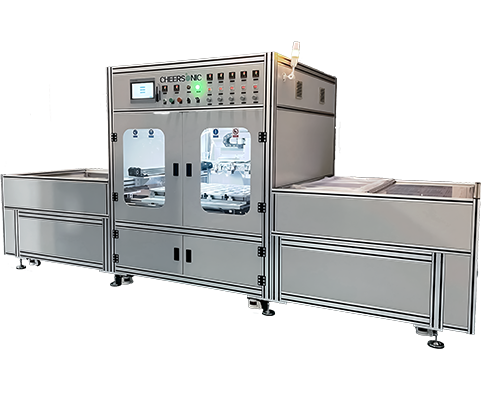
4. Compatible with mass production line equipment, balancing efficiency and cost. The ultrasonic spray coating machine adopts a modular and automated design, seamlessly integrating into the fully automated CGM sensor production line. It supports continuous, high-volume, and unmanned production, with single-unit capacity increasing by 3-5 times compared to traditional dispensing equipment. The equipment features process parameter memory, online monitoring, and fault self-diagnosis functions, ensuring batch-to-batch process stability and improving the yield rate to over 95%. Simultaneously, pL-level precision spraying increases the utilization rate of oxidase materials to over 95%, significantly reducing the dissipation of high-value biomaterials. Combining high efficiency and high yield, it reduces unit manufacturing costs throughout the entire production process, resolving the cost-quality contradiction in the large-scale production of CGM sensors.
III. Conclusion.
The uniformity, precision, adhesion, and large-scale production of oxidase coatings are the core technological barriers in CGM sensor manufacturing. The inherent defects of traditional processes have become a bottleneck for industry development. Ultrasonic spraying machines offer four core advantages: high-precision positioning, pL-level droplet control, closed-loop humidity adaptation, and compatibility with large-scale mass production. They systematically solve four major challenges: uneven enzyme distribution, poor micro-volume control, insufficient binding force, and high mass production costs. This significantly improves the response sensitivity, lifespan, and batch consistency of CGM sensors, while simultaneously reducing costs and increasing efficiency.
As diabetes management evolves towards precision, long-term, and portable solutions, the market demand for CGM sensors continues to surge. Ultrasonic spraying technology, with its unique advantages in the field of biomedical precision coating, will become the mainstream process for manufacturing high-end CGM sensors. This will drive the domestic CGM industry to break through technological barriers, achieve quality upgrades, and realize large-scale adoption, providing diabetic patients with more reliable and economical continuous blood glucose monitoring solutions.
About Cheersonic
Cheersonic is the leading developer and manufacturer of ultrasonic coating systems for applying precise, thin film coatings to protect, strengthen or smooth surfaces on parts and components for the microelectronics/electronics, alternative energy, medical and industrial markets, including specialized glass applications in construction and automotive.
Our coating solutions are environmentally-friendly, efficient and highly reliable, and enable dramatic reductions in overspray, savings in raw material, water and energy usage and provide improved process repeatability, transfer efficiency, high uniformity and reduced emissions.