
Ultrasonic Spraying Assists Thin-film Photovoltaic Industry
From Formulation Development to Mass Production: How Ultrasonic Spraying Technology Connects the Entire Industrialization Chain of Thin-Film Photovoltaics
In the research and industrialization of novel thin-film photovoltaic technologies, process controllability, repeatability, and seamless transition from laboratory to mass production are always key to whether a technology can leave the laboratory and realize commercial value. If you are engaged in the formulation development of next-generation perovskite light-absorbing layers, transitioning from existing thin-film preparation processes to ultrasonic pyrolysis spraying technology, or facing any process scale-up challenges related to thin-film photovoltaics, then a spraying solution with high precision, high uniformity, and easy scalability will become the core support for accelerating your technology’s implementation.
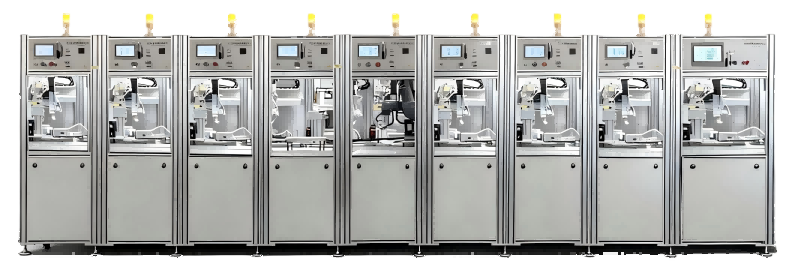
Ultrasonic spraying technology, as an advanced coating method that uses high-frequency sound wave energy to drive liquid atomization, has shown great potential in recent years in photovoltaic thin films, especially perovskite solar cells, organic photovoltaics (OPV), copper indium gallium selenide (CIGS), and quantum dot sensitized cells. Compared to traditional pneumatic or two-fluid spraying, ultrasonic atomization does not rely on high-speed airflow and high-pressure drive, thus producing more uniform and gentler droplets with narrower droplet size distribution and lower velocity. This significantly reduces material waste caused by bounce and splashing, making it particularly suitable for expensive and thickness-sensitive functional layer materials—such as perovskite precursor solutions. Furthermore, since it eliminates the need for high-pressure gas, ultrasonic spraying also significantly reduces the risk of micropore clogging and surface inhomogeneity, resulting in a smooth, dense, and pinhole-free thin film structure. This is crucial for improving the photoelectric conversion efficiency and long-term stability of solar cells.
However, scaling up thin-film photovoltaic processes from laboratory prototypes to large-scale production is often accompanied by a series of challenging engineering problems. During the perovskite layer formulation development stage, researchers need to quickly screen the effects of different solvent systems, additive ratios, and annealing conditions on crystal quality. At this point, an experimental-grade device capable of low-flow-rate, high-precision, programmable patterned spraying becomes crucial. Ideally, the device should support sub-microliter-level flow rate control and precisely regulate the film thickness from tens of nanometers to several micrometers by adjusting parameters such as ultrasonic frequency, carrier gas flow rate (if applicable), nozzle movement speed, and substrate temperature. More importantly, the device needs to have good process repeatability, ensuring that the results of each spraying experiment are statistically significant, thus providing a reliable basis for formulation optimization.
When you decide to switch from traditional processes such as spin coating, blade coating, or vapor deposition to ultrasonic pyrolysis spraying, the challenge lies in how to quickly establish a new process window. Pyrolysis spraying typically requires heating the precursor solution to a certain temperature, causing it to undergo an instantaneous thermal decomposition reaction upon contact with a high-temperature substrate, generating a dense metal oxide or sulfide film. If ultrasonic nozzles can be efficiently integrated with heating systems, inert atmosphere protection environments, and automated substrate transport modules, the process development cycle can be significantly shortened. For example, in the fabrication of electron transport layers (such as SnO₂, TiO₂) or hole transport layers (such as NiOx), ultrasonic atomization pyrolysis can produce thin films with uniform thickness and excellent interfacial contact on various substrates such as glass, flexible polymers, or stainless steel foil, thereby effectively reducing interfacial recombination losses and improving the open-circuit voltage and fill factor of the battery.
As for process scale-up—that is, the transition from monolithic small-area devices to roll-to-roll (R2R) or sheet-to-sheet (S2S) continuous production—high scalability and stability of the equipment are required. At this stage, the nozzle arrangement (single-head or multi-head array), the stability of the liquid supply system, the uniformity of the atomization field, and the coordination with the online defect detection system all become core factors determining capacity and yield. A mature ultrasonic spraying platform should be able to provide a complete process solution that maps directly from laboratory R&D to pilot lines and even mass production lines. This means that the nozzle module must support rapid replacement and cleaning, the liquid supply system should be compatible with solutions of different viscosities and volatility, and the entire system should be seamlessly integrated into existing nitrogen glove boxes, hot plates, annealing furnaces, or continuous baking tunnels. Meanwhile, comprehensive process support services—including initial process development, formulation optimization guidance, fault diagnosis training, and remote operation and maintenance support—can greatly reduce the technical risks for users during process transfer, avoiding the repeated trial-and-error costs caused by “good laboratory results but poor production line results.”
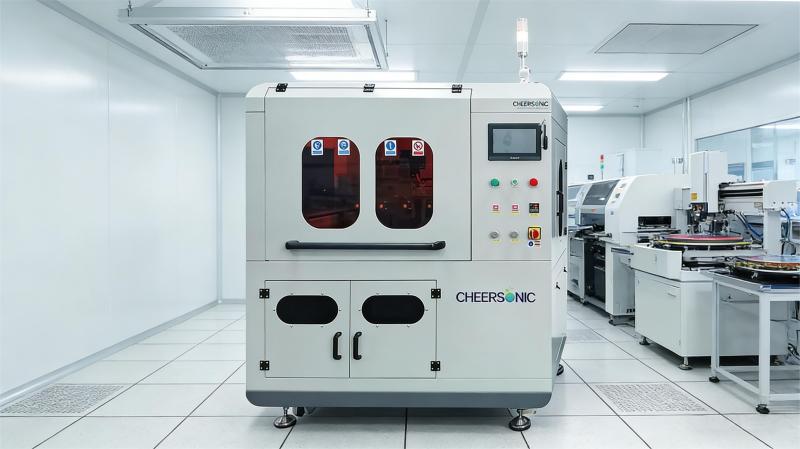
In summary, whether it’s overcoming the challenge of uniform crystallization in perovskite layers, completing the technological transformation from traditional processes to ultrasonic pyrolysis spraying, or stably replicating superior laboratory-grade performance on large-area, high-volume production lines, a reliable, adaptable ultrasonic spraying system with comprehensive process support is an indispensable accelerator. A professional team of application engineers can assist you in analyzing the atomization characteristics of specific materials, designing experimental schemes, and even conducting pre-experiments directly on your material system, thereby identifying the optimal process window in the shortest possible time. From initial formula screening to final commercial mass production, this comprehensive support model, encompassing equipment, application knowledge, and process optimization, is helping an increasing number of photovoltaic R&D teams cross the “valley of death,” transforming laboratory innovations into competitive products in the clean energy market. If you are currently at some point in this technological journey, consider thoroughly evaluating the compatibility potential of ultrasonic spraying technology with your current processes—it could very well be the key piece of the puzzle for breaking through efficiency bottlenecks and achieving large-scale manufacturing.
About Cheersonic
Cheersonic is the leading developer and manufacturer of ultrasonic coating systems for applying precise, thin film coatings to protect, strengthen or smooth surfaces on parts and components for the microelectronics/electronics, alternative energy, medical and industrial markets, including specialized glass applications in construction and automotive.
Our coating solutions are environmentally-friendly, efficient and highly reliable, and enable dramatic reductions in overspray, savings in raw material, water and energy usage and provide improved process repeatability, transfer efficiency, high uniformity and reduced emissions.
Chinese Website: Cheersonic Provides Professional Coating Solutions