
Find the Optimal Coating Solution for Your Fuel Cell or Electrolyzer Application
In-depth conversation with application engineers: Find the optimal coating solution for your fuel cell or electrolyzer application
In today’s rapidly developing clean energy technology landscape, fuel cells and electrolyzers are core components of the hydrogen energy industry chain. The preparation of the catalyst coating—a crucial step in their manufacturing process—directly determines the device’s performance, lifespan, and economics. Whether you focus on proton exchange membrane fuel cells (PEMFC), solid oxide fuel cells (SOFC), or are dedicated to developing proton exchange membrane electrolyzers (PEMEC) or alkaline electrolyzers, coating consistency and controllability remain key challenges for technological breakthroughs. Cheersonic understands that every company’s material system, loading target, and production scale are different. Therefore, we strongly recommend that you directly communicate with application engineers. Simply tell us your specific application scenario and performance requirements, and Cheersonic, leveraging its extensive process database and modular equipment platform, will tailor the most suitable fuel cell coating machine configuration, ultrasonic spray catalyst setup scheme, complete coating process parameters, and a coating system that can seamlessly connect to production scale. This will comprehensively help you achieve precise control of catalyst deposition, maximize precious metal utilization efficiency, optimize porous morphology design, and improve long-term durability.

I. Why is direct communication with application engineers necessary?
The preparation of catalyst layers for fuel cells and electrolyzers is by no means a “one-size-fits-all” process. Different membrane electrode assembly (MEA) materials, catalyst slurry rheological properties, solvent systems (such as water-based or alcohol-based), target loading (from low precious metal content to high power density designs), and production cycle requirements will all pose differentiated challenges to coating equipment and processes. Through one-on-one communication with application engineers, you can describe in detail the bottlenecks you are currently encountering, such as decreased uniformity due to catalyst agglomeration, utilization loss caused by edge effects, cracking caused by excessively fast drying rates, or scale-up effects from R&D to mass production. Cheersonic’s engineering team has over thousands of hours of practical experience in ultrasonic spraying processes and can quickly determine the appropriate equipment configuration based on the slurry parameters and quality indicators you provide.
II. Cheersonic’s Recommended Core Equipment and Configuration Elements
For your specific application, Cheersonic will provide professional advice from the following four aspects:
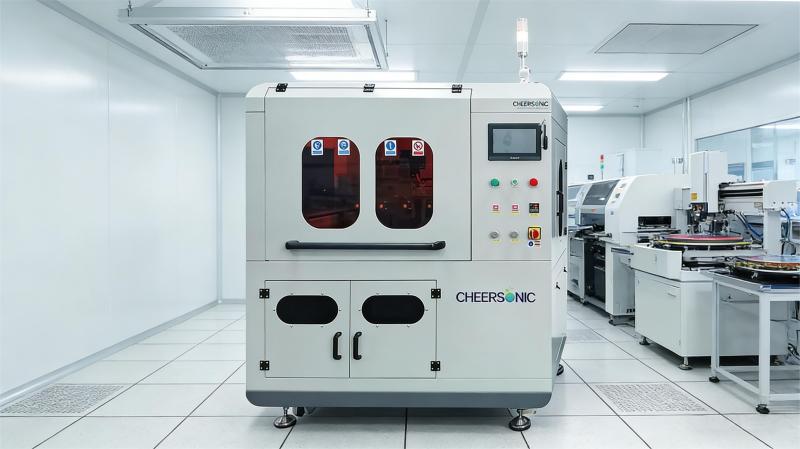
1. Fuel Cell Coating Machine Configuration: Depending on your working mode (manual experimentation, semi-automatic R&D, or fully automatic roll-to-roll production), we recommend coating platforms of different specifications. For example, for R&D-level needs, a compact single-station coating machine with a programmable three-axis motion mechanism is sufficient; for pilot lines, we recommend a modular system with a vacuum heating platform, closed-loop flow control, and online thickness monitoring; and for large-scale production, Cheersonic’s high-speed roll-to-roll coating machine can achieve continuous and stable coating with a width of over 300mm and a linear speed of 5m/min, and integrates a defect detection and correction system.
2. Ultrasonic Spray Catalyst Setup: The core of ultrasonic spraying technology lies in the matching of the atomizing head and the dispersion system. Cheersonic offers a variety of frequencies (e.g., 25kHz, 40kHz, 60kHz) and nozzle geometries (converging, wide-area, linear). For high-viscosity catalyst slurries (such as systems containing Nafion® ionomers), we recommend nozzles with wide-channel liquid delivery and anti-clogging designs; for ultra-low loadings (<0.1 mg/cm² precious metals), high-frequency fine atomizing nozzles are used to generate uniform submicron droplets, while precise angle and flow rate adjustment of the carrier gas flow prevents splashing or over-drying.
3. Coating Process Parameter Optimization: Parameters are the bridge between equipment and performance. Cheersonic’s application engineers will set a set of validated initial parameters for you based on your catalyst material (platinum, iridium, ruthenium, or their alloys), solvent evaporation rate, and substrate characteristics (such as GDL or proton exchange membranes). These parameters include: nozzle scanning speed (typically 20–200 mm/s), step spacing (1–5 mm), substrate temperature (programmable from room temperature to 120°C), slurry supply rate (0.5–20 ml/min), atomizing gas pressure (0.1–0.5 bar), and carrier gas pressure. More importantly, we provide parameter sensitivity analysis reports to help you quickly understand the impact of each variable on coating morphology and electrochemical performance.
4. Production-Scale Coating System Integration: Once your process is finalized, Cheersonic can provide scalability solutions from single machines to complete production lines. Our production-grade systems support multi-nozzle array parallel coating, closed-loop tension control, online drying tunnels, and automated loading and unloading devices. Simultaneously, the system can interconnect with the enterprise’s MES (Manufacturing Execution System) to achieve batch traceability and formula management, ensuring coating consistency from the first square meter to the 100,000th square meter.
III. Meeting Four Core Performance Objectives
Through the synergistic optimization of the above configuration and process, Cheersonic’s solution can precisely achieve the following objectives:
– Accuracy of catalyst deposition: Coating loading deviation can be controlled within ±3%, local areal density change rate <5%, and there are no pinholes, streaks, or thick edges.
– Maximizing precious metal efficiency: Due to the absence of high-speed impact during ultrasonic atomization, catalyst particles maintain their original particle size distribution, increasing utilization by 20%~40% compared to traditional spraying, achieving higher current density at the same loading.
– Ideal porous morphology: By controlling droplet drying kinetics, a structure with controllable porosity (50%~80%) and a three-dimensional interconnected network can be formed, promoting gas diffusion and proton transport while reducing mass transfer overpotential.
– Superior Durability: Optimized coating adhesion and cohesion, combined with defect-free uniform coverage, reduce the voltage decay rate of the membrane electrode assembly (MEA) by more than 30% in accelerated aging tests, meeting the lifespan requirements of 5000 hours for automotive fuel cells or 80000 hours for stationary electrolyzers.
IV. Take Action Now and Start Your Dedicated Process Consultation
Whether you are currently in the laboratory formulation exploration stage or selecting materials for a large-scale production line, Cheersonic’s application engineering team is ready to listen to your needs. Please tell us your application type (fuel cell/electrolyzer), target coating area, catalyst slurry characteristics (solid content, viscosity, solvent), and key performance indicators (load capacity, uniformity, defect rate). We will provide a preliminary solution within one week, including equipment selection, parameter recommendations, and a trial coating test plan. Cheersonic – empowering hydrogen energy production with ultrasonic spraying technology, from a gram of catalyst to a megawatt-class fuel cell stack, we are always there for you.
About Cheersonic
Cheersonic is the leading developer and manufacturer of ultrasonic coating systems for applying precise, thin film coatings to protect, strengthen or smooth surfaces on parts and components for the microelectronics/electronics, alternative energy, medical and industrial markets, including specialized glass applications in construction and automotive.
Our coating solutions are environmentally-friendly, efficient and highly reliable, and enable dramatic reductions in overspray, savings in raw material, water and energy usage and provide improved process repeatability, transfer efficiency, high uniformity and reduced emissions.
Chinese Website: Cheersonic Provides Professional Coating Solutions
