
Analysis of Ultrasonic Spraying Technology for SOFC
Analysis of Ultrasonic Spraying Technology for Solid Oxide Fuel Cell Substrate Coatings
In the manufacturing process of solid oxide fuel cells (SOFCs), the preparation of the substrate coating is a crucial step determining the cell’s performance, lifespan, and reliability. Ultrasonic spraying systems, as a high-precision, low-damage coating technology, have been widely applied in the deposition processes of SOFC anodes, cathodes, and adjacent functional layers of the electrolyte. Compared with traditional spraying methods, ultrasonic spraying can achieve uniform and controllable coating of ceramic slurries, metal oxide suspensions, and various functional coatings, and is particularly suitable for porous ceramic substrates and electrode surfaces with complex geometries. The following will elaborate on this technology from the aspects of technical principles, process advantages, material compatibility, and its supporting role in fuel cell stack performance.
I. Basic Principles of Ultrasonic Spraying and its Compatibility in SOFC Coatings
Ultrasonic spraying technology utilizes piezoelectric transducers to convert electrical energy into high-frequency mechanical vibrations (typically 20 kHz to 120 kHz), generating longitudinal standing waves at the nozzle tip. When a liquid slurry is delivered to a vibrating surface, a thin liquid film forms, generating capillary waves that atomize into micron- or even submicron-sized droplets. Guided by an auxiliary carrier gas (such as clean air or an inert gas), these droplets deposit onto the substrate at a low velocity. Because the atomization process does not rely on high-speed liquid flow or high-pressure gas flow, the droplets have extremely low kinetic energy, hence the term “soft atomization.”

For solid oxide fuel cells, the anode, cathode, and electrolyte layer typically have porous structures, and the substrate is often made of brittle ceramic materials such as yttrium-stabilized zirconium oxide (YSZ) or lanthanum gallate-doped ceramics. Traditional pneumatic spraying or spin coating techniques can easily impact porous surfaces, causing particles to become embedded in the pores, damaging the pore structure, or inducing microcracks. Ultrasonic spraying, with its gentle droplet flow, can gently wet the porous ceramic surface, avoiding damage to the original pore network while ensuring that the coating material is uniformly filled in the electrode active areas or adhered to the electrolyte separator.
II. Processing Capabilities for Various Functional Coatings and Complex Slurries
SOFC single cells consist of a multi-layered structure including an anode support layer, an anode functional layer, an electrolyte layer, a cathode functional layer, and a cathode current collector layer. Each layer has significantly different material formulations and physical properties. Ultrasonic spraying systems can handle the following typical material systems:
– Ceramic slurries: such as NiO-YSZ mixed slurries for the anode, YSZ slurries for the electrolyte, and lanthanum-strontium-manganese (LSM) or lanthanum-strontium-cobalt-iron (LSCF) slurries for the cathode. Ultrasonic atomization effectively disperses ceramic particles, prevents agglomeration, and maintains stable solids content during spraying.
– Metal oxide suspensions: such as impregnation-modified cerium oxide, cobalt oxide, or copper oxide nanosuspensions, which can be used to enhance electrode catalytic activity or improve anti-carbon deposition performance.
– Functional coatings: including barrier layers (such as GDC layers to prevent electrolyte-cathode reaction), contact layers, or diffusion barrier layers. These coatings often require extremely thin thicknesses (a few micrometers to tens of micrometers) and extremely high density. Ultrasonic spraying allows for layer-by-layer deposition through multiple scans, precisely controlling thickness and porosity.
Furthermore, ultrasonic spraying is highly adaptable to slurry viscosity (typically 1–100 cP) and is less prone to nozzle clogging, making it particularly suitable for suspension systems containing large particles (such as submicron to several micrometer-sized ceramic powders). By adjusting the vibration frequency, carrier gas flow rate, liquid flow rate, and spraying path, engineers can optimize droplet size (from 10 μm to 150 μm) and deposition patterns for different materials, thereby meeting the differentiated requirements of each functional layer in SOFC.
III. Mechanisms for Improving Uniformity and Adhesion
During long-term operation of SOFC (typically operating at 600–1000°C), thermal expansion matching between the coating and the substrate, as well as interfacial adhesion, are crucial to preventing peeling and cracking. Ultrasonic spraying technology significantly improves coating quality in two aspects:
1. Macroscopic Uniformity: Due to the uniform droplet size and controllable flight trajectory, ultrasonic spraying can achieve a uniform coating with a thickness deviation of less than ±5%, which is particularly crucial for the electrolyte isolation layer—any excessively thin area can lead to gas penetration, resulting in a drop in open-circuit voltage or even a direct short circuit. Simultaneously, a uniform anodic functional layer ensures sufficient distribution of the three-phase reaction interface, increasing current density.
2. Enhanced Microscopic Adhesion: The soft atomization characteristics allow droplets to “spread” rather than “impact” the substrate surface. On porous ceramics, this low-speed deposition helps the slurry naturally penetrate into the pore edges, forming a mechanically interlocking structure; on the relatively dense electrolyte layer, after uniform droplet spreading and subsequent sintering, a solid-state diffusion reaction occurs with the substrate, forming chemical bonds. Experiments show that the peel strength of the NiO-YSZ anodic coating prepared by ultrasonic spraying is approximately 30%–50% higher than that of traditional spraying methods.
Furthermore, for substrates with complex geometries—such as tubular SOFCs or microchannel structures—the atomized flow of ultrasonic spraying has low momentum, allowing it to flow around to shaded areas and achieve better conformal coverage. This characteristic is particularly important for the manufacture of non-planar fuel cell stacks.
IV. Support for the Durability of SOFC Stacks
One of the bottlenecks to the commercialization of solid oxide fuel cells is long-term operational stability, and the uniformity, defect-free nature, and adhesion of the coating directly determine the degradation rate of the fuel cell stack. Ultrasonic spraying technology improves overall durability in the following ways:
– Inhibiting anode carbon deposition and sulfur poisoning: By uniformly coating a suspension of nanocatalysts (such as CeO₂ or Ru), a catalytic protective layer can be formed on the porous anode surface, avoiding carbon deposition or sulfide adsorption caused by local hot spots.
– Preventing electrolyte crack propagation: At electrolyte edges or between adjacent layers, the dense and pinhole-free barrier layer formed by ultrasonic spraying effectively inhibits crack initiation and reduces mechanical failure during thermal cycling.
– Reduced contact resistance: The current collector layer (such as silver or LSM slurry) on the cathode side is coated with a thin and continuous layer using ultrasonic spraying, ensuring uniform current collection and avoiding sintering shrinkage or delamination caused by localized Joule heating.
In summary, SOFC substrate coatings prepared using ultrasonic spraying technology exhibit excellent performance in both initial properties (such as power density and fuel utilization) and long-term degradation rates (typically <0.5% per thousand hours). Many research institutions and companies have adopted ultrasonic spraying as a standardized coating method in SOFC mass production processes, especially suitable for production lines of large-area flat-panel cells or complex tubular cells.
V. Summary and Outlook
Ultrasonic spraying systems, with their low-damage, high-uniformity, and strong material compatibility, have become an ideal choice for preparing coatings for the anode, cathode, and adjacent electrolyte layers of solid oxide fuel cells. It can effectively coat ceramic slurries, metal oxide suspensions, and various functional coatings, achieving excellent adhesion and conformal coverage on porous ceramics and complex geometric substrates, thereby supporting the long-term, durable, and stable operation of SOFC stacks. As SOFCs develop towards lower operating temperatures (500–650°C) and thinner electrolytes in the future, the requirements for coating precision will be further increased. Ultrasonic spraying technology will also continue to evolve in the directions of automation, online monitoring and multi-component co-spraying, providing key process guarantees for the large-scale manufacturing of high-performance fuel cells.
About Cheersonic
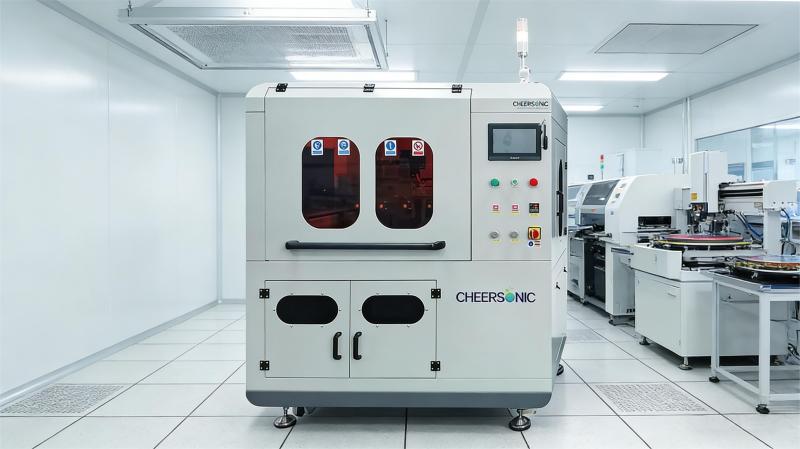
Cheersonic is the leading developer and manufacturer of ultrasonic coating systems for applying precise, thin film coatings to protect, strengthen or smooth surfaces on parts and components for the microelectronics/electronics, alternative energy, medical and industrial markets, including specialized glass applications in construction and automotive.
Our coating solutions are environmentally-friendly, efficient and highly reliable, and enable dramatic reductions in overspray, savings in raw material, water and energy usage and provide improved process repeatability, transfer efficiency, high uniformity and reduced emissions.
Chinese Website: Cheersonic Provides Professional Coating Solutions
