
Multi-Scale Coating Capabilities of Ultrasonic Spraying
From Lab to Production Line: Multi-Scale Coating Capabilities of Ultrasonic Spraying
Ultrasonic spraying technology, with its unique atomization mechanism, exhibits exceptional flexibility in coating preparation—providing ideal patterning solutions from precise laboratory research to large-scale industrial production. Its core lies in the fact that ultrasonic energy can break down liquid precursors into uniform droplets at the micron or even submicron scale, thereby forming coatings with clear boundaries and controllable thickness. This “scale-as-you-go” capability allows the same technology platform to meet the needs of the entire chain from scientific research to mass production.
In the research and development and small-batch trial production stages, ultrasonic spraying can achieve extremely small and precise coating coverage. Traditional two-fluid spray guns, due to their larger droplet size and dispersed distribution, struggle to form regular patterns in areas even smaller than millimeters. In contrast, ultrasonic nozzles produce droplets with narrow size distribution and low momentum, resulting in almost no splashing or bounce. Researchers can directly define coating paths only a few millimeters wide on the surfaces of chips, sensors, micro fuel cells, or microfluidic devices, with edge straightness better than ±0.5 millimeters. This precise patterning control is significant for precious metal catalysts, bioactive substances, or high-value nanomaterials—it can increase material utilization to over 95% and significantly reduce R&D costs. Simultaneously, since the atomization process does not require high-pressure gas, it avoids disturbance to the tiny substrates by airflow and eliminates the risk of cross-contamination from aerosol dispersion. Therefore, ultrasonic spraying has become one of the standard methods for micro/nano coating preparation in academic laboratories, pharmaceutical R&D centers, and prototyping lines for high-end electronic devices.
When the process needs to transition to pilot or small-batch production, users can extend the spray footprint to tens of centimeters wide by changing nozzles with different orifice diameters and structures. This scalability is not simply a matter of increasing the flow rate, but rather achieving wide-area uniform deposition by optimizing the resonant frequency and amplitude while maintaining a essentially unchanged droplet size distribution. For example, in the development of perovskite solar cells or flexible OLED lighting panels, it is often necessary to coat hole transport layers or light-emitting layers on 100mm × 100mm substrates. Ultrasonic nozzles can complete this in a single scan, with film thickness non-uniformity below 3%. Compared to spin coating or slot coating, it avoids the significant material waste in spin coating (approximately 80% of the coating liquid is splashed out) and eliminates the need for customized high-precision molds for each size, as required by slot coating dies, greatly shortening the process iteration cycle.
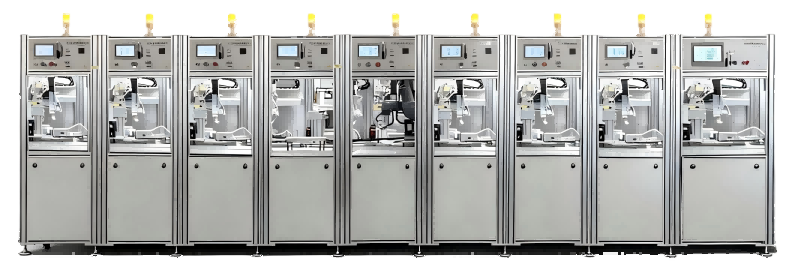
In large-scale, high-throughput industrial manufacturing, the advantages of ultrasonic spraying technology are fully realized through multi-nozzle array design. For large-area substrates, such as energy-saving architectural glass (often exceeding 1.5m × 3.0m in size), photovoltaic modules (2m × 1m thin-film or crystalline silicon-perovskite tandem cells), and large-size touch panels for automotive interiors, the cycle time of a single nozzle scan is insufficient for mass production requirements. Multi-nozzle arrays arrange multiple independently controlled ultrasonic nozzles linearly or in a matrix layout. Each nozzle is responsible for a specific coating area. By coordinating the movement trajectory and start-stop sequence of each nozzle, synchronous coverage of the entire wide substrate is achieved. This parallel operation mode can reduce the coating time per unit area to a fraction of that of a single-nozzle solution. More importantly, each nozzle in the array can independently adjust its flow rate, atomization power, and coating pattern boundary, thereby compensating for local distance variations caused by substrate warping or conveyor belt vibration, ensuring film thickness uniformity within ±5% over large areas. On production lines for lithium-ion battery separator ceramic coatings, proton exchange membrane fuel cell gas diffusion layers (microporous layers), and high-end electromagnetic shielding films, multi-nozzle ultrasonic spraying systems have successfully achieved continuous roll-to-roll operation with linear speeds reaching several meters per minute, and annual production capacity exceeding one million square meters.
It is worth emphasizing that the reason ultrasonic spraying technology can simultaneously cover both the “tiniest” and “largest” extremes lies in its inherent characteristics of being non-contact, low-stress, and highly efficient in material utilization. Whether using a single nozzle for micro-area dot coating or employing hundreds of nozzles for wide-area array spraying, the droplet generation mechanism remains consistent—high-frequency mechanical vibration replaces high-pressure gas or centrifugal force, allowing for seamless scaling without altering formulation viscosity or surface tension. Users only need to configure the number of nozzles, scanning path, and deposition density via software to develop processes ranging from milligram-level to kilogram-level material consumption on the same platform. This scalability significantly shortens the product transformation cycle from laboratory to market and substantially reduces equipment investment and operation and maintenance costs.
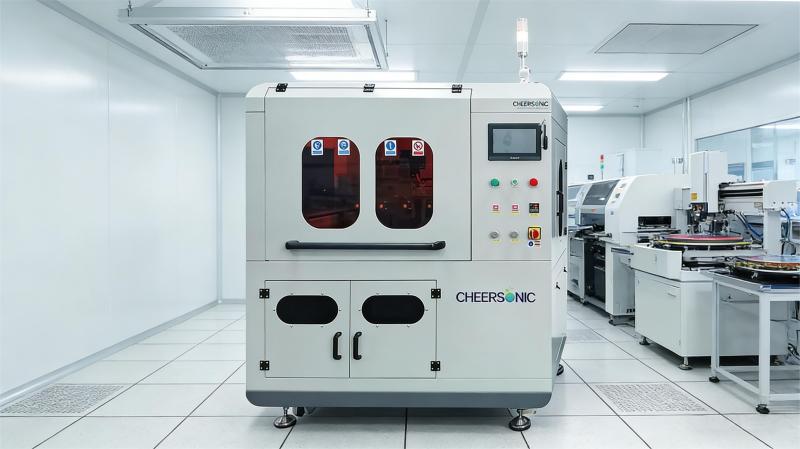
In summary, ultrasonic spraying offers an extremely high dynamic range for pattern size: it can be refined to sub-millimeter precision points, serving rapid prototyping of cutting-edge materials; and it can be expanded to meter-level large-area uniform coating through multi-nozzle arrays, meeting the demands of high-speed, low-cost industrial production. This versatile characteristic makes it a key bridge connecting scientific research and advanced manufacturing, continuously releasing technological value in fields such as new energy, semiconductor packaging, biomedicine, and optical coating. With increasing demands for coating uniformity, material utilization, and process flexibility, ultrasonic spraying technology is evolving towards more intelligent array control, more real-time closed-loop feedback, and greater adaptability to high-viscosity slurries, providing solid process support for the next generation of precision manufacturing.
About Cheersonic
Cheersonic is the leading developer and manufacturer of ultrasonic coating systems for applying precise, thin film coatings to protect, strengthen or smooth surfaces on parts and components for the microelectronics/electronics, alternative energy, medical and industrial markets, including specialized glass applications in construction and automotive.
Our coating solutions are environmentally-friendly, efficient and highly reliable, and enable dramatic reductions in overspray, savings in raw material, water and energy usage and provide improved process repeatability, transfer efficiency, high uniformity and reduced emissions.
Chinese Website: Cheersonic Provides Professional Coating Solutions
