Advantages and Performance Enhancement of Ultrasonic Spraying Technology
As an advanced thin-film preparation technology, ultrasonic spraying demonstrates significant advantages in various functional coating preparation fields due to its unique working principle and precise control capabilities. It plays an irreplaceable role, especially in scenarios requiring high-precision thin-film construction. This technology uses ultrasonic vibrations to atomize liquid raw materials into tiny, uniform droplets, which are then precisely deposited onto the substrate surface. This allows for precise control over the film thickness and structural morphology, providing strong support for the optimized design of catalyst layers.
In the engineering preparation of catalyst layers, porosity and mass transport efficiency are the core factors determining their performance, and ultrasonic spraying technology precisely meets these core requirements. Traditional spraying techniques often suffer from uneven droplet size and difficulty in controlling deposition thickness, easily leading to disordered pore distribution and uneven structure in the catalyst layer, thus affecting mass transport efficiency and catalytic performance. In contrast, ultrasonic spraying can precisely control the size and deposition rate of atomized droplets by adjusting parameters such as ultrasonic frequency, liquid flow rate, and spraying distance, making the catalyst layer thickness uniform and controllable, while simultaneously achieving precise control over the pore structure.
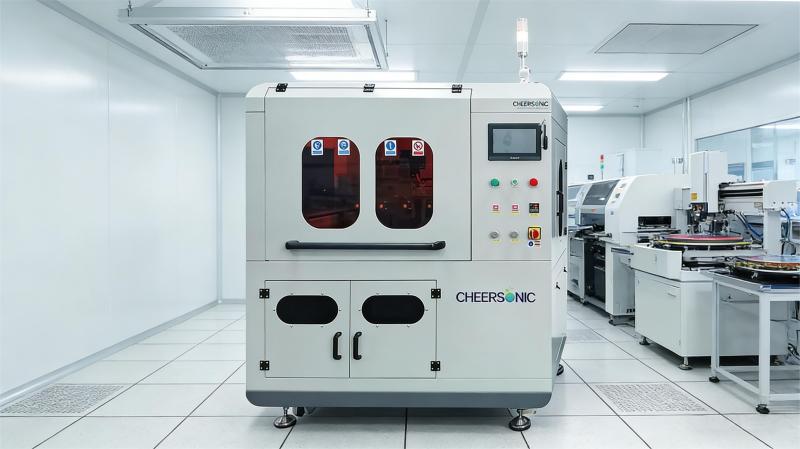
Catalyst layers prepared using ultrasonic spraying technology allow for flexible adjustment of pore size, distribution, and connectivity to create an optimal pore structure tailored to specific application needs. This optimized pore structure not only provides smooth transport channels for reactants and products, reducing resistance during mass transport and improving catalytic reaction efficiency, but also increases the specific surface area of the catalyst, fully exposing active sites and further enhancing catalytic performance. Whether in energy conversion, environmental protection, or other fields requiring catalytic reactions, this precisely controllable catalyst layer significantly improves the overall performance of the equipment.
In addition to optimizing the structure and performance of the catalyst layer, ultrasonic spraying technology can also effectively improve the comprehensive performance of proton exchange membrane (PEM) coatings, particularly in terms of flexibility and crack resistance. As a core component of many energy devices, the performance stability of the PEM directly determines the long-term operational reliability of the equipment. During coating preparation and subsequent handling and operation, traditional coatings are prone to cracking and peeling due to stress changes, temperature fluctuations, and other factors, severely impacting the equipment’s lifespan.
PEM coatings prepared using ultrasonic spraying technology, due to uniform droplet deposition and tight adhesion between the coating and the substrate, can form a dense and highly flexible thin film. This coating effectively disperses stress and prevents cracking when subjected to external impacts, temperature changes, or fatigue from long-term operation, thus maintaining the integrity and stability of the coating. Simultaneously, its good flexibility makes the coating less susceptible to damage during handling and installation, reducing losses during production and use.
In the long term, PEM coatings prepared using ultrasonic spraying technology can effectively improve the long-term durability of equipment. On the one hand, the improved crack resistance and flexibility reduce the probability of coating damage, avoiding equipment failure due to coating failure; on the other hand, the optimized pore structure and uniform coating distribution reduce the impact of corrosion, aging, and other factors on the coating, extending its service life. This not only reduces equipment maintenance costs and replacement frequency but also improves the stability and reliability of equipment operation, providing strong support for technological upgrades and industrial development in related fields.
Overall, ultrasonic spraying technology, through precise control of thin film construction and morphology regulation, makes it possible to optimize the design of catalyst layers, thereby producing high-performance PEM coatings. Its significant advantages in improving coating flexibility, crack resistance and long-term durability make it widely applicable in various fields that require high-precision coatings, which can promote the continuous improvement of related equipment performance and inject new impetus into the high-quality development of the industry.
About Cheersonic
Cheersonic is the leading developer and manufacturer of ultrasonic coating systems for applying precise, thin film coatings to protect, strengthen or smooth surfaces on parts and components for the microelectronics/electronics, alternative energy, medical and industrial markets, including specialized glass applications in construction and automotive.
Our coating solutions are environmentally-friendly, efficient and highly reliable, and enable dramatic reductions in overspray, savings in raw material, water and energy usage and provide improved process repeatability, transfer efficiency, high uniformity and reduced emissions.
Chinese Website: Cheersonic Provides Professional Coating Solutions