
Uniform Catalyst Deposition on Metal and Carbon-Based Substrates
Ultrasonic Spraying Technology for Uniform Catalyst Deposition on Metal and Carbon-Based Substrates
In the fields of advanced materials preparation and surface engineering, obtaining uniform, controllable, and high-quality thin-film coatings on metal or carbon-based substrates with high precision requirements has always been a core focus of technological breakthroughs. Ultrasonic spraying technology, as an emerging thin-film deposition method, is becoming an ideal solution to meet these needs due to its unique atomization mechanism and mild transport characteristics. This technology can achieve high-quality, highly repeatable thin-film coatings on metal substrates requiring uniform catalyst loading (such as stainless steel mesh, nickel foam, titanium plates, etc.) and carbon-based substrates (such as carbon paper, carbon cloth, graphene films, carbon nanotube arrays, etc.).
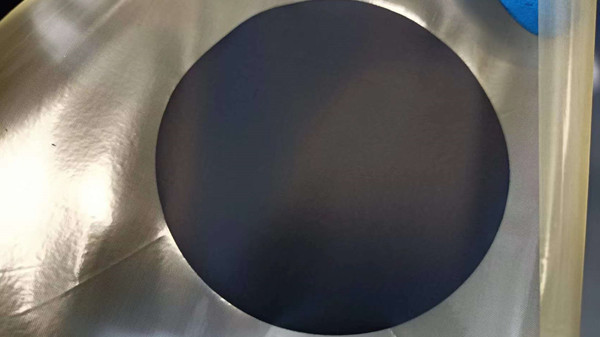
The working principle of ultrasonic spraying lies in utilizing high-frequency sound waves to generate cavitation effects and surface tension waves in liquids, breaking the precursor solution into tiny droplets at the micron or even submicron scale. Compared with traditional pneumatic spray guns, these droplets have the characteristics of narrow size distribution, low flight speed, and significantly reduced momentum. When these catalysts fall onto the substrate surface, they do not bounce or splash violently, but rather spread and fuse smoothly, ultimately forming a smooth thin film layer with uniform thickness, high density, and minimal defects. This process significantly reduces the “coffee ring effect” or localized accumulation, resulting in a highly consistent catalyst deposition per unit area, thus ensuring the consistency of subsequent electrochemical or catalytic reactions.
For metal substrates, many catalytic applications—such as hydrogen production through water electrolysis, electrodes in fuel cells, and air cathodes in metal-air batteries—require catalysts (such as platinum, iridium, ruthenium, and nickel-iron layered double hydroxides) to achieve atomic or nanoscale uniform distribution on a three-dimensional porous metal structure. Ultrasonic spraying technology can adapt to catalyst inks of varying viscosities. By precisely controlling parameters such as liquid flow rate, substrate temperature, and nozzle scanning path, it can form a composite catalytic layer with strong adhesion and low interfacial resistance without damaging the surface morphology of the metal substrate. Simultaneously, due to the low droplet kinetic energy, this process causes almost no mechanical impact on the fragile structures of metal foils or foam metals, making it particularly suitable for flexible or thin metal substrates.
Carbon-based substrates are another important type of support. Carbon paper, carbon cloth, and other materials are widely used in the gas diffusion layer of proton exchange membrane fuel cells, electrodes of lithium-air batteries, and various sensing elements due to their large specific surface area, good conductivity, and strong chemical stability. However, carbon materials are often hydrophobic and porous, and traditional coating methods can easily lead to catalyst seepage into the deep pores, resulting in waste, or uneven agglomeration on the surface. Ultrasonic spraying generates ultrafine droplets that can uniformly cover each filament of carbon fiber in the form of a “wet aerosol.” By adjusting the solvent evaporation rate and droplet size, the catalyst is mainly loaded on the fiber surface rather than deep within the pores, thereby maximizing catalyst utilization. Furthermore, this technology supports the continuous deposition of multilayer heterogeneous structures, such as first spraying a hydrophilic modification layer and then depositing a catalytic active layer, providing great flexibility for the functional design of carbon-based supports.
In terms of specific process control, ultrasonic spraying systems are typically equipped with high-precision injection pumps, heating platforms, X-Y-Z motion modules, and closed-loop control software. Operators can set the spraying area, number of layers, single-layer thickness, and nozzle movement speed according to the substrate size and shape. For thick catalytic films on metal substrates, multiple thin-layer stacking can be used to avoid internal stress cracking. For ultrathin layers only a few nanometers thick on carbon-based substrates, smaller droplet diameters can be obtained by diluting the precursor concentration and increasing the ultrasonic frequency. Temperature control is also crucial: appropriate heating of the substrate can promote rapid solvent evaporation at the moment of droplet impact, preventing excessive lateral spread of the droplets and resulting in decreased resolution, which is particularly suitable for applications requiring patterned coatings.
In terms of application results, catalyst-coated electrodes prepared using ultrasonic spraying technology exhibit superior uniformity compared to manual brushing or traditional spraying in cyclic voltammetry tests, polarization curves, and long-term stability. For example, on the cathode side of a proton exchange membrane fuel cell, the thickness deviation of the platinum-carbon catalyst layer deposited on the carbon paper surface can be controlled within ±5%, significantly increasing the electrochemical active area. On the nickel foam anode for hydrogen production via water electrolysis, the in-situ grown iron-nickel oxide film achieves atomic-level mixing through ultrasonic spraying, resulting in a significant reduction in overpotential. More importantly, this technology boasts extremely high material utilization (typically exceeding 90%) and produces no splashing pollution, making it suitable for the economical use of precious metal catalysts.
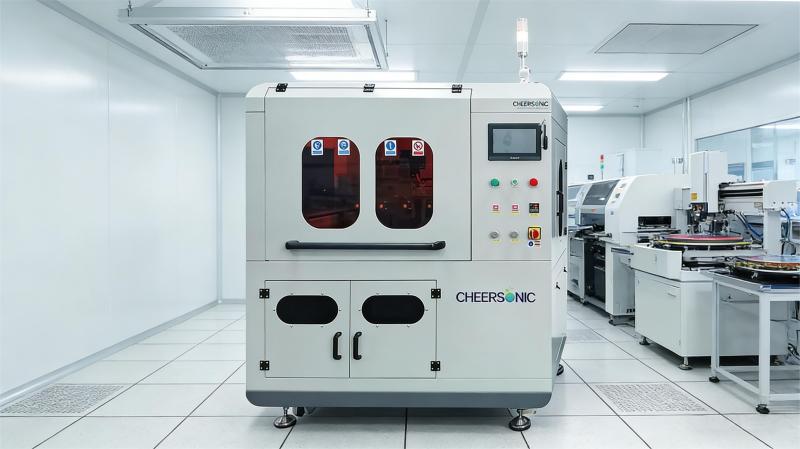
In summary, ultrasonic spraying technology perfectly meets the stringent requirement of “coating thin film layers on metal or carbon-based substrates requiring uniform catalyst deposition.” It not only solves the long-standing pain points of traditional coating methods, such as uneven thickness, material waste, and substrate damage, but also provides a reliable and reproducible process route for the research and large-scale production of next-generation high-performance catalytic electrodes, energy storage devices, and flexible electronic products. With a deeper understanding of atomization mechanisms and increased automation, this technology will unleash even greater application potential in fields such as new energy materials, environmental catalysis, and biosensing.
About Cheersonic
Cheersonic is the leading developer and manufacturer of ultrasonic coating systems for applying precise, thin film coatings to protect, strengthen or smooth surfaces on parts and components for the microelectronics/electronics, alternative energy, medical and industrial markets, including specialized glass applications in construction and automotive.
Our coating solutions are environmentally-friendly, efficient and highly reliable, and enable dramatic reductions in overspray, savings in raw material, water and energy usage and provide improved process repeatability, transfer efficiency, high uniformity and reduced emissions.
Chinese Website: Cheersonic Provides Professional Coating Solutions
