
Ultrasonic Spray Deposition Solution for Gas-Sensing Materials
Ultrasonic Spray Deposition Solution for Gas-Sensing Materials in MEMS Gas Sensors
With the explosive development of Micro-Electro-Mechanical Systems (MEMS) technology, the field of gas sensing is undergoing profound changes. MEMS gas sensors, with their unique advantages of miniaturization, integration, and intelligence, have become core sensing tools in fields such as industrial safety, environmental monitoring, and healthcare. As a core component of MEMS gas sensors, the deposition quality of gas-sensitive materials directly determines the sensor’s sensitivity, selectivity, response speed, and long-term stability. Ultrasonic spray deposition technology, as a highly efficient and precise thin-film preparation method, offers advantages such as high coating uniformity, high material utilization, and strong process compatibility. It has become the preferred solution for solving the deposition challenges of gas-sensitive materials in MEMS gas sensors, effectively overcoming the limitations of traditional deposition techniques and facilitating the large-scale production and application upgrades of high-performance MEMS gas sensors.
This solution centers on ultrasonic spray deposition technology, combining it with the specific requirements of gas-sensitive materials for MEMS gas sensors. It constructs a standardized system covering the entire process from initial preparation, process optimization, process control to post-process testing. It is compatible with various commonly used gas-sensitive materials such as tin oxide (SnO₂), zinc oxide (ZnO), and zinc tin oxides (ZnSnO₃, Zn₂SnO₄), meeting the performance requirements of MEMS gas sensors in different scenarios while balancing R&D testing and large-scale mass production needs. This achieves efficient, precise, and stable gas-sensitive material deposition.
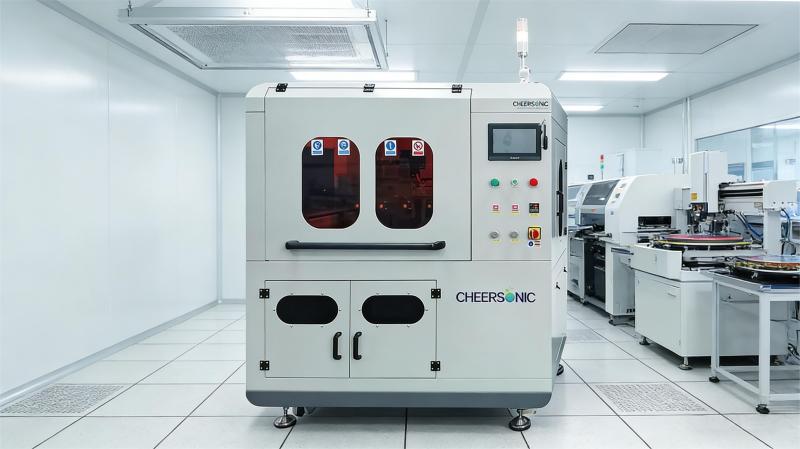
At the technical principle level, ultrasonic spray deposition technology relies on high-frequency ultrasonic vibration to atomize the gas-sensitive material precursor solution into uniformly sized, well-dispersed microdroplets. These droplets, propelled by a carrier gas, are precisely sprayed onto the surface of the MEMS sensor substrate. Subsequent processing, including heating, drying, and pyrolysis, forms a dense, uniform gas-sensitive thin film that is tightly bonded to the substrate. Compared to traditional chemical vapor deposition (CVD), physical vapor deposition (PVD), and blade coating techniques, ultrasonic spraying deposition eliminates the need for high-pressure gas assistance, achieves droplet velocities below 2 m/s, significantly reduces droplet bounce and overspray, and boasts a material utilization rate exceeding 90%, substantially lowering production costs. Furthermore, it allows for precise control of process parameters to fabricate gas-sensitive films with thicknesses ranging from nanometers to micrometers, and it can adapt to complex MEMS substrate structures without damaging the substrate, perfectly meeting the miniaturization and high-precision fabrication requirements of MEMS sensors.
The core advantages of this solution lie in its multi-dimensional process optimization and precise control. Regarding the compatibility of gas-sensitive materials, the precursor solution preparation process is optimized based on the physicochemical properties of different types of gas-sensitive materials. By controlling the solute concentration, solvent ratio, and dopant proportion, the stability of the solution and the atomization effect are ensured. For example, in the deposition of tin oxide gas-sensitive materials, the sensitivity of the material to toxic gases such as carbon monoxide (CO) can be improved and the sensor operating temperature reduced by adding catalytic particles such as palladium (Pd) and platinum (Pt) combined with the uniform deposition characteristics of ultrasonic spraying. In zinc-tin oxide systems, the selectivity of the material to volatile organic compounds (VOCs) such as acetone can be improved by adjusting the Zn/Sn stoichiometry and optimizing the oxygen vacancy density and surface active sites.
Regarding process parameter control, a multi-parameter synergistic optimization system is established, focusing on controlling key parameters such as ultrasonic atomization frequency, precursor flow rate, carrier gas flow rate, spraying distance, and substrate temperature. The ultrasonic atomization frequency can be adjusted within the range of 1.7~3.5MHz to ensure uniform droplet size and a coefficient of variation of less than 15%. The precursor flow rate is controlled at 5~20mL/min, combined with precise adjustment of the carrier gas flow rate (10~500mL/min) to achieve uniform droplet spreading on the substrate surface. The spraying distance is set at 0.5~5cm, and the substrate temperature is controlled at 300~540℃ according to the material characteristics, ensuring rapid drying and pyrolysis of the droplets while avoiding excessively large material grains that could affect sensing performance. Furthermore, by introducing an annealing process to stabilize the deposited gas-sensitive film in a pure air environment, the microstructure of the material can be optimized, improving the film resistivity and gas sensitivity, resulting in a 2~10-fold increase in the response value of the gas-sensitive material to the target gas.
A comprehensive quality control system is a crucial guarantee for the reliability of the solution. In the initial stage, the MEMS sensor substrate undergoes rigorous cleaning using ultrasonic treatment with ethanol, acetone, and deionized water to remove surface oil and impurities, followed by nitrogen drying to ensure surface cleanliness and enhance the adhesion between the gas-sensitive film and the substrate. During deposition, a real-time monitoring system dynamically monitors parameters such as atomization state, droplet distribution, and substrate temperature, promptly adjusting any abnormal parameters to prevent defects such as coating cracking, pinholes, and uneven thickness. In the subsequent stage, X-ray diffraction (XRD), scanning electron microscopy (SEM), and X-ray photoelectron spectroscopy (XPS) are used to analyze the crystal structure, surface morphology, elemental distribution, and thickness uniformity of the gas-sensitive film. Simultaneously, gas sensing performance testing verifies the material’s response value, response/recovery time, selectivity, and long-term stability to the target gas, ensuring the deposition quality meets the design standards for MEMS gas sensors.
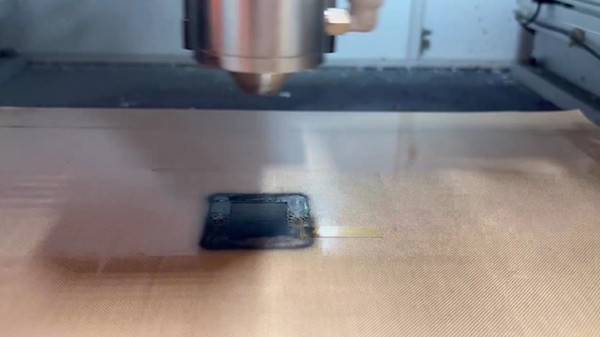
This solution offers exceptional flexibility and scalability, allowing for flexible adjustment of process parameters and material systems to meet the design requirements of different types of MEMS gas sensors. It adapts to wafer-level mass production scenarios, enabling seamless transitions from small-batch R&D trials to large-scale production. Its application effectively solves problems such as uneven coating, significant material waste, poor process compatibility, and unstable sensing performance in traditional gas-sensitive material deposition processes, significantly improving the detection accuracy and lifespan of MEMS gas sensors while reducing production costs.
Currently, this solution has been widely adopted in the fabrication of MEMS gas sensors for various fields, including industrial safety monitoring, ambient air quality detection, and medical breath analysis, meeting the needs for accurate detection of various gases such as carbon monoxide, methane, and acetone. In the future, with continuous technological optimization, it will further integrate intelligent control and multi-technology collaboration, introduce machine learning models for accurate prediction and optimization of sensing performance, expand compatibility with more novel gas-sensitive materials, and drive the development of MEMS gas sensors towards higher sensitivity, higher selectivity, and lower power consumption, providing more reliable technical support for gas detection applications in various fields.
About Cheersonic
Cheersonic is the leading developer and manufacturer of ultrasonic coating systems for applying precise, thin film coatings to protect, strengthen or smooth surfaces on parts and components for the microelectronics/electronics, alternative energy, medical and industrial markets, including specialized glass applications in construction and automotive.
Our coating solutions are environmentally-friendly, efficient and highly reliable, and enable dramatic reductions in overspray, savings in raw material, water and energy usage and provide improved process repeatability, transfer efficiency, high uniformity and reduced emissions.
Chinese Website: Cheersonic Provides Professional Coating Solutions