
Optical Coating Ultrasonic Coating Technology
Optical Coating Ultrasonic Coating Technology – Cheersonic
In the world of precision manufacturing, optical coating is like draping lenses and prisms in a nanoscale “intelligent coat,” directly determining the performance boundaries of optical systems. While traditional coating technologies have evolved over a century, they have consistently faced bottlenecks in uniformity and adhesion. Now, a revolutionary force originating from the field of acoustics—ultrasonic technology—is quietly revolutionizing the fabrication paradigm of optical thin films, acting as a “molecular-level sculptor,” propelling this precision process from macroscopic “coating” to a new era of microscopic “controllable growth.”
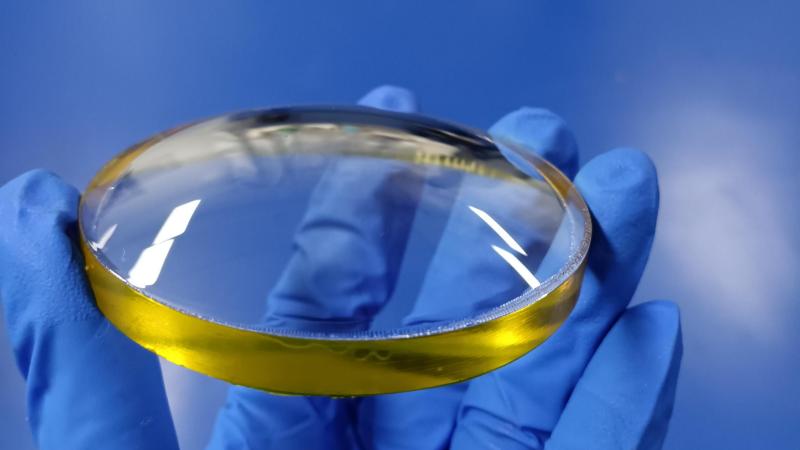
Traditional coating technologies, such as vapor deposition and sputtering, essentially “transport” the film material to the substrate surface in a vacuum environment. This process is akin to scattering sand in a strong wind, making it difficult to precisely control the landing point of each grain of sand. Uneven film thickness distribution on complex curved surfaces, insufficient adhesion between the film and the substrate leading to early failure, and the difficulty in achieving nanoscale gradient composite structures have long been the “Achilles’ heel” plaguing the industry. Especially as optical systems move towards larger apertures and more free-form surfaces, the limitations of traditional technologies become increasingly apparent.
The introduction of ultrasonic technology is the key to overcoming these challenges. Its core mechanism lies in utilizing two major effects excited by high-frequency mechanical vibrations (typically 20 kHz to several MHz) in the coating material or reaction environment: “ultrasonic cavitation” and “acoustic flow.” In solution-based coating, the cavitation effect generates an instantaneous local high-temperature, high-pressure microenvironment, violently accelerating chemical reactions and driving film-forming particles to deposit with higher energy and better orientation. In vapor-phase deposition, directional acoustic flow acts like an invisible nanoscale “stirring hand,” precisely transporting reactive groups and removing adsorbed impurities and weakly bound particles from the substrate surface.
This microscopic control capability brings revolutionary performance breakthroughs. First, there is unprecedented uniformity and consistency. The intense stirring and energy field generated by ultrasound effectively breaks down solute concentration gradients and temperature boundary layers, enabling atomically uniform film thickness even on complex aspherical or deep-pore structures. Experimental data show that, under the same process conditions, introducing ultrasonic assistance can reduce the film thickness non-uniformity on large-aperture lenses from ±5% using traditional methods to within ±0.8%. Secondly, it results in an exponential enhancement of film-substrate adhesion. High-energy particles, driven by ultrasound, continuously perform “microscopic impact cleaning” and “activation” on the substrate, not only removing the interfacial contamination layer but also increasing the active sites for defects on the substrate surface. This transforms the adhesion between the film and substrate from primarily physical adsorption to stronger chemical bonding, increasing the adhesion force by 3 to 5 times and significantly extending the device’s service life in harsh environments.
More remarkably, ultrasound opens the door to active and intelligent film deposition. By programming and controlling the spatial distribution, frequency, and power of the ultrasonic field, researchers can “sculpt” the film growth process in real time. For example, by coupling multiple ultrasonic transducers to form a standing wave field, nanoparticles can be guided to preferentially deposit at specific antinodes, directly “writing” a pre-defined periodic nanostructure. This “acoustic template” capability makes it possible to form gradient refractive index thin films, photonic crystals, or metasurface structures in a single coating process in one step, providing a new path for manufacturing next-generation broadband achromatic lenses, high-performance laser resonator mirrors, and other disruptive optical components.
Currently, ultrasound-assisted coating technology has moved from the laboratory to production lines in specific high-end industries. In inertial confinement fusion (ICF) devices, the uniformity and damage threshold of large-aperture KDP crystal polarizing films used to withstand extremely high-power laser loads directly affect the success or failure of the experiment; ultrasonic coating technology has become a core process to ensure its performance. In the miniaturized camera modules of smartphones, ultrasonic technology helps to achieve more uniform and robust deposition of antireflective and filter films on tiny aspherical lenses, improving image quality. In the future, as semiconductor lithography machines pursue shorter extreme ultraviolet (EUV) wavelengths, the precision requirements for optical component films are approaching physical limits; ultrasound, as a control method that combines high efficiency and nanometer-level precision, will increasingly highlight its strategic value.
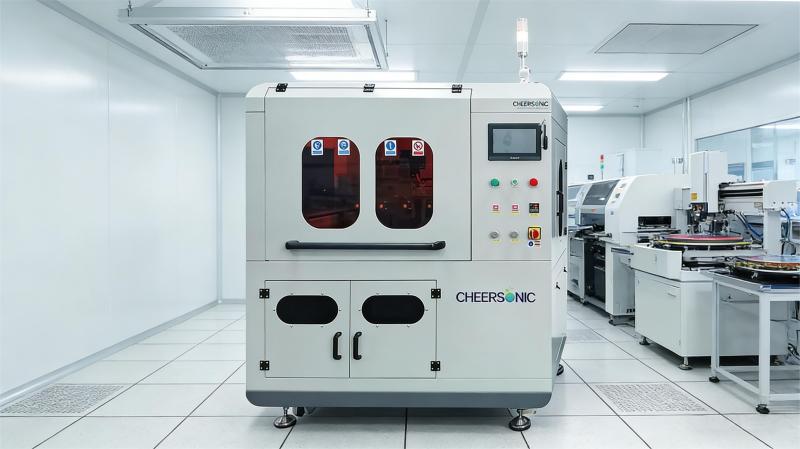
From the precise manipulation of microscopic particle behavior to leaps in macroscopic optical performance, ultrasonic technology is transforming optical coating from an experience-dependent “art” into a “science” capable of precise calculation and design. It’s not merely a process improvement, but a conceptual leap: optical thin films are no longer simply “coatings” covering component surfaces, but integrated structures with specific functions and superior reliability that naturally “grow” from interfaces under the guidance of a precise energy field. When the rhythm of sound waves and the trajectory of light waves deeply intertwine at the nanoscale, we are witnessing a precision manufacturing revolution that is reshaping the way light and matter interact.
About Cheersonic
Cheersonic is the leading developer and manufacturer of ultrasonic coating systems for applying precise, thin film coatings to protect, strengthen or smooth surfaces on parts and components for the microelectronics/electronics, alternative energy, medical and industrial markets, including specialized glass applications in construction and automotive.
Our coating solutions are environmentally-friendly, efficient and highly reliable, and enable dramatic reductions in overspray, savings in raw material, water and energy usage and provide improved process repeatability, transfer efficiency, high uniformity and reduced emissions.
Chinese Website: Cheersonic Provides Professional Coating Solutions
