
Application of Ultrasonic Coating Technology in Lens Photoresist Coating
In the field of precision optics, the imaging quality of a lens is closely related to its surface coating process. Photoresist coating, as a core step in lens manufacturing, places extremely high demands on the uniformity, adhesion, and precision of the coating. Ultrasonic coating technology, with its unique energy transfer method, has become an ideal solution to the challenges of lens photoresist coating, providing efficient and precise technical support for optical component manufacturing.
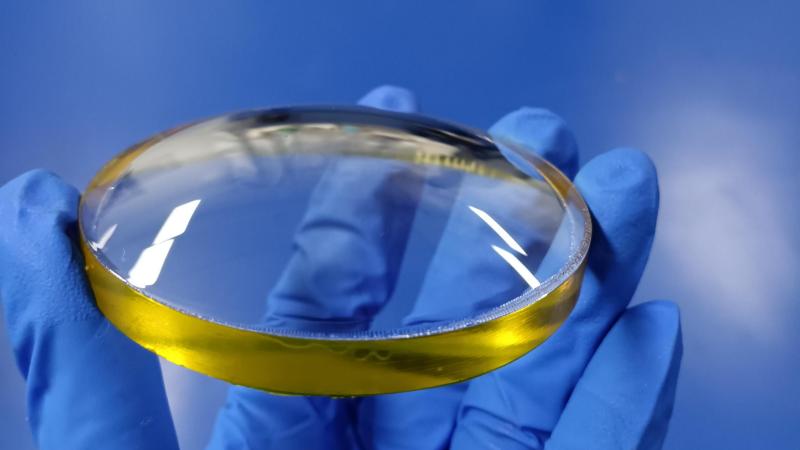
The core principle of ultrasonic coating is to utilize the energy generated by high-frequency vibrations to form a stable and uniform thin film of photoresist on the lens surface. Compared with traditional coating methods, the vibration of ultrasound can effectively break the molecular tension within the photoresist, avoiding defects such as bubbles and pinholes. During the coating process, the ultrasonic generator converts electrical energy into high-frequency mechanical vibrations, which are transmitted to the photoresist solution through a transducer. This causes the solution to form tiny vibration waves, which drive the photoresist molecules to uniformly adhere to the curved or flat surfaces of the lens, achieving complete coverage even in small areas at the lens edges.
Lens photoresist coating demands stringent precision, typically requiring thickness errors to be controlled at the nanometer level. Ultrasonic coating technology achieves this stringent standard by precisely controlling the vibration frequency and coating time. In practice, technicians set appropriate process parameters based on the lens’s material and size: for glass lenses, the vibration frequency can be adjusted to 20-40kHz to ensure a tight bond between the photoresist and the glass surface; for plastic lenses, the frequency needs to be appropriately reduced to avoid damage to the lens itself from high-frequency vibrations. Simultaneously, the cavitation effect of ultrasound can also perform a slight cleaning of the lens surface, removing residual micro-impurities and further improving coating quality.
This technology also offers advantages in terms of efficiency and environmental friendliness. Traditional coating processes often require complex pre- and post-processing steps, while ultrasonic coating simplifies the operation and shortens the production cycle. The utilization rate of photoresist is significantly improved, reducing material waste and aligning with the trend of green manufacturing. In high-end fields such as aerospace and precision instruments, lenses coated with ultrasonic technology not only improve image clarity but also enhance wear and corrosion resistance, adapting to harsh working environments.
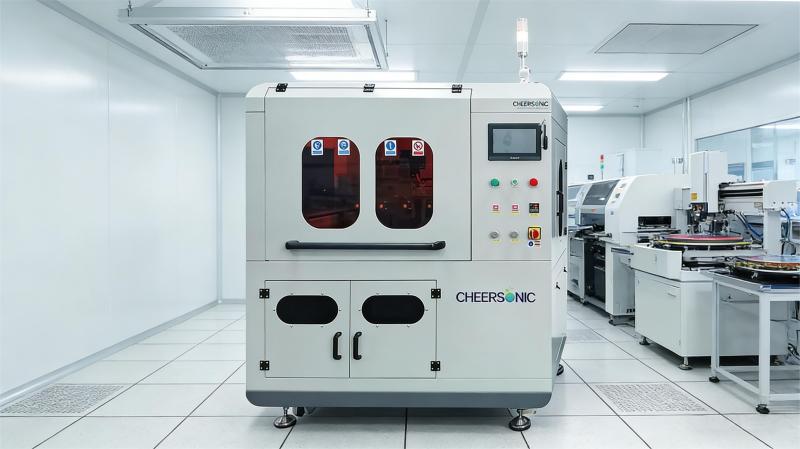
With the continuous development of optical technology, ultrasonic coating will be used more widely in lens photoresist coating. Its combination of precision and efficiency is driving the manufacturing technology of precision optical components to a higher level, providing a solid guarantee for the performance improvement of various optical devices.
About Cheersonic
Cheersonic is the leading developer and manufacturer of ultrasonic coating systems for applying precise, thin film coatings to protect, strengthen or smooth surfaces on parts and components for the microelectronics/electronics, alternative energy, medical and industrial markets, including specialized glass applications in construction and automotive.
Our coating solutions are environmentally-friendly, efficient and highly reliable, and enable dramatic reductions in overspray, savings in raw material, water and energy usage and provide improved process repeatability, transfer efficiency, high uniformity and reduced emissions.
Chinese Website: Cheersonic Provides Professional Coating Solutions