
Ultrasonic Thin Film Coatings for Sensor Manufacturing
In the era of intelligent manufacturing, the performance of sensors directly determines the accuracy of data acquisition in industrial control, medical diagnosis, and environmental monitoring. Ultrasonic spray coating technology has emerged as a core support for high-performance sensor production, relying on its unique deposition mechanism to inject new vitality into thin film preparation.
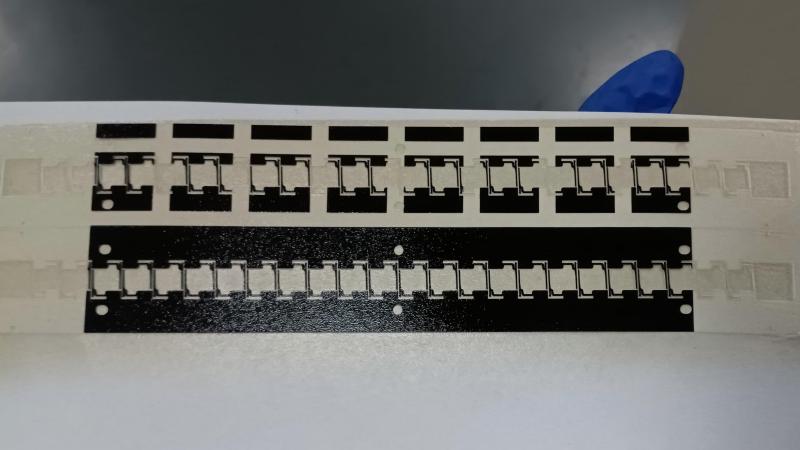
The core advantage of ultrasonic spray systems lies in their precise control over functional materials. These systems can efficiently deposit a variety of coating materials onto sensor surfaces, including functional nanoparticles with enhanced sensitivity, polymers with excellent insulation properties, conductive polymers that ensure stable signal transmission, and oxide formulations with strong environmental resistance. Each material is atomized into uniform microdroplets through ultrasonic vibration, avoiding agglomeration problems common in traditional processes and maximizing the intrinsic performance of the materials.
The non-contact coating method is a game-changer for sensor manufacturing. Unlike contact processes that may scratch fragile sensor substrates, ultrasonic spraying applies coatings through air-borne microdroplets, which can evenly cover substrates of various shapes—whether flat silicon wafers, curved MEMS structures, or porous ceramic components. This versatility allows the technology to adapt to the diverse structural needs of pressure sensors, temperature sensors, and gas sensors, ensuring consistent coating quality across different product lines.
Precise film thickness control is another highlight of this technology. By integrating closed-loop real-time monitoring systems, ultrasonic spray equipment can adjust parameters such as spray pressure, moving speed, and solution concentration in real-time according to feedback data, achieving film thickness control ranging from nanolayers to tens of microns. For example, in the production of biosensors, a nanoscale coating can improve the binding efficiency of biological probes, while industrial sensors require thicker films to enhance wear resistance—both demands can be precisely met.
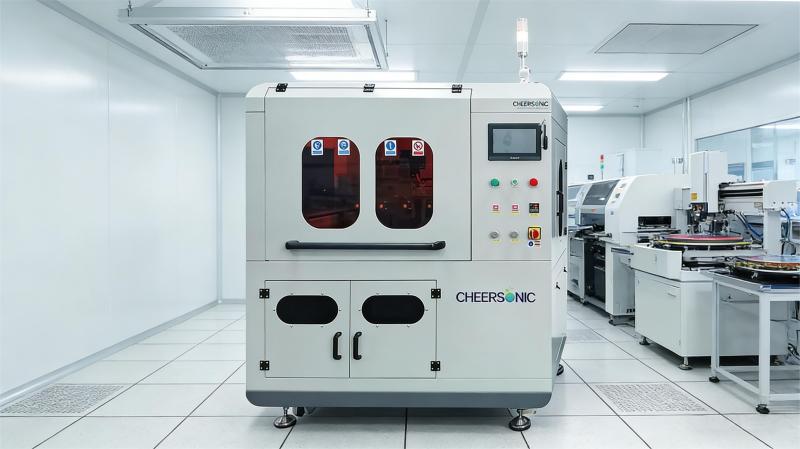
This technology also brings significant economic and environmental benefits. The high material utilization rate (up to 90%) reduces raw material waste compared to traditional spraying (which often has utilization rates below 50%), while the low-temperature deposition process avoids damage to heat-sensitive sensor components. These advantages make ultrasonic thin film coatings not only a guarantee of sensor performance but also a key technology for promoting green and efficient manufacturing in the industry.
About Cheersonic
Cheersonic is the leading developer and manufacturer of ultrasonic coating systems for applying precise, thin film coatings to protect, strengthen or smooth surfaces on parts and components for the microelectronics/electronics, alternative energy, medical and industrial markets, including specialized glass applications in construction and automotive.
Our coating solutions are environmentally-friendly, efficient and highly reliable, and enable dramatic reductions in overspray, savings in raw material, water and energy usage and provide improved process repeatability, transfer efficiency, high uniformity and reduced emissions.
Chinese Website: Cheersonic Provides Professional Coating Solutions
