
Ultrasonic Spray vs. Sputtering and Atomic Layer Deposition
Ultrasonic Spray vs. Sputtering and Atomic Layer Deposition – Ultrasonic Coating – Cheersonic
In high-tech fields such as semiconductors, new energy, and flexible electronics, thin film deposition technology is the core link that determines product performance. Sputtering and Atomic Layer Deposition (ALD), as traditional mainstream technologies, have long dominated the market. However, with the industry’s transformation towards scale and low cost, their inherent shortcomings are becoming increasingly prominent. Ultrasonic Spray technology, with its characteristics of non vacuum operation and continuous production, is becoming an important choice to break through technical bottlenecks, and the difference between the two is gradually becoming clear in practical applications.
The core limitations of sputtering and ALD technology focus on production modes and cost control. Sputtering technology uses high-energy particles to bombard the target material, causing atoms to escape and deposit, while ALD relies on precursor alternating adsorption to achieve atomic level precise deposition. Both require operation in a high vacuum environment – the purchase cost of the vacuum chamber can easily reach millions, and the energy consumption of the vacuum pump, replacement of seals, and vacuum calibration in daily maintenance all require continuous capital investment. More importantly, this vacuum dependence leads to the adoption of only batch production mode, where each batch of workpieces undergoes a complete cycle of vacuuming, deposition, and deflation. Parameter adjustments during production changes also prolong the production cycle, making it difficult to adapt to the continuous needs of modern manufacturing industry.
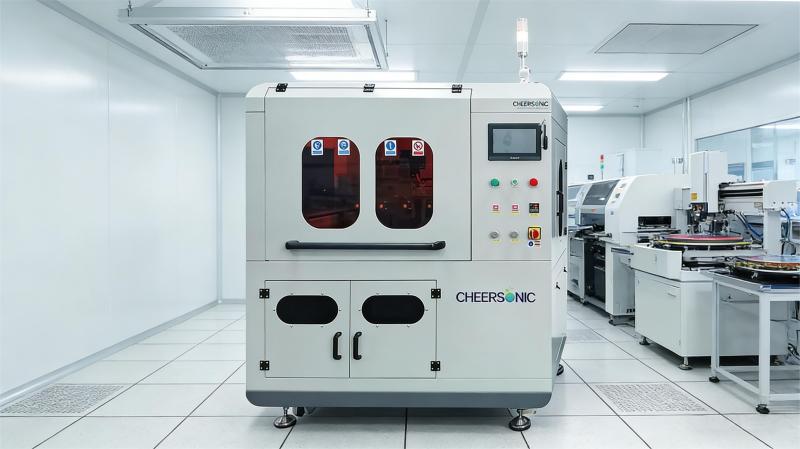
In sharp contrast, ultrasonic spraying technology has the core advantage of non vacuum environment, completely breaking free from the constraints of traditional technology. The principle is to atomize liquid coating materials into micrometer sized droplets through ultrasound, and then accurately transport them to the surface of the substrate through airflow. The entire process can be completed under normal pressure, eliminating the need for complex vacuum systems. The initial investment of the equipment is only 1/5 to 1/3 of that of sputtering or ALD equipment. For the demand for large-area coatings such as anti reflective films for photovoltaic cells and transparent conductive layers for flexible screens, ultrasonic spraying can be directly integrated into the assembly line to achieve integrated production from substrate transportation to coating curing. The product throughput is more than three times higher than that of batch production mode.
The core reason why manufacturers favor ultrasonic spraying is also its flexible process characteristics and lower total cost of ownership. In terms of process control, by adjusting the ultrasonic frequency, the droplet size can be changed. Combined with the conveying airflow speed and nozzle movement trajectory, coating thickness control from 10 nanometers to several micrometers can be achieved, and the coating uniformity error can be controlled within ± 5%, fully meeting the requirements of most industrial scenarios, especially suitable for rapid process iteration in the research and development stage. On the cost level, in addition to the advantage of equipment investment, the material utilization rate of ultrasonic spraying is over 85%, far superior to sputtering’s 40% and ALD’s 60%. At the same time, it does not require high energy consumption support from vacuum systems, and a single production line can save tens of thousands of yuan in electricity expenses annually.
Of course, each of the three technologies has its own applicable scenarios: ALD is suitable for chip level atomic layer precision requirements, sputtering performs stably in metal thick film deposition, and ultrasonic spraying demonstrates irreplaceable advantages in large-scale, low-cost thin film preparation. With the explosion of industries such as new energy vehicles and flexible electronics, ultrasonic spraying technology is becoming a core force in promoting the transformation of thin film deposition processes towards high efficiency and economy, thanks to its unique technical characteristics.
About Cheersonic
Cheersonic is the leading developer and manufacturer of ultrasonic coating systems for applying precise, thin film coatings to protect, strengthen or smooth surfaces on parts and components for the microelectronics/electronics, alternative energy, medical and industrial markets, including specialized glass applications in construction and automotive.
Our coating solutions are environmentally-friendly, efficient and highly reliable, and enable dramatic reductions in overspray, savings in raw material, water and energy usage and provide improved process repeatability, transfer efficiency, high uniformity and reduced emissions.
Chinese Website: Cheersonic Provides Professional Coating Solutions