CPI Transparent Polyimide Coating Analysis
CPI Transparent Polyimide Coating Analysis – Ultrasonic Coating – Cheersonic
1. What kind of coating is applied?
The CPI film is typically coated with one or more high-performance hardened coatings or functional coatings. Specifically, these mainly include:
- High-hardness coating: The most common is a polysiloxane-based hardening liquid. Through coating and curing processes, a hard, wear-resistant, and transparent protective layer is formed on the surface of the flexible CPI film.
- Anti-fingerprint coating: An oleophobic and hydrophobic coating that makes the screen less prone to fingerprints and oil stains, making it easy to clean.
- Anti-reflective coating: Reduces light reflection on the screen surface, improving visibility under strong light.
- Chemical-resistant coating: Improves the screen’s resistance to chemicals such as sweat and cosmetics.
Key Relationships:
- The CPI film, as a substrate, provides flexibility and high-temperature resistance, forming the basis for foldable functionality as a replacement for rigid glass.
- The hardened coating, as a surface functional layer, provides wear resistance and scratch resistance, compensating for the relatively soft nature of the CPI film itself.
This structure can be imagined as a combination of “steel reinforcement (CPI) + concrete (hardened coating)”: CPI provides load-bearing capacity and toughness, while the concrete provides surface hardness and durability.

2. What is the purpose of this coating? (Core Function)
This hardened coating applied to the CPI plays a crucial role, directly determining the durability of the flexible screen and the user experience. Its main uses include:
1. Improving Surface Hardness and Scratch Resistance
- Problem: While pure CPI film is flexible, its surface hardness is very low (typically only 1-2H for pencil hardness). A light scratch with a fingernail or a hard object will leave a permanent mark.
- Function: The hardened coating can increase the surface pencil hardness to 3H or higher (e.g., Huawei Mate Xs 2 claims to reach 7H), making it approach the scratch resistance level of traditional glass, resisting scratches from everyday objects such as keys and grit.
2. Enhanced Impact and Fold Resistance
- This coating typically possesses a degree of toughness, allowing it to withstand repeated bending and twisting along with the CPI substrate without cracking or peeling. Together with CPI, it forms a rigid yet resilient composite structure, protecting the delicate OLED light-emitting units beneath.
3. Provides a Smooth Touch
- The hardened coating provides a remarkably smooth and even surface, ensuring a fluid and seamless touch experience when gliding your finger across the screen, eliminating the “sticky” feel of ordinary plastic films.
4. Additional Functions (Anti-fingerprint, Anti-reflective, etc.)
- As mentioned above, the composite functional coating simultaneously achieves anti-fingerprint and anti-reflective effects, improving the overall optical performance and usability of the screen.
In short:
CPI (transparent polyimide) is the foundation for the “foldable” function, while the “hardened coating” applied to it makes this foldable screen “durable” and “user-friendly.” Without this coating, foldable phone screens would be extremely fragile and unusable.
With technological advancements, UTG (ultra-thin flexible glass) has become an important direction for flexible cover glass. While UTG itself has higher hardness, it typically needs to be combined with a PET/CPI protective film and coating to enhance its impact resistance and crack propagation resistance. Currently, CPI with a hardened coating and UTG are the two mainstream technologies for flexible display cover glass.
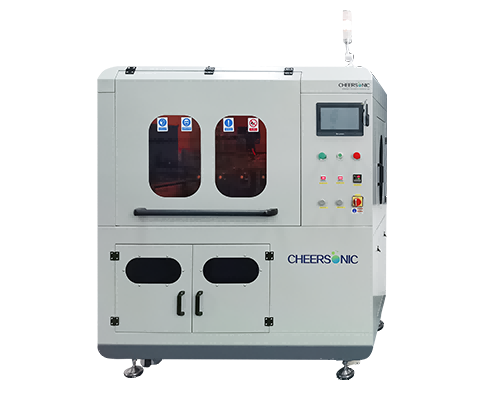
Ultrasonic spraying technology provides a high-precision solution for processing CPI transparent polyimide substrates, leveraging its micron-level atomization advantage to complement its flexible, high-temperature resistant, and highly transparent material properties. In the process, ultrasonic vibration transforms the coating material into uniform droplets, depositing them on the CPI surface with low impact, forming a functional coating with controllable thickness (accuracy up to ±1μm), no pinholes, and high adhesion, effectively avoiding the damage to the substrate caused by traditional spraying.
This technology is widely used in flexible displays, wearable devices, and other fields, enabling functional modifications to the CPI surface such as anti-reflection, scratch resistance, and fingerprint resistance, while also being compatible with precision processes such as photoresist coating and conductive layer preparation. Its non-contact spraying characteristic reduces material waste (utilization rate increases to over 90%), and the process parameters can be precisely controlled to meet the coating performance requirements in different scenarios, providing stable and reliable process support for the application of CPI materials in the high-end electronics field.
About Cheersonic
Cheersonic is the leading developer and manufacturer of ultrasonic coating systems for applying precise, thin film coatings to protect, strengthen or smooth surfaces on parts and components for the microelectronics/electronics, alternative energy, medical and industrial markets, including specialized glass applications in construction and automotive.
Our coating solutions are environmentally-friendly, efficient and highly reliable, and enable dramatic reductions in overspray, savings in raw material, water and energy usage and provide improved process repeatability, transfer efficiency, high uniformity and reduced emissions.
Chinese Website: Cheersonic Provides Professional Coating Solutions