
Spray pyrolysis applications in the medical field
Spray pyrolysis applications in the medical field – Cheersonic
Ultrasonic spray pyrolysis granulation is an advanced powder preparation technology combining ultrasonic atomization and high-temperature pyrolysis. The precursor solution is atomized into micron sized droplets with uniform particle size by high-frequency ultrasound. The droplets enter the high-temperature reaction zone with the carrier gas. After rapid drying, thermal decomposition, solid phase reaction and shrink forming, high-purity, high spherical micro nano particles are prepared in one step.
This technology does not require subsequent sintering and grinding, avoiding particle agglomeration. The particle size, composition, and microstructure are precisely controllable, and the production process is simple, green, and efficient. The powder has excellent dispersibility and uniform composition, suitable for the preparation of high-end functional materials such as oxides, phosphates, lithium large single crystal cathode materials, catalytic powders, biomedical microspheres, etc. It can meet the strict requirements for powder performance in new energy, catalysis, biomedical and other fields, and is suitable for large-scale continuous production.
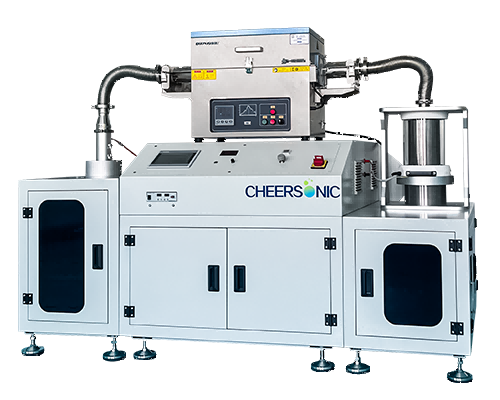
In the medical field, spray pyrolysis equipment can be used to prepare various materials. Here are some examples:
1. Metal Nanoparticle Materials:
Nano Silver: Possesses excellent antibacterial properties and can be used in antibacterial dressings, wound disinfection, and surface coatings for medical devices. Spray pyrolysis technology allows for precise control of the size and distribution of nano-silver particles, resulting in better antibacterial effects. For example, the prepared nano-silver particles can be added to medical gauze to create novel antibacterial dressings that effectively prevent wound infection.
Nano Gold: Has wide applications in the biomedical field, such as biosensors and drug carriers. Spray pyrolysis equipment can prepare nano-gold particles with uniform particle size. Their unique optical and electrical properties can be used for disease detection and treatment. For example, utilizing the surface plasmon resonance effect of nano-gold, highly sensitive biosensors can be developed for detecting disease biomarkers.
2. Metal Oxide Materials:
Titanium Dioxide: Possesses good biocompatibility and photocatalytic properties and can be used in dental materials and surface coatings for orthopedic implants. Titanium dioxide films prepared by spray pyrolysis can improve the wear resistance and corrosion resistance of dental materials, and also exhibit antibacterial properties under light irradiation, which is beneficial to oral health. In orthopedic implants, titanium dioxide coatings can enhance the bonding strength between the implant and bone, reducing rejection reactions.
Zinc oxide: An important semiconductor material with antibacterial and anti-inflammatory bioactivities. In the medical field, it can be used to prepare antibacterial dressings and skin repair materials. Spray pyrolysis technology can prepare zinc oxide into nanoscale particles or films, allowing it to better exert its bioactivity and promote wound healing.
3. Ceramic Materials:
Hydroxyapatite: The main inorganic component of human bones and teeth, possessing good biocompatibility and bioactivity. Hydroxyapatite powder or films can be prepared using spray pyrolysis equipment for use in bone repair materials, dental restoration materials, etc. For example, the prepared hydroxyapatite powder can be combined with other materials to make bone cement for filling bone defects; hydroxyapatite films can be deposited on the surface of dental implants to improve their biocompatibility.
Silica: Can be used as a drug carrier, biosensor, etc. Silica materials prepared by spray pyrolysis have a porous structure, capable of loading drug molecules for sustained drug release. Simultaneously, the surface of silica can be modified to immobilize biomolecules and construct biosensors.<sup>2</sup>
4. Carbon-based materials:
Carbon nanotubes: Possess excellent mechanical, electrical, and biocompatibility properties, they can be used in tissue engineering, biosensors, and other fields. Spray pyrolysis technology can prepare high-quality carbon nanotubes, which can be combined with biomaterials to construct tissue engineering scaffolds to promote cell growth and differentiation; or used to prepare biosensors to detect biomolecules and disease biomarkers.
5. Sensitive materials:
MXene wrinkled sphere sensitive materials: For example, three-dimensional porous Ti₃C₂Tₓ wrinkled sphere sensitive materials can be used to prepare biodegradable gas and pressure sensors for sensing harmful gases and pressures in medical environments. They have important applications in environmental pollution monitoring, smart healthcare, wearable smart devices, and other fields.
About Cheersonic
Cheersonic is the leading developer and manufacturer of ultrasonic coating systems for applying precise, thin film coatings to protect, strengthen or smooth surfaces on parts and components for the microelectronics/electronics, alternative energy, medical and industrial markets, including specialized glass applications in construction and automotive.
Our coating solutions are environmentally-friendly, efficient and highly reliable, and enable dramatic reductions in overspray, savings in raw material, water and energy usage and provide improved process repeatability, transfer efficiency, high uniformity and reduced emissions.
Chinese Website: Cheersonic Provides Professional Coating Solutions