
Applications of Spray-Coated Glass Chips
Applications of Spray-Coated Glass Chips – Cheersonic
Spray-coated glass chips are a high-tech precision processing technology with a wide range of applications, covering multiple high-tech and industrial fields. The following is a summary of the main application areas of spray-coated glass chips:
1. Biomedical Research
As a core component of microfluidics technology, glass chips play a crucial role in biomedical research. Through spray coating technology, microchannels, reaction chambers, and other structures can be formed on the chip surface, enabling precise manipulation of tiny volumes of liquid. This allows complex biological experimental procedures to be completed within a very small space, improving experimental efficiency and accuracy. Spray-coated glass chips are commonly used in biomedical research in areas such as drug screening, cell culture, and gene sequencing.
2. Chemical Analysis
In the field of chemical analysis, spray-coated glass chips also demonstrate enormous application potential. Due to their high precision, high sensitivity, and high integration, they can achieve rapid and accurate analysis of chemical samples. Furthermore, spray-coated glass chips can be integrated with sensors and other components to achieve real-time monitoring and early warning of chemical substances. This makes spray-coated glass chips widely applicable in areas such as environmental monitoring, food safety, and drug detection.
3. Environmental Monitoring
Environmental monitoring is another important application area for spray-coated glass chips. Spray coating technology allows for the construction of microfluidic systems on the chip, enabling the collection, separation, detection, and analysis of environmental samples. This technology features high throughput, high sensitivity, and low cost, and can monitor the concentration and type of pollutants in the atmosphere, water, and soil in real time, providing strong technical support for environmental protection and pollution control.
4. Semiconductor Industry
Spray-coated glass chip technology is also widely used in the semiconductor industry. For example, during chip packaging, spray coating technology can be used to uniformly coat the chip surface with glass materials or other functional coatings to improve chip reliability and lifespan. Furthermore, spray-coated glass chips can be used to prepare high-performance optical and ceramic materials, providing more possibilities for the development of the semiconductor industry.
5. Other Fields
Besides the above fields, spray-coated glass chips can also be applied to many other areas. For example, in the aerospace field, sprayed glass chips can be used to fabricate high-performance sensors and actuators, improving aircraft performance and safety; in the energy field, sprayed glass chips can be used to fabricate novel energy devices such as solar cells and fuel cells, improving energy conversion efficiency and utilization.
In conclusion, sprayed glass chip technology has a wide range of applications and enormous market potential. With the continuous development and progress of science and technology, it is believed that sprayed glass chips will play an important role in even more fields, making a greater contribution to the development and progress of human society.
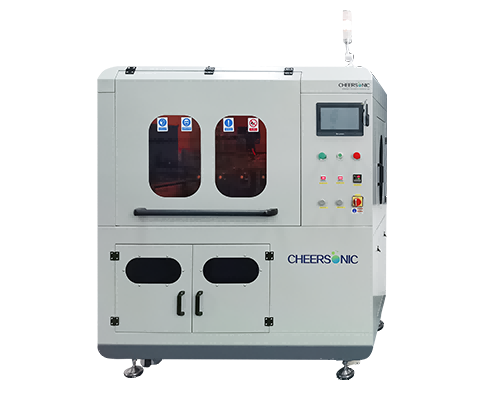
Ultrasonic spraying technology, with its core advantages of precision and controllability, has become a key process in glass chip fabrication. Its principle involves converting high-frequency electrical energy into mechanical vibration using a piezoelectric transducer, breaking the coating material into uniform droplets of 5-50 μm. Guided by a low-speed carrier gas, these droplets are precisely deposited onto the glass chip surface, forming a dense and uniform functional coating.
Compared to traditional processes, this technology achieves sub-micron level coating thickness control with an error of less than 5%, effectively avoiding defects such as pinholes and orange peel effect, and significantly improving the optical and electrical performance of glass chips. The non-contact spraying characteristic avoids physical damage to the glass substrate, adapts to the complex microstructure of the chip surface, and achieves coating without dead angles.
Its material utilization rate exceeds 90%, significantly reducing the loss of special functional materials. Furthermore, it does not require high-pressure gas assistance, resulting in a significant reduction in VOC emissions, meeting clean production requirements. Currently, it is widely used in photoresist coating and transparent conductive coating preparation for glass chips, providing assurance for high-precision micro/nano structure processing and driving performance upgrades of glass chips in semiconductors, optical equipment, and other fields.
About Cheersonic
Cheersonic is the leading developer and manufacturer of ultrasonic coating systems for applying precise, thin film coatings to protect, strengthen or smooth surfaces on parts and components for the microelectronics/electronics, alternative energy, medical and industrial markets, including specialized glass applications in construction and automotive.
Our coating solutions are environmentally-friendly, efficient and highly reliable, and enable dramatic reductions in overspray, savings in raw material, water and energy usage and provide improved process repeatability, transfer efficiency, high uniformity and reduced emissions.
Chinese Website: Cheersonic Provides Professional Coating Solutions
