
Preparation of Ceramic Coatings by Ultrasonic Spraying
In modern industrial and technological fields, the surface properties of materials often determine the service life, reliability, and efficiency of the entire component or equipment. Ceramic coatings, with their excellent hardness, wear resistance, corrosion resistance, and thermal stability, have become a key technology for protecting metal substrates and improving their overall performance. With the continuous evolution of coating technology, an advanced process called “ultrasonic spraying” is emerging, bringing revolutionary breakthroughs to the preparation of high-performance ceramic coatings with its unique advantages.
The outstanding characteristics of ceramic materials and the challenges of spraying
The range of ceramic materials that ultrasonic spraying technology can be applied to is extremely wide, covering metal oxides (such as aluminum oxide Al ₂ O3, zirconium oxide ZrO ₂), silicates, as well as metal carbides, nitrides, borides, and silicides (such as tungsten carbide WC, titanium nitride TiN, zirconium boride ZrB ₂). These materials are not traditional clay, but advanced high-performance ceramics.
Its interior is mainly composed of ionic and covalent bonds, and this strong bonding structure endows them with an unparalleled series of excellent characteristics:
*High melting point and high thermal stability: enable it to maintain structural integrity in extreme high temperature environments, making it an ideal protective layer for hot end components of aircraft engines and gas turbines.
*High hardness and excellent wear resistance: greatly enhancing the wear resistance of tools, molds, mechanical seals and other products, extending their service life.
*Excellent chemical inertness: It has strong resistance to corrosive media such as acids, bases, and salts, and is widely used in the field of chemical anti-corrosion.
*Good insulation: It can be used as an insulation and thermal protection layer for electronic components.
*Small coefficient of thermal expansion: Good dimensional stability, can form a firmly bonded coating when matched with certain metal substrates.
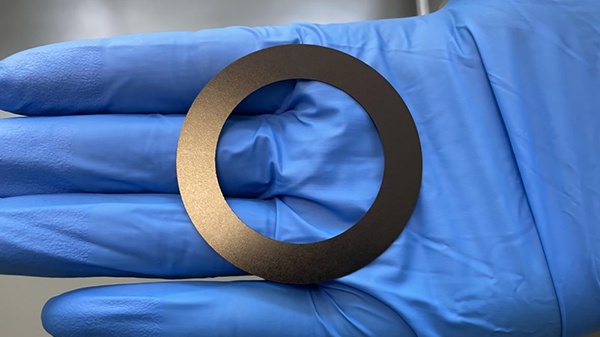
However, it is precisely these high melting point and high hardness characteristics that make it exceptionally difficult to uniformly, densely, and firmly coat ceramic materials on metal surfaces. Although traditional plasma spraying or high-speed oxygen fuel spraying (HVOF) is effective, the process temperature is often extremely high, which has a significant thermal impact on the substrate, and the equipment is complex and costly.
The principle and core advantages of ultrasonic spraying technology
Ultrasonic spraying technology cleverly utilizes the energy of ultrasonic waves, providing a new solution to address the aforementioned challenges. The core working principle is to convert high-frequency electrical signals into mechanical vibrations of the same frequency through piezoelectric transducers. This ultrasonic vibration is transmitted to the atomization surface at the nozzle tip, causing the flowing ceramic slurry (usually a suspension made of ceramic powder, solvent, dispersant, and binder) to form extremely fine capillary waves on the surface. Droplets are violently torn at the peak, resulting in highly uniform, micrometer or even nanometer sized fine mist droplets.
Compared with traditional pressure spraying or dual fluid spraying, ultrasonic atomization technology exhibits significant advantages:
1. Uniform atomization and high coating quality: The generated droplet size distribution range is extremely narrow, ensuring the uniformity and consistency of spraying, and can prepare a dense coating with smooth surface, no defects, and controllable thickness.
2. High spraying efficiency and material utilization rate: The atomization process does not require high-pressure air, the droplet orientation is good, the “overspray” and rebound losses are small, and the material utilization rate can reach over 90%, significantly saving expensive ceramic materials.
3. Mild process conditions: The entire process is usually carried out at room temperature or lower temperatures (followed by sintering), which is very friendly to heat sensitive matrix materials (such as certain aluminum alloys or pre treated composite materials), avoiding deformation and phase transformation caused by high temperatures.
4. Precise control and repeatability: By precisely controlling the slurry flow rate, nozzle movement speed, and ultrasonic power, coatings with different thicknesses ranging from hundreds of nanometers to tens of micrometers can be easily achieved, with excellent repeatability, making it very suitable for industrial mass production.
5. Suitable for complex shapes: the spray is soft and controllable, and can well cover the surface of complex three-dimensional structure, including grooves, edges and other difficult to treat areas.
Preparation process and application fields of ultrasonic spray ceramic coatings
The typical ultrasonic spraying process for preparing ceramic coatings mainly includes the following steps:
1. Slurry preparation: Mix the selected ceramic powder evenly with solvents, dispersants, etc. to form a stable and non settling suspension. The rheological properties of the slurry directly affect the atomization effect and coating quality.
2. Substrate pretreatment: Cleaning, degreasing, sandblasting and roughening the metal substrate to enhance the adhesion between the coating and the substrate.
3. Ultrasonic spraying: Transport the slurry to the ultrasonic nozzle and spray it on the surface of the substrate to form a uniform wet film.
4. Drying and sintering: The sprayed workpiece needs to be dried to remove solvents, and then sintered in a high-temperature furnace. During the sintering process, strong neck like connections are formed between ceramic particles through diffusion, ultimately resulting in a dense ceramic coating.
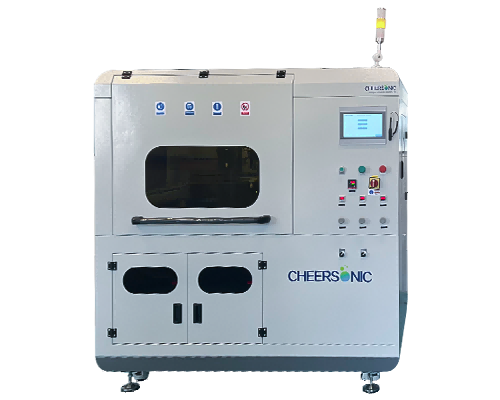
Based on the above process, ultrasonic spraying ceramic coating technology has shown great potential for application in many high-tech fields:
*In the field of new energy, it is used to spray the electrolyte layer and electrode functional layer of solid oxide fuel cells (SOFC). Its uniform and ultra-thin characteristics can effectively reduce the internal resistance of the cell and improve power generation efficiency.
*Semiconductor and Electronics Industry: Spraying insulation layers, dielectric layers (such as aluminum oxide, yttrium oxide) or conductive ceramic layers on silicon wafers and glass substrates for the manufacture of microsensors, memories, etc.
*High temperature protection: Spray thermal barrier coatings (such as yttria stabilized zirconia, YSZ) on components such as aircraft engine blades and turbine disks to effectively isolate high temperatures and protect metal substrates.
*Wear resistant and corrosion-resistant coating: applied to petrochemical machinery, automotive engine components, marine equipment, etc., providing long-term wear and corrosion protection.
*Biomedical: Spraying bioactive ceramic coatings (such as hydroxyapatite, HA) on the surface of medical implants (such as titanium alloy joints) to promote bone integration and improve implantation success rates.
Outlook and Conclusion
Ultrasonic spraying technology, as an emerging thin film preparation technology, is redefining the manufacturing method of ceramic coatings with its unique characteristics of cold atomization, high uniformity, high precision, and high efficiency. It successfully combines the outstanding characteristics of high-performance ceramic materials with the excellent mechanical properties of metal substrates, achieving the effect of 1+1>2.
Although this technology still faces some challenges in terms of slurry stability, large-area efficient spraying, and coating sintering shrinkage control, these challenges will gradually be overcome with the continuous progress of materials science, ultrasonic technology, and automation control. In the future, ultrasonic spraying technology will inevitably develop towards more precision, intelligence, and integration, providing key surface engineering solutions for more cutting-edge fields such as aerospace, new energy, electronic information, and biomedicine, and becoming one of the indispensable core technologies in advanced manufacturing.
About Cheersonic
Cheersonic is the leading developer and manufacturer of ultrasonic coating systems for applying precise, thin film coatings to protect, strengthen or smooth surfaces on parts and components for the microelectronics/electronics, alternative energy, medical and industrial markets, including specialized glass applications in construction and automotive.
Our coating solutions are environmentally-friendly, efficient and highly reliable, and enable dramatic reductions in overspray, savings in raw material, water and energy usage and provide improved process repeatability, transfer efficiency, high uniformity and reduced emissions.
Chinese Website: Cheersonic Provides Professional Coating Solutions
