
Ultrasonic Spraying Laser Cutting Protective Liquid
In today’s increasingly sophisticated laser cutting technology, especially for high-precision processes such as cover cutting, a seemingly small but far-reaching challenge is becoming increasingly prominent: pollution during the cutting process. When a high-energy laser beam acts on the surface of a material, the intense high temperature generated in an instant not only causes the material to melt and vaporize, but also emits a large amount of micro – or even nano scale molten metal splashes, oxide dust, and heavy condensed particles. These ‘by-products’ are like stubborn stains, easily adhering to cutting surfaces, adjacent surfaces, and even expensive laser lenses. They not only seriously damage the smoothness and geometric accuracy of the cutting edge, causing difficulties in subsequent processes such as welding and electroplating, but may also significantly weaken the performance and reliability of the cut material itself due to local thermal effects or impurity contamination. Therefore, seeking an efficient, uniform, and dynamically adaptable protection method for high-speed cutting has become a key bottleneck that urgently needs to be overcome in the field of precision manufacturing.
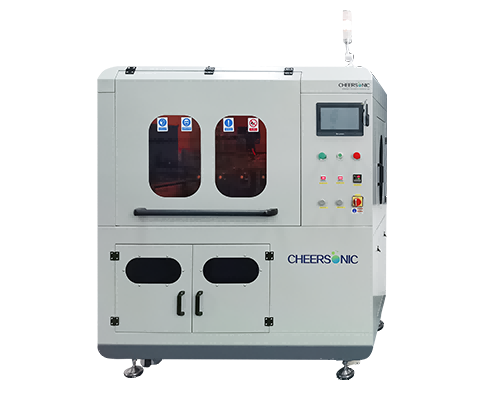
Traditional application methods of protective coatings, such as spin coating, scraping coating, or immersion coating, often struggle to meet the protection requirements of high-speed, large-area, or complex curved laser cutting. Its uniformity is difficult to guarantee, and it is easy to form local weak points; The thickness of the coating is difficult to precisely control, as excessive thickness affects cutting efficiency, while excessive thickness loses its protective significance; Insufficient coverage ability for complex geometric shapes, especially difficult to form effective protective layers in areas such as deep grooves and micropores; The material consumption is high and it is easy to form unnecessary accumulation in non cutting areas. These limitations call for an innovative coating application technology. Ultrasonic spraying technology stands out with its unique working principle – high-frequency ultrasonic energy acts on the liquid, efficiently breaking and atomizing it into extremely fine and highly uniform droplet clouds at the nozzle tip. This non-contact spraying method is like covering the material surface with a precise and controllable “micrometer level protective mesh”, which is particularly good at forming ultra-thin, dense, and uniform liquid films on complex workpiece surfaces. Its precise flow control and instantaneous start stop characteristics perfectly meet the dynamic requirements of high-speed laser cutting paths, providing a new technological path for precision cutting protection.
To maximize the effectiveness of ultrasonic spraying technology in this field, the core lies in developing a low viscosity protective liquid system that is highly compatible with it. The formula design needs to be delicately balanced around several core properties:
1. Viscosity optimization (200-500 cP range): Excessive viscosity can hinder effective atomization of liquids under ultrasonic energy, resulting in increased droplet size, uneven distribution, and even nozzle blockage. The viscosity must be strictly controlled in a lower range to ensure a delicate and uniform spray field.
2. Surface tension regulation and wettability: The protective liquid needs to have a low surface tension, so that it can quickly spread and wet on the surface of various cut substrates (metals, ceramics, composite materials, etc.), forming a continuous and defect free protective film. Good wettability is the foundation for achieving uniform coverage.
3. Rapid film formation and instantaneous protection: In high-speed cutting scenarios, after the protective liquid is sprayed onto the surface of the substrate, it must have the ability to quickly level and form an effective physical barrier to immediately block the invasion of splashing slag and smoke. This requires the solvent evaporation rate in the formula to be accurately matched with the process speed.
4. Efficient protection mechanism: As the core function of the protective liquid, its formula must contain active components or special structures that can effectively isolate high-temperature molten materials, inhibit oxidation, and promote slag stripping (such as forming pyrolytic carbon layers, molten glass isolation layers, etc.). At the same time, it also needs to have a certain cooling effect to help reduce the temperature of the heat affected zone (HAZ) at the cutting edge.
5. Stability and compatibility: The formula needs to ensure that its physical and chemical properties remain stable during long-term storage and ultrasonic atomization processes, avoiding sedimentation, delamination, or reaction failure. In addition, it is not allowed to corrode equipment or have adverse effects on subsequent processes.
The value of applying this optimized low viscosity protective liquid to the cover cutting process is particularly significant. Cover cutting typically involves fine slotting, marking, or separation operations on the surface of multi-layer composite structures or precision components. Ultrasonic spraying can accurately apply an ultra-thin and uniform protective liquid film in the cutting path area. At the moment of laser beam action, this liquid film plays multiple critical roles:
*Physical barrier: directly blocking the upward spray of molten metal splashes and smoke, preventing them from contaminating expensive upper cover materials or optical components.
*Cooling medium: absorbs some heat, reduces thermal damage and deformation at the cutting edge, and improves the quality of the cross-section.
*Atmosphere control: Some formulas can decompose at high temperatures to produce inert gases, locally improving the cutting environment and inhibiting oxidation reactions.
*Slag control: Promote the directional discharge of slag or make it easier to remove in subsequent cleaning, keeping the cutting channel or separation surface clean.

Of course, the implementation of technology cannot be separated from the precise optimization of process parameters. The viscosity and surface tension of the protective liquid itself need to be optimally matched with specific ultrasonic frequencies and power settings, which is a prerequisite for achieving ideal atomization effects (droplet size, distribution uniformity). The flow rate of spraying, the distance between the nozzle and the substrate, and the moving speed must be precisely coordinated with the scanning rate of the laser cutting head to ensure that the protective film covers the target area evenly before cutting occurs and can continuously provide effective protection during the cutting process. In addition, it is necessary to systematically evaluate the comprehensive impact of the protective fluid on the final cutting quality (such as seam width, perpendicularity, roughness, size of heat affected zone), residue cleanability, and potential side effects on the substrate itself (such as corrosion, stress induction).
The combination of ultrasonic spraying technology and precision formulated low viscosity protective liquid provides a highly promising technical route to solve the pollution problem in laser cutting, especially in high demand cover cutting processes. It represents an upgrade in the concept from passive cleaning to active protection. With the continuous progress of materials science and in-depth research on atomization deposition protection mechanisms, future protective liquid formulations will be more intelligent and multifunctional (such as integrated self-healing and sensing characteristics), and spray control will also be more precise and adaptive. This technological integration is not only expected to significantly improve the quality and efficiency of laser microfabrication in current high-end manufacturing industries (consumer electronics, semiconductor packaging, precision medical equipment, new energy batteries), but its core principles may also be extended to other broad fields that require ultra-thin, uniform, and dynamic functional coatings, opening up new possibilities for precision manufacturing.
About Cheersonic
Cheersonic is the leading developer and manufacturer of ultrasonic coating systems for applying precise, thin film coatings to protect, strengthen or smooth surfaces on parts and components for the microelectronics/electronics, alternative energy, medical and industrial markets, including specialized glass applications in construction and automotive.
Our coating solutions are environmentally-friendly, efficient and highly reliable, and enable dramatic reductions in overspray, savings in raw material, water and energy usage and provide improved process repeatability, transfer efficiency, high uniformity and reduced emissions.
Chinese Website: Cheersonic Provides Professional Coating Solutions